Introduction
This sacred Ifá story, preserved under the Odù Oyekun Juani, teaches through the relationship between an Awó, his land, and the sacred presence of Elegbara.
Awó Fare lives in the land of Ayare Lekun. But the source says that he does not attend to what is happening there, and he does not attend to Elegbara. Because of this neglect, Elegbara abandons him and goes to another land.
That other land belongs to Badawa Ifá.
Badawa Ifá always attends to Elegbara. He gives Elegbara everything he wants to eat. Because of this, his land is marked by abundance.
The contrast is the foundation of the story.
Awó Fare’s land is marked by misery because Elegbara has been neglected. Badawa Ifá’s land is marked by abundance because Elegbara is properly attended.
This story is not only about poverty and prosperity. It is about sacred relationship, ritual attention, food, song, correction, and the return of Elegbara to a place where he had been forgotten.
The story also preserves an opening Rezo, an Ebbó, two chants, and a final Note. These elements are central to the sacred structure of the story. They are preserved here for cultural and educational understanding, not as a public ritual procedure.
Quick Takeaway
STORY REFERENCE
This retelling draws on a traditional account preserved in Caminos de Ifá, edited by Ernesto Valdés Jane under Proyecto Orunmila, a collaborative Cuban project dedicated to collecting, comparing, preserving, and publishing Osha-Ifá source materials.
The narration, adaptation, commentary, and visual interpretation presented here are original to IFAStories.
This article is offered for spiritual education, cultural preservation, and reflective study. It is not presented as ritual instruction, nor as a substitute for proper guidance from initiated elders within the tradition.
IFAStories honors the source tradition, the ancestors, and the sacred responsibility of preserving these teachings with respect.
Quick Takeaway
Sacred presence must be maintained.
Awó Fare’s land suffers because he does not attend to Elegbara. Badawa Ifá’s land has abundance because he does.
The story teaches that restoration is possible, but what returns must still be cared for.
The Story
Rezo
The story opens with this Rezo:
Babawa Ifá Obá Mayire Elegbara Badawa Ifá Oyere Lekun Obá Yere Obá Lekun Elegbara Ifá Leye Beifa Ire Ashegun Eta Lese Elegbara Oun Bati Aye Aun Bati Awó Begbo Aun Laye Eluefare.
Cautious Working Interpretation
This Rezo is preserved as sacred source speech.
A cautious working interpretation may be heard like this:
Father of Ifá.
Royal one of Mayire.
Elegbara.
Badawa Ifá, connected with the opening of the gate.
King who opens.
King of the doorway.
Elegbara of Ifá, connected with life, movement, and the work of Ifá.
Good fortune, victory, and triumph over opposition stand at the feet of Elegbara.
He is with the world.
He is with the Awó in the sacred bush.
He is with the life and the road of Awó Fare.
This is not a confirmed word-for-word translation. The Rezo is preserved in source-based Lukumí / Yorùbá liturgical spelling. Its full meaning should be reviewed by qualified practitioners and language authorities.
The Rezo prepares the listener for the heart of the story. It places Elegbara at the doorway. It connects him with Ifá, the road, the Awó, good fortune, victory, and the life of Awó Fare.
Before the story begins, Elegbara is already shown as central.
What follows is the story of what happens when Awó Fare does not attend to him.
The Narrative
This is the road where Awó Fare did not attend to Elegbara.
In this story, Obatalá was suffering because of what was happening in the land of Ayare Lekun.
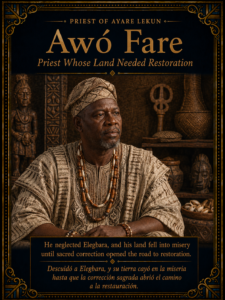
In that land lived Awó Fare.
But Awó Fare did not attend to what was happening there. And he did not attend to Elegbara.
Because of this, Elegbara abandoned him.
Elegbara left Awó Fare and went to another land.
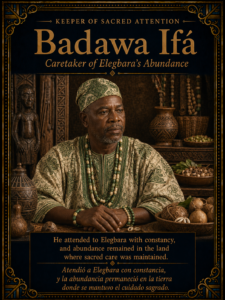
That other land was where Badawa Ifá lived.
Badawa Ifá always attended to Elegbara. He gave Elegbara everything he wanted to eat.
And in that land, everything was abundant.
The story places two lands beside one another.
In Ayare Lekun, Awó Fare neglects Elegbara. In Badawa Ifá’s land, Elegbara is cared for.
In one land, there is misery. In the other, there is abundance.
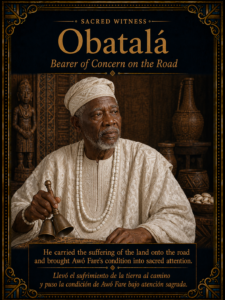
One day, Obatalá went out onto the road.
He carried his agogo.
And as he walked, he sang:
“Baba Ifá Nanire Oshabi Oshababa Ifá Nanire.”
Cautious Working Interpretation
A cautious working interpretation may be heard like this:
Father Ifá carries blessing.
The sacred gives birth to the sacred.
And through Ifá, blessing returns to the road.
This interpretation is provisional. The words Nanire, Oshabi, and Oshababa should remain source-preserved until reviewed by qualified practitioners and language authorities.
Orunmila heard the song.
He came out.
He embraced Obatalá and asked him:
“Father, what is happening to you?”
Obatalá answered Orunmila.
He told him about all the hardship Awó Fare was experiencing. He also told him that in the land where Awó Fare lived, there was great misery.
Orunmila was carrying a rooster, seven goats, three chickens, ekú, eyá, and awadó.
Then Orunmila said to Obatalá:
“You will see how we are going to triumph, because Elegbara has never eaten ounko nor akukó. And you will see how we have what is needed to overcome Omó Badawa Ifá.”
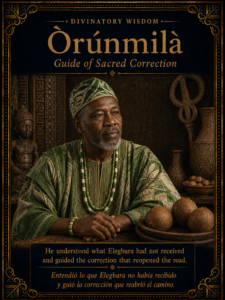
Orunmila understood what Elegbara had not received.
He knew that the correction would require more than words. It would require addressing what had been absent.
They arrived where Awó Fare was.
Awó Fare was sad.
But when Obatalá and Orunmila arrived, Awó Fare became happy despite his sadness.
They told him:
“From today, your land will be great, and nothing will be lacking for you. But in these lands, akukó and ounko must never be absent.”
From that moment, the story gives a clear condition.
Awó Fare’s land would become great. Nothing would be lacking. But akukó and ounko could never be absent there.
Awo Fare gave moforibale to Orunmila.
After this, they left for the land of Badawa Ifá.
Each one carried an agogo.
And as they traveled, they sang:
“Awó Fare Niyere Ambo Badawa Aboshire Elegbara Badawa.”
Cautious Working Interpretation
A cautious working interpretation may be heard like this:
Awó Fare is being called into blessing.
We are coming toward Badawa.
Badawa has served and cared for Elegbara.
Elegbara is with Badawa.
This chant must be understood in relation to the story. It names the three points of the conflict: Awó Fare, Badawa, and Elegbara.
The exact translation requires practitioner and liturgical review.
Elegbara heard this chant.
He gave moforibale to Orunmila and said:
“What a delicious smell you bring.”
Orunmila answered:
“This is food you have never eaten.”
Elegbara asked:
“Well, where is that delicious food?”
Obatalá answered:
“In the land that you abandoned.”
Elegbara immediately replied:
“Then I am going there with you.”
They set out on the road.
As they traveled, Orunmila kept restraining Elegbara. Elegbara kept passing his hand over Orunmila and smelling him.
Elegbara was very happy.
They arrived in the land of Awó Fare.
Awó Fare immediately gave moforibale to Elegbara.
Then Elegbara said to him:
“I will stay with you in this land, so that you may become greater.”
Final Note
The final note says that after seven days, a goat is to be given to Elegbara.
A piece of goat skin is always toasted.
Everything Elegbara eats is given to him and distributed in different places.
Elegbara must be refreshed with seven of his herbs, and oborí is named with obí and omí tuto.
This final note preserves ritual importance and partial ritual details. It does not provide a complete public ritual manual.
Any practical ritual explanation requires source verification and practitioner review.
Story Structure
The Neglected Relationship
The story begins with Awó Fare living in Ayare Lekun.
But he does not attend to what is happening in his land, and he does not attend to Elegbara.
This is the root condition.
The source gives the cause directly: because Awó Fare neglects Elegbara, Elegbara abandons him.
The Two Lands
The story then creates contrast.
Awó Fare’s land is marked by misery.
Badawa Ifá’s land is marked by abundance.
The difference between the two lands is connected to how Elegbara is treated.
Badawa Ifá always attends to Elegbara and gives him everything he wants to eat.
This contrast teaches the story before any explanation is needed.
Obatalá Carries the Suffering
Obatalá suffers because of the condition connected to Awó Fare’s land.
He goes onto the road carrying his agogo and singing.
His chant brings Orunmila into the matter.
This is important because the suffering of the land is not ignored by the sacred powers in the story.
Obatalá carries the suffering onto the road.
Orunmila Understands the Correction
Orunmila hears Obatalá and receives the report of Awó Fare’s suffering.
But Orunmila does more than recognize the problem.
He understands what Elegbara has not received.
He says that Elegbara has never eaten ounko or akukó.
This is one of the most important details in the story. The correction is specific. It is not vague.
The Promise and the Condition
Awó Fare is told that from that day his land will become great and nothing will be lacking.
But the promise comes with a condition.
In that land, akukó and ounko must never be absent.
This means the correction is not only about bringing Elegbara back once. It is about establishing the condition by which Elegbara’s favor and presence can remain.
The Chant That Calls the Return
When Orunmila, Obatalá, and the others go toward the land of Badawa Ifá, each one carries an agogo and they sing.
The second chant names Awó Fare, Badawa, and Elegbara.
Elegbara hears it. He smells what Orunmila is carrying. He asks where the food is.
When Obatalá tells him it is in the land he abandoned, Elegbara chooses to return.
Restoration with Obligation
Elegbara returns to Awó Fare’s land.
Awó Fare gives moforibale to Elegbara.
Elegbara promises to stay with him so that Awó Fare may become greater.
But the story does not end with restoration alone.
It ends with responsibility.
Akukó and ounko must not be absent in that land.
Main Characters and Relationship Roles
Awó Fare
Awó Fare is the central human figure of the story.
He is an Awó living in Ayare Lekun, but the source says that he does not attend to what is happening there, nor does he attend to Elegbara.
His title alone does not keep Elegbara with him.
The story shows that sacred responsibility must be maintained. Awó Fare’s land weakens when Elegbara leaves, and his future greatness depends on restoring and maintaining Elegbara’s favor.
Elegbara
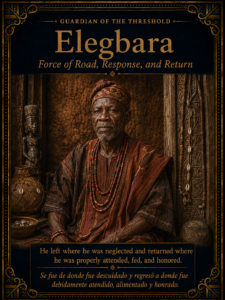
Elegbara is the sacred presence whose attention, feeding, and favor affect Awó Fare’s land and future greatness.
He should not be described as demonic, evil, horror-like, or as a fantasy trickster.
Elegbara is active in the story.
He leaves Awó Fare’s land. He remains with Badawa Ifá. He hears the chant. He smells the food. He asks where the food is. He chooses to return. He receives Awó Fare’s moforibale. And he promises to remain so that Awó Fare may become greater.
In this story, Elegbara responds to treatment, food, song, recognition, and proper ritual care.
Badawa Ifá
Badawa Ifá is the contrast figure.
Where Awó Fare neglects Elegbara, Badawa Ifá attends to him.
Where Awó Fare’s land has misery, Badawa Ifá’s land has abundance.
Badawa Ifá helps the reader understand what proper attention looks like in the story.
Obatalá
Obatalá is the sacred witness and mover of concern.
The story says Obatalá was suffering because of the condition connected to Awó Fare’s land.
He goes onto the road with his agogo and sings.
His chant brings Orunmila into the matter.
Obatalá does not correct the situation alone. He carries the suffering to Orunmila, whose knowledge can address the problem.
Orunmila
Orunmila is the sacred intelligence of correction.
He hears Obatalá, receives the report of Awó Fare’s suffering, and understands what Elegbara has not received.
His role is practical, ritual, and strategic. He identifies what has been absent and uses that missing element to restore Elegbara to the land Awó Fare had lost.
Awo Fare
Oluo Fare appears when he gives moforibale to Orunmila.
This name should be preserved as it appears in the source. It may require later review to determine whether it is a title form, a variant of Awó Fare, or a distinct naming usage in the source.
Human Conditions Revealed
Neglect
The central human condition is neglect.
Awó Fare does not attend to what is happening in his land, and he does not attend to Elegbara.
This neglect affects more than one private relationship. It affects the condition of the land.
Misery and Abundance
The story contrasts misery and abundance.
Awó Fare’s land is marked by misery after Elegbara leaves.
Badawa Ifá’s land is marked by abundance because he attends to Elegbara and gives him what he wants to eat.
The teaching is carried through this contrast.
Sacred Accountability
Awó Fare’s mistake is specific.
The story does not blame every hardship on ritual neglect. It says that in this road, Awó Fare had a responsibility toward Elegbara, and he failed to maintain it.
This is sacred accountability, not general accusation.
Restoration
The story also shows that restoration is possible.
Elegbara returns.
Awó Fare gives moforibale.
Elegbara remains so Awó Fare may become greater.
But restoration does not erase responsibility. It creates continuing obligation.
Moral and Spiritual Teachings
This story teaches that sacred relationships are not automatic.
Awó Fare is an Awó, but his title alone does not keep Elegbara with him. The relationship must be maintained.
The story also teaches through contrast. Badawa Ifá gives Elegbara everything he wants to eat, and his land has abundance. Awó Fare does not attend to Elegbara, and his land has misery.
The deeper teaching is not that every hardship comes from ritual neglect. The story gives one specific sacred situation.
In this road, Awó Fare’s suffering is connected to his failure to attend to Elegbara. Because of that, the correction must address Elegbara directly.
The story also teaches that correction requires specific knowledge. Orunmila understands that Elegbara has never eaten ounko or akukó. He recognizes what has been absent and uses that missing element to restore the relationship.
Finally, the story teaches that blessing comes with obligation.
Awó Fare’s land will become great. Nothing will be lacking. But akukó and ounko must never be absent there.
The correction must become continuity.
Symbols and Sacred Elements
The Road
The road is where Obatalá carries the suffering of the land into sacred motion.
It is also the path through which Orunmila, Obatalá, and Elegbara move between lands.
The road is where hidden suffering becomes revealed concern.
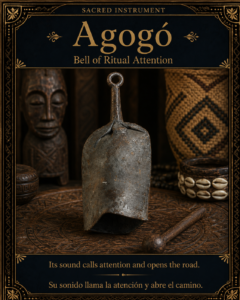
The Agogo
The Agogo is a traditional Yoruba bell or metal gong used to call attention, mark sacred presence, and announce spiritual movement.
The agogo is carried by Obatalá and later by the group traveling toward Badawa Ifá’s land.
It accompanies sacred song and marks movement, announcement, and ritual attention.
Food
Food is central to the story.
Badawa Ifá gives Elegbara everything he wants to eat.
Orunmila says Elegbara has never eaten ounko or akukó.
The food draws Elegbara’s attention and becomes part of the continuing obligation in Awó Fare’s land.
Akukó and Ounko
Akukó and ounko are named as required elements that must never be absent in Awó Fare’s land.
They are not decorative details. They are part of the warning and continuing ritual responsibility of this specific story.
Moforibale
Moforibale appears when Oluo Fare gives moforibale to Orunmila and later when Awó Fare gives moforibale to Elegbara.
It marks reverence, recognition, humility, and proper relationship.
The Rezo and Chants
The Rezo and chants carry sacred speech through the story.
The opening Rezo frames Elegbara’s importance before the narrative begins.
Obatalá’s chant brings Orunmila into the matter.
The second chant draws Elegbara’s attention and helps begin his return.
The chants are not decorative. They move the story.
Ritual and Ceremony Public Education Layer
This story contains ritual material, but it does not provide a public ritual manual.
The Ebbó names ritual materials. The final Nota gives partial ritual details connected to Elegbara. The story also names food, agogo, song, moforibale, and the condition that akukó and ounko must never be absent in Awó Fare’s land.
For public education, the important point is not procedure.
The important point is that Awó Fare’s neglected relationship with Elegbara must be corrected. That correction is shown through sacred attention, food, song, reverence, and continuing obligation.
Any practical ritual explanation requires source verification and practitioner review.
This article preserves the ritual importance of the story without teaching ritual procedure.
Prayer, Rezo, Chant, and Sacred Speech Status
This story contains one opening Rezo and two chants inside the narrative.
The opening Rezo frames the story before the Patakín begins. It names Ifá, Elegbara, Badawa Ifá, royal authority, the gate or doorway, good fortune, victory, the world, the Awó, and the road of Awó Fare.
The first chant belongs to Obatalá’s movement on the road:
“Baba Ifá Nanire Oshabi Oshababa Ifá Nanire.”
This chant brings Orunmila into the story. Obatalá sings, Orunmila hears, and the suffering of Awó Fare’s land becomes known.
The second chant belongs to the movement toward Badawa Ifá’s land:
“Awó Fare Niyere Ambo Badawa Aboshire Elegbara Badawa.”
This chant draws Elegbara’s attention. He hears it, smells the food, and begins to ask where the food is.
Because these lines are preserved in liturgical and source-based spelling, their meanings should be treated as cautious working interpretations, not confirmed literal translations.
Cultural and Divinatory Context
This story operates within a divinatory world where sacred relationship, food, song, land, obligation, and consequence are linked.
It belongs to Oyekun Juani as preserved in the source.
The story is not only about one man’s hardship. It is about the relationship between an Awó, his land, Elegbara, sacred food, song, and continuing responsibility.
The final warning is important:
Akukó and ounko must never be absent in that land.
This instruction should remain tied to the story’s specific divinatory context. It should not be generalized into a universal public rule for everyone.
When This Odù Appears
When Oyekun Juani appears in relation to this story, it may point to neglected sacred responsibility, especially where a person has failed to attend to the force that supports their road, work, or land.
It may warn that a condition of lack or disorder is connected to something that has not been properly maintained.
It may also point to the need for correction through proper consultation, recognition, and ritual care.
But this guidance must remain responsible.
The story does not say that all hardship comes from ritual neglect. It shows one specific road in which Awó Fare’s hardship is connected to his failure to attend to Elegbara.
When this story is used in divinatory reflection, the details should be handled by qualified practitioners, especially because the source preserves ritual materials and a final Nota.
Modern Ethical Explanation
Modern readers should hear this story with care.
It should not be used to blame suffering people, families, priests, or communities in a broad or careless way.
The story shows a specific sacred responsibility. Awó Fare did not attend to Elegbara. That failure affected his land.
This is not a license to accuse every person who is suffering of neglecting ritual obligations.
It is also not a statement that priests control every outcome.
A priest is not a magician who controls all results. A person’s situation may involve many things: destiny, timing, consultation, sacrifice, discipline, community conditions, spiritual factors, and practical life decisions.
But when a specific sacred duty belongs to a person, that duty must not be neglected.
That is the balance of the teaching.
What Must Not Be Misunderstood
This story should not be reduced to a simple punishment formula.
It should not be used to say that every hardship comes from ritual neglect.
It should not be used to blame vulnerable people or suffering communities.
Elegbara should not be described as demonic, evil, horror-like, or fantasy-based.
Orunmila should not be reduced to a generic wise man.
Obatalá should not be treated as a passive background figure.
Badawa Ifá should not be treated as a villain who stole Elegbara. The source does not say Elegbara was stolen. It says Elegbara abandoned Awó Fare and went to another land where Badawa Ifá attended to him.
The Ebbó and final Nota should not be turned into a public ritual manual.
The Rezo and chants should not be treated as fully translated unless reviewed by qualified practitioners and language authorities.
Reflection Questions
- What does the story reveal about the difference between having a sacred relationship and maintaining one?
- Why does the story contrast Awó Fare’s land with the land of Badawa Ifá?
- What role does Obatalá’s chant play in moving the story forward?
- Why is Orunmila’s knowledge of what Elegbara has not eaten so important?
- What does the warning about akukó and ounko reveal about restoration and continuing obligation?
- How can this story be read without turning ritual neglect into a simple punishment formula?
- Why should the Rezo and chants be preserved even when their exact translation requires review?
- What does the story teach about responsibility without turning that responsibility into general blame?
- Why should Elegbara not be framed as demonic, horror-like, or fantasy-based?
- How does the final Nota continue the ritual frame of the story?
Conclusion
The Road Where Awó Fare Did Not Attend to Elegbara teaches through loss, contrast, correction, and return.
Awó Fare does not attend to Elegbara, and Elegbara leaves.
Badawa Ifá attends to Elegbara, and abundance is found in his land.
Obatalá carries the suffering of Awó Fare’s land into motion.
Orunmila understands what Elegbara has not received and leads the correction.
Elegbara returns, but the story does not end with return alone.
It ends with responsibility.
The food that brings Elegbara back must not be absent. The favor that returns must be cared for. The land that becomes great again must continue to honor the force that made that greatness possible.
Downstream Summary Block
Core Story Tension:
Awó Fare neglects Elegbara, and Elegbara leaves his land.
Core Ritual Dynamic:
Elegbara returns through sacred song, food, recognition, and restored ritual attention.
Core Character Dynamic:
Awó Fare fails to attend. Badawa Ifá provides the contrast. Obatalá witnesses and carries the suffering. Orunmila understands the correction. Elegbara returns when properly recognized.
Core Teaching:
Sacred presence must be maintained. Restoration creates continuing obligation.
Core Divinatory Warning:
Akukó and ounko must never be absent in Awó Fare’s land.
Prayer / Sacred Speech Status:
The opening Rezo and two chants are preserved. All English meanings are cautious working interpretations requiring review.
Ritual / Ceremony Boundary:
Ritual materials and the final Nota are present, but no complete public ritual procedure is provided.
Modern Ethical Flag:
Do not universalize hardship as ritual neglect. Do not blame suffering people or communities. Preserve the specific sacred responsibility shown in the story.
Terms Requiring Diacritic / Liturgical Review:
Babawa, Mayire, Oyere Lekun, Leye Beifa, Begbo, Eluefare, Nanire, Oshabi, Oshababa, Niyere, Ambo, Aboshire, Elegbara, Elegbá, Orunmila, Obatalá, Ebbó, moforibale, Oluo Fare, Omó Badawa Ifá, ounko, akukó, oborí, obí, omí tuto.
IFAStories Website Story Article Complete
Leave a Reply