

INTRODUCTION
This story, preserved under the Odù Oyeku-Biroso, teaches through a simple but serious event: Orúnmila needs coconuts because his Guardian Angel has asked him to rogare his head with coconut. He has no money, so he goes to the plaza and asks the coconut sellers to give him the coconuts on credit.
The sellers refuse him. But the source says they do more than refuse — they insult him.
That detail matters.
The story is not simply about business, credit, or coconuts. It is about how people respond when someone comes before them with a real need, especially when that need is connected to sacred responsibility.
After being refused and insulted in the plaza, Orúnmila goes to an old man whom he knows. The old man receives him, listens to him, gives him the coconuts and the other things he needs, and even allows him to fulfill the request of his Guardian Angel in his own house.
Then Ikú arrives.
Ikú has come for the old man because his days have been fulfilled. But Orúnmila is present, and he speaks on the old man’s behalf. The old man’s goodness becomes his witness.
This story teaches about service, dignity, sacred responsibility, gratitude, intercession, and consequence. It must be read with seriousness, but not with fear. Ikú is not horror in this story. Ikú is a sacred force moving within the order of destiny.
STORY REFERENCE
This retelling draws on a traditional account preserved in Caminos de Ifá, edited by Ernesto Valdés Jane under Proyecto Orunmila, a collaborative Cuban project dedicated to collecting, comparing, preserving, and publishing Osha-Ifá source materials.
The narration, adaptation, commentary, and visual interpretation presented here are original to IFAStories.
This article is offered for spiritual education, cultural preservation, and reflective study. It is not presented as ritual instruction, nor as a substitute for proper guidance from initiated elders within the tradition.
IFAStories honors the source tradition, the ancestors, and the sacred responsibility of preserving these teachings with respect.
QUICK TAKEAWAY
When sacred need appears in ordinary form, the way people respond matters.
The story does not condemn poverty. Orúnmila himself has no money. The deeper warning is against contempt, humiliation, and harshness toward someone who comes with a true need.
The old man’s goodness becomes his witness. The sellers’ contempt becomes their burden.
THE STORY
One day, this sign came out for Orúnmila.
Through this sign, his Guardian Angel asked him to rogare his head with coconut. But Orúnmila had no money.
So he went to the plaza to ask if the coconut sellers would give him the coconuts on credit. He was trying to obtain what he needed to fulfill the instruction of his Guardian Angel.
But the sellers refused him. They would not give him the coconuts on credit. And beyond refusing him, they insulted him.
After this, Orúnmila went to see an old man whom he knew. The old man received him and told him to come inside.
There, Orúnmila told him what had happened in the plaza. The good man listened. Then he gave Orúnmila the coconuts and the other things he needed to fulfill the request of his Guardian Angel.
He even allowed Orúnmila to rogare his head there, in that same house.
At that moment, someone knocked at the door.
It was Ikú.
Without hesitation, Orúnmila went out to meet Ikú.
Ikú had come for the old man.
Ikú said that the elder’s days had already been fulfilled. Ikú had not expected to find Orúnmila there.
But Orúnmila pleaded for the old man.
He asked Ikú not to take him, because the old man had been very good to him. Then Orúnmila spoke of the coconut sellers in the plaza, the ones who had refused him and insulted him when he was trying to fulfill the instruction of his Guardian Angel.
In this way, Orúnmila convinced Ikú.
Ikú left the old man in peace and took the coconut sellers.
STORY STRUCTURE
The Sign Appears
The story begins when this sign comes out for Orúnmila. The source does not give a long divination procedure. It establishes that the sign appeared and that the instruction followed from there.
This gives the story its sacred frame.
Sacred Instruction
Orúnmila’s Guardian Angel asks him to rogare his head with coconut. The coconut is not treated as an ordinary object in the story. It is connected to sacred instruction.
Material Difficulty
Orúnmila has no money. This is important because the story does not present his lack as wrongdoing. His poverty is not the failure. He still tries to fulfill what was asked of him.
Conflict in the Plaza
Orúnmila goes to the plaza and asks for the coconuts on credit. The sellers refuse him and insult him.
This is where the moral weight begins to deepen. The issue is not only that they refuse. The source says they humiliate him.
The Old Man’s Goodness
The old man receives Orúnmila, listens to him, gives him what is needed, and allows the instruction of the Guardian Angel to be fulfilled in his house.
The old man is not described as wealthy or powerful. He is simply shown as good.
Ikú Arrives
Ikú comes to the old man’s door because the old man’s days have been fulfilled. Ikú is not presented as random cruelty. Ikú comes with responsibility within the order of destiny.
Orúnmila Intercedes
Orúnmila speaks for the old man. He does not fight Ikú. He does not take life with his own hand. He gives testimony about the old man’s goodness.
Sacred Consequence
The old man is spared, and the coconut sellers are taken by Ikú. This must be understood carefully. The story should not be reduced to revenge or ordinary punishment logic. It is a sacred narrative consequence within this specific Odù story.
MAIN CHARACTERS AND RELATIONSHIP ROLES
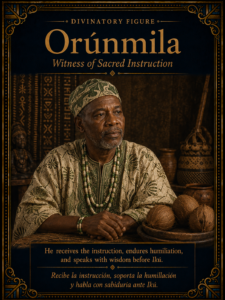
Orúnmila
Orúnmila is the central sacred figure of the story. He receives the sign, receives the instruction from his Guardian Angel, seeks the coconuts, suffers refusal and insult, receives help from the old man, and later intercedes when Ikú arrives.
The story shows two movements in Orúnmila.
First, Orúnmila is the one who must obey sacred instruction. He has no money, but he does not abandon what was asked of him.
Second, Orúnmila becomes the one who intercedes. When Ikú comes for the old man, Orúnmila speaks on his behalf.
First, Orúnmila needed help.
Then, Orúnmila gives help.
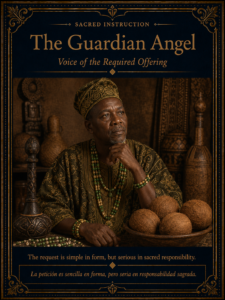
Guardian Angel
The Guardian Angel gives the instruction that moves the story forward. The request to rogare the head with coconut is not casual. It creates the sacred obligation behind Orúnmila’s need.
The source uses the Spanish religious register connected to “Ángel de la Guarda.” For this article, the term is rendered as Guardian Angel while preserving the meaning of the source.
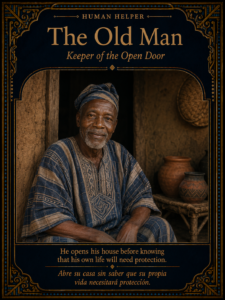
The Old Man
The old man is the human helper in the story. He receives Orúnmila, listens to him, gives him the coconuts and other things he needs, and allows the request of the Guardian Angel to be fulfilled in his house.
His importance is not based on status. The source does not present him as a priest, king, or wealthy man. His importance comes from his action.
He opens the door.
He listens.
He helps.
He gives dignity.
Because of this, when Ikú comes, Orúnmila speaks for him.
Ikú
Ikú is the sacred death-force in the story. Ikú comes to take the old man because his days have already been fulfilled.
Ikú should not be portrayed as horror, evil, or a monster. Ikú has a responsibility. Ikú is acting within the order of destiny.
The story becomes more serious because Ikú is not acting randomly. Ikú has come with a duty. But when Ikú finds Orúnmila there, Orúnmila intercedes.
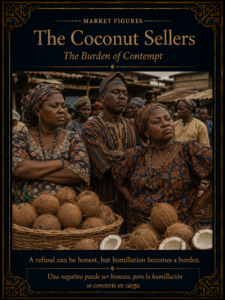
The Coconut Sellers
The coconut sellers are the collective group who refuse Orúnmila in the plaza.
They should not be exaggerated into cartoon villains. A seller may have responsibilities. A seller may have limits. A seller may not always be able to give on credit.
But the source says they did more than refuse. They insulted Orúnmila.
That is where the moral weight rests — not in ordinary business boundaries, but in contempt and humiliation toward someone trying to fulfill a sacred instruction.
HUMAN CONDITIONS REVEALED
Material Lack
Orúnmila does not have money. The story does not shame him for this. His lack of money is a condition, not a moral failure.
Sacred Responsibility
Orúnmila has been asked by his Guardian Angel to rogare his head with coconut. His need is therefore connected to spiritual responsibility, not ordinary desire.
Refusal
The sellers refuse him. This alone must be read carefully, because refusal is not always evil. People may have limitations.
Humiliation
The sellers insult him. This is what changes the moral weight of the event. The story warns against adding shame to another person’s burden.
Hospitality
The old man receives Orúnmila. Before giving him coconuts, he opens his house and listens. This act of receiving is part of his goodness.
Gratitude
When Ikú arrives, Orúnmila remembers what the old man did. The old man’s earlier kindness becomes something Orúnmila can speak for.
Intercession
Orúnmila stands between the old man and Ikú through speech, testimony, and spiritual authority. He does not act through violence.
Consequence
The story places the sellers under consequence because of the contempt they showed. This must be understood within the specific sacred frame of Oyeku-Biroso, not as a universal rule for ordinary life.
MORAL AND SPIRITUAL TEACHINGS
The story teaches that sacred instruction should be treated seriously. Orúnmila receives the instruction and seeks to fulfill it even though he has no money.
It also teaches that poverty is not spiritual failure. Orúnmila lacks money, but he remains obedient to the instruction of his Guardian Angel.
The deeper issue is contempt. The sellers do not only refuse him. They insult him. The story warns that humiliation can carry serious spiritual weight.
A person may have boundaries. A person may have responsibilities. A seller may not always be able to give on credit. But the story teaches that even when one cannot give, one can still answer with dignity.
The old man’s action teaches the value of hospitality. He does not perform a grand act. He receives Orúnmila, listens to him, gives what is needed, and allows the sacred instruction to be fulfilled in his home.
The story also teaches that goodness may speak for a person later. When Ikú comes, the old man does not defend himself. Orúnmila speaks for him. His earlier goodness becomes his witness.
The most sensitive teaching concerns the coconut sellers. Orúnmila tells Ikú not to take the old man and speaks of the sellers instead. This should not be taught as personal revenge. Orúnmila does not return to the plaza to harm them. He does not take justice into his own hands. Ikú had already arrived with a duty.
This is not ordinary punishment logic. It is sacred narrative consequence within this Odù story.
The ethical teaching is:
A refusal can be honest, but humiliation is dangerous. A boundary can be necessary, but contempt can become a burden.
SYMBOLS AND SACRED ELEMENTS
Coconut
The coconut is the named material needed for the head rogation. It is not decorative in the story. It becomes the object through which need, refusal, service, and consequence are revealed.
The Head
The head is the place requiring spiritual attention. In the story, the head represents the part of the person that must be aligned through the requested rogation.
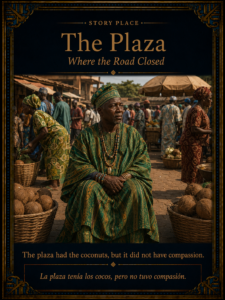
The Plaza
The plaza represents public exchange, commerce, and social response. It is where Orúnmila’s need is refused and where insult appears.
The plaza had what Orúnmila needed, but the plaza closed the road.
The Old Man’s House
The old man’s house represents reception, listening, hospitality, and protection. It becomes the place where the instruction of the Guardian Angel is fulfilled.
The old man’s house also becomes the threshold where Ikú arrives and Orúnmila intercedes.
The Door
The door is an important symbol. The old man opens his door to Orúnmila. Later, Ikú comes to that same door.
The doorway becomes the place where hospitality and destiny meet.
Ikú
Ikú represents the force of death, destiny, and appointed time. Ikú is not a horror figure in this story. Ikú comes with duty and responsibility.
Oyeku-Biroso
Oyeku-Biroso frames the story’s pattern: sacred instruction, lack, refusal, insult, hospitality, intercession, and consequence.
RITUAL / CEREMONY PUBLIC EDUCATION LAYER
This story contains ritual material, but it does not provide a ritual manual.
The source says that this sign came out for Orúnmila and that his Guardian Angel asked him to rogare his head with coconut. It also says that other things were needed, but it does not name them.
The story does not give a complete ritual procedure. It does not explain how to perform the head rogation. It does not list all articles. It does not provide step-by-step instruction.
For public education, the important point is not procedure. The important point is that Orúnmila is trying to fulfill a sacred instruction, and the difficulty of obtaining the coconuts becomes the moral and spiritual test of the story.
Any practical ritual explanation would require source verification and practitioner review.
PRAYER / REZO / CHANT / SACRED SPEECH STATUS
No explicit prayer, rezo, chant, or súyẹ̀rẹ̀ is preserved in this story segment as sacred speech text.
Because no sacred speech is preserved, this article does not create one.
Sacred force in the story is carried through the sign, the instruction of the Guardian Angel, the head rogation with coconut, the old man’s goodness, Orúnmila’s intercession, and the arrival of Ikú.
CULTURAL AND DIVINATORY CONTEXT
This story operates within a divinatory world where signs, sacred instruction, material need, human conduct, and consequence are linked.
The source says that the sign came out for Orúnmila. From that point, his Guardian Angel asks him to rogare his head with coconut.
This article avoids adding procedural details that are not in the source. It also avoids turning the story into a public ritual guide.
The term Guardian Angel is used for the source’s Spanish religious register of Ángel de la Guarda. The term Ikú is used for the death-force that appears in the story, while recognizing that the source text uses Spanish wording for death.
This rendering keeps the story aligned with IFAStories style while preserving the meaning of the source.
WHEN THIS ODÙ APPEARS
When Oyeku-Biroso appears in relation to this story, it may point to sacred instruction that must be treated seriously.
It may indicate that a person has something important to fulfill but may face lack, delay, refusal, or public humiliation while trying to do it.
It may also point to the importance of helping someone whose need is connected to sacred responsibility. The old man’s help appears simple, but it becomes spiritually important.
The story may warn against contempt, harsh speech, and humiliating those who come with need.
It should not be read as a fixed or mechanical prediction. The story does not say that every refusal brings death. It shows a specific pattern within this Odù: sacred need appears, one group refuses with insult, one person helps with goodness, Ikú arrives with duty, and Orúnmila intercedes.
No additional ritual prescription should be added beyond what the source states.
MODERN ETHICAL EXPLANATION
This story contains a sensitive moral issue because Ikú takes the coconut sellers after Orúnmila speaks on behalf of the old man.
This must be explained carefully.
From a simple human point of view, a seller refusing credit does not deserve death. A seller may have responsibilities. A seller may have limits. A seller may not be able to give away what is being sold.
So the teaching cannot be reduced to:
“Those who refuse you should be punished.”
That would be wrong and would make the story smaller than it truly is.
The source gives another detail: the sellers did not only refuse. They insulted Orúnmila. They humiliated someone who was trying to fulfill a sacred instruction.
That is where the moral weight rests.
Not in business boundaries.
Not in ordinary refusal.
But in contempt.
Even then, the story should not be taught as a model for revenge. Orúnmila does not return to the plaza to harm the sellers. He does not act violently. He does not take justice into his own hands.
Ikú had already arrived. Ikú had already come with a duty. Orúnmila speaks within that sacred encounter.
The consequence belongs to this specific Odù story and should be handled with humility.
The ethical teaching is:
The story does not tell us to punish those who refuse us. It tells us to be careful how we treat people when they come before us in need.
WHAT MUST NOT BE MISUNDERSTOOD
This story does not teach that poverty is spiritual failure. Orúnmila has no money, but he remains obedient.
This story does not teach that every refusal is evil. A person may have limits and responsibilities.
This story does warn against insult, humiliation, and contempt toward someone in need.
This story does not teach revenge. Orúnmila does not take life with his own hand. Ikú has already arrived with a duty.
This story does not present Ikú as horror, fantasy, or demonic force. Ikú is a sacred force of destiny and consequence.
This story does not teach ritual procedure. It names the head rogation with coconut but does not explain how to perform it.
This story does not contain a preserved prayer, rezo, chant, or súyẹ̀rẹ̀. No sacred speech should be invented for it.
The old man should not be turned into a hidden priest or divine figure unless another source clearly states that. In this source, he is an old man whose goodness becomes spiritually important.
REFLECTION QUESTIONS
- Why does the story begin with the sign coming out for Orúnmila before he goes to the plaza?
- What is the difference between Orúnmila’s lack of money and the sellers’ refusal?
- Why does the source’s detail that the sellers insulted Orúnmila matter so much?
- How does the old man’s hospitality change the direction of the story?
- Why should Ikú be understood as carrying responsibility rather than acting as horror?
- How does Orúnmila intercede for the old man?
- Why should this story not be taught as revenge?
- What is the difference between an honest boundary and contempt?
- How can a community help without humiliating those who come with need?
- How does the story show that goodness may speak for a person later?
CONCLUSION
When Coconuts Were Denied to Orúnmila teaches that sacred responsibility may appear through ordinary things: coconuts, a request for credit, a closed market, an old man’s open door.
Orúnmila’s lack of money is not condemned. His obedience remains visible. He still seeks what is needed to fulfill the instruction of his Guardian Angel.
The sellers’ failure is not simply that they refuse. The deeper issue is that they insult and humiliate him.
The old man, however, receives him. He listens. He gives what is needed. He allows the instruction to be fulfilled in his house.
When Ikú comes, Orúnmila speaks for him.
The story is serious, but it should not be sensationalized. It does not teach revenge. It teaches that goodness, service, and respect can carry protection in ways no one sees at first.
In Oyeku-Biroso, the plaza closed the road.
The old man opened his house.
Ikú came with a duty.
Orúnmila answered with intercession.
And the story remembers that the way we respond to someone’s need may become part of our own destiny.
Leave a Reply