Odù: Ejiogbe
Category: Odù, Ejiogbe, Story Articles
Source Title: The Second Marriage of Ejiogbe
STORY REFERENCE
This story is respectfully adapted from the Baba Èjìogbè section of IFISM: The Complete Work of Orunmila by Mr. C. Osamaro Ibie.
Within IFAStories, this account is presented as a sacred Ifá narrative for spiritual education, cultural preservation, and reflective study.
This adaptation preserves the traditional meaning of the story while shaping the narration, structure, and commentary for a modern educational audience. It is offered with respect for Ifá, Yoruba sacred knowledge, and the ancestral wisdom carried through Odù.
INTRODUCTION
Some stories teach that prosperity does not create danger by itself. Prosperity often reveals what has already been forgotten, left unexplained, or poorly handled.
This traditional Ifá story from Ejiogbe speaks about Ejiogbe, his second wife Iwere were, and a household pattern that was respected in poverty but broken in public abundance. The story is not only about marriage. It is also about memory, religious responsibility, ceremonial order, humility, and the danger of allowing public authority to erase private loyalty.
At the center of the story is the head of an animal. In poverty, the head was given to the wife as part of household life. In prosperity, the head of a cow appeared within a public thanksgiving ceremony, where priests, family members, and sacred order were present. One object carried two meanings. To the priests, the cow’s head belonged to ceremonial order. To Iwere were, it carried the memory of poverty, loyalty, and recognition.
The conflict becomes serious because no one built a bridge between these meanings before the wound became public.
QUICK TAKEAWAY
What was honored in hardship must not be carelessly denied in abundance.
This story teaches that private memory and public ceremony must be explained to one another. Religious duty requires communication, marriage requires humility, and sacred communities must correct misunderstanding without humiliating the people who do not yet understand the order of the ceremony.
THE STORY
The story says that the first wife of a true son of Ejiogbe will not remain long with him unless she is fair in complexion.
It also says that the children of Ejiogbe, those for whom Ejiogbe appeared during Ifá initiation or Ugbodu, often marry women who belong to the world of witchcraft. If such a man has three wives, at least two of them are said to be witches.
The next woman Ejiogbe married was called Iwere were. She was identified in the story as a witch.
At that time, Ejiogbe was very poor. He and Iwere were lived below the starvation line. Whenever they killed a rat, Orunmila would give the head to his wife. The same thing happened with a fish, a hen, and later a goat. By the time they were able to afford a goat, their fortunes had begun to improve.
Eventually, Ejiogbe became sufficiently prosperous. He built his own house, raised children, and married other wives.
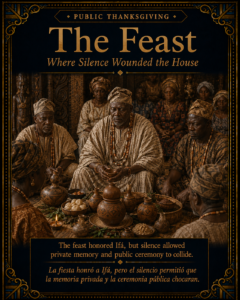
At the height of this prosperity, Ejiogbe decided to offer thanksgiving to his Ifá. He bought a cow for a great feast and invited other priests who were members of his family.
During the feast, the meat was shared among the invitees. The senior wife expected, as usual, to receive the head of the cow. After waiting in vain, she drew the head toward herself.
Almost immediately, some of the more vindictive priests rebuked her. They said that the head was not the proper part of a cow to give to a woman. The cow’s head was then taken away from her.
Iwere were remained still for some time. She gave her husband the chance to correct the situation. But when no positive response came from him, she withdrew from the feast chamber and went to her room.
Three days later, she gathered her belongings and left Ejiogbe’s house. She went to live with her brother, Iroko, who gave her sanctuary.
When the thanksgiving ceremonies were over, Ejiogbe went in search of her. He searched everywhere without success. Finally, he went to her brother Iroko, who confirmed that he had given her refuge.
When Ejiogbe saw Iwere were, he asked why she had left him so unceremoniously.
With tears in her eyes, she reminded him that when they were poor, he often gave her the head of whatever animal they could afford to slaughter for food. He had given her the head of the rat, the fish, the hen, and the goat. No priest or member of his family had appeared during those days to demand those heads from her.
She asked why, now that they were wealthy enough to feast with a cow, the priests had come to deny her the privilege of keeping its head.
She asked why no family member had come earlier to demand the heads of the rat, the fish, or the hen.
Then, in poetic speech, she declared:
What man can boast
of being bigger than the elephant?
Who can claim
to be bigger than the buffalo?
Who can boast
of being more influential than the king?
No head-tie can be wider
than those used by the elders of the night.
No rope can be as long
as the one used by the witches.
No hat can be more famous
than a crown.
In width or in breadth,
the hand cannot be taller than the head.
The palm frond is often taller
than the palm leaves
on the head of a palm tree.
Wherever there is a musical performance,
it is the sound of the bell
that sounds louder
than all other instruments.
And the palm tree
is more influential
than all other trees in the forest.
When Ejiogbe heard this poem, he too began to weep. He apologized to his wife and asked her to forgive him.
Iwere were took pity on him and agreed to return with him to the house. But she returned on the condition that he would appease her with a piece of white cloth, some money, and by serving her head with a goat.
This is why the source explains that whoever is born by Ejiogbe at Ugbodu is required, at the height of his prosperity, to serve the head of his senior wife with a goat.
When this story comes out in divination for a person who was born by Ejiogbe, he should be asked whether he has already served his wife’s head with a goat.
He should be told that his senior wife, if described in the source as yellow or fair in complexion, is a benevolent witch who may help him prosper in life, provided he does not despise her.
If, on the other hand, this story comes out in divination for a man whose senior wife has left his house, he should be advised to go and beg her to return without delay, lest he return to poverty.
STORY STRUCTURE
Poverty and Household Pattern
The story begins with poverty. Ejiogbe and Iwere were live with very little. During this time, whenever they slaughter a rat, fish, hen, or goat, the head is given to the wife.
This pattern becomes important because it is not only about food. Over time, it becomes a sign of memory, care, and recognition within the household.
Prosperity and Public Thanksgiving
As Ejiogbe prospers, the household expands. He builds his own house, raises children, marries other wives, and reaches the point where he can offer thanksgiving to his Ifá.
The thanksgiving feast changes the setting. What had once been a private household pattern now enters a public ceremonial environment.
The Cow’s Head and Public Conflict
During the feast, Iwere were expects to receive the cow’s head as she had received the heads of smaller animals in poverty. But the priests rebuke her and take the head away.
The conflict begins because the cow’s head is read in two different ways. The priests see it through ceremonial order. Iwere were sees it through the memory of hardship and household recognition.
Ejiogbe’s Silence
Ejiogbe’s failure is not that he refuses Ifá or rejects thanksgiving. He performs the sacred public obligation. His failure is that he does not mediate between the private history of his marriage and the public order of the ceremony.
He does not explain Iwere were’s expectation to the priests. He does not explain the ceremonial difference to Iwere were. And when the rebuke occurs, he does not act quickly enough to prevent the wound.
Departure and Refuge
Iwere were does not immediately destroy the household or create public chaos. She withdraws, waits, gathers her belongings, and leaves. Her brother Iroko gives her refuge.
This refuge becomes important because it creates distance. Ejiogbe must now leave the ceremonial space and go to where the wound can be spoken clearly.
Listening, Apology, and Repair
When Ejiogbe finds her, Iwere were explains the meaning of her grief. Her poem is not ordinary complaint. It is sacred reasoning. She speaks through images of elephant, buffalo, king, crown, elders of the night, hand, head, bell, and palm tree.
Ejiogbe listens, weeps, apologizes, and asks forgiveness.
Lasting Instruction
The story ends with divinatory instruction. Those born by Ejiogbe are told to honor the head of the senior wife at the height of prosperity. A man whose senior wife has left should be advised to beg her to return, so that he does not fall back into poverty.
MAIN CHARACTERS AND RELATIONSHIP ROLES
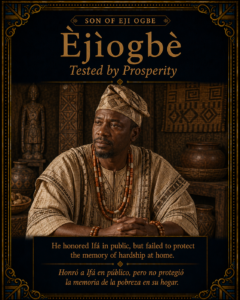
Ejiogbe
Ejiogbe is the central figure of the story. He begins in poverty, rises into prosperity, performs thanksgiving to Ifá, and becomes responsible for the conflict that unfolds between private household memory and public ceremonial order.
He is not presented as a man who never cared for his wife. During poverty, he gave her the heads of the animals they could afford. After she leaves, he searches for her. When she speaks, he listens and apologizes.
His weakness is silence at the wrong moment. His greatness is that when the truth is placed before him, he humbles himself and corrects the breach.
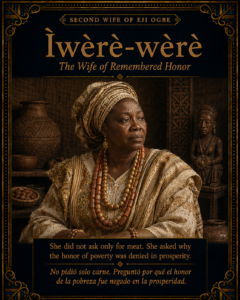
Iwere were
Iwere were is Ejiogbe’s second wife. The story identifies her as a witch, but this must be handled carefully. In this context, the word should not be read through modern horror, fantasy, or insult. The story presents her as spiritually serious, powerful, and deeply connected to the memory of the household’s hardship.
Her grievance is not shallow. She is not simply reaching for meat. She is reaching for the sign of recognition that had followed her through poverty.
Her poem shows wisdom, proportion, and spiritual force. She speaks in images that explain order, authority, hierarchy, and the meaning of the head.
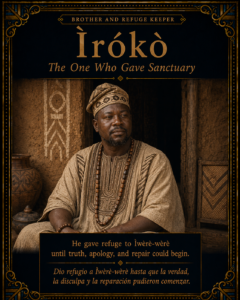
Iroko
Iroko is Iwere were’s brother. His role is brief but important. He gives her sanctuary after she leaves Ejiogbe’s house.
His home becomes a place of cooling and protection. Because Iwere were is received there, Ejiogbe must go to her, listen, and face the matter outside the noise of the feast.
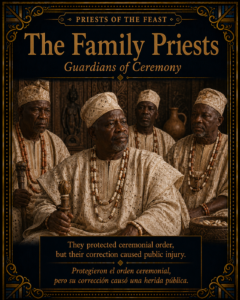
The Priests
The priests are members of Ejiogbe’s family who attend the thanksgiving feast. The story says some of them rebuke Iwere were and take the cow’s head away from her.
They should not be reduced too quickly to simple villains. The story does not fully explain their ceremonial reasoning, but it suggests that they may have understood the cow’s head through public ritual order.
Their error is not necessarily that they recognized ceremonial importance. Their error is the public injury caused by the way correction was handled.
The Household and Community
The household is not only the background of the story. It is the place where prosperity, marriage, memory, public ceremony, and religious authority meet.
The story shows that when a household becomes prosperous, the responsibilities around that household also grow. Public success must not erase the one who endured private hardship.
HUMAN CONDITIONS REVEALED
Poverty and Memory
Poverty creates memory. During hardship, small gestures can become deeply meaningful. The head of the rat, fish, hen, and goat becomes tied to Iwere were’s memory of shared struggle.
When prosperity comes, those memories do not disappear. They may become even more important because prosperity tests whether hardship will still be remembered.
Public Honor and Private Pain
The wound happens in public. Iwere were is not only denied what she expected. What had once represented private recognition is taken from her in front of others.
The story shows that public correction can create deep injury when it ignores private history.
Silence and Mediation
Ejiogbe’s silence is central. He stands between two worlds but does not speak quickly enough to protect the bridge between them.
The story teaches that a person who belongs to both worlds has responsibility. A spouse, elder, priest, or family leader must help translate meaning before misunderstanding becomes humiliation.
Religious Difference
Iwere were and Ejiogbe do not belong to the same spiritual orientation in the same way. Ejiogbe belongs to the public priestly order of Ifá. Iwere were is associated with another spiritual force.
The story does not teach that such difference must destroy a marriage. It teaches that difference requires explanation, preparation, and humility.
Humility and Repair
Ejiogbe’s correction matters. He does not hide behind public ceremony. He does not dismiss Iwere were’s pain. He searches, listens, weeps, apologizes, and accepts the terms of repair.
Iwere were also shows disciplined dignity. She does not answer humiliation with chaos. She leaves, speaks truth, and allows the road of repair to remain open.
MORAL AND SPIRITUAL TEACHINGS
This story should not be reduced to one simple lesson about prosperity.
Ejiogbe does not ignore Ifá. He does not refuse thanksgiving. In fact, he fulfills a public sacred obligation by buying a cow, preparing a feast, and inviting priests from his family.
The deeper problem is that a private household pattern enters a public ceremonial setting without preparation.
During poverty, the head of each animal had become a sign of recognition. During prosperity, the cow’s head entered a ceremonial order where priests and family authority were present. Both meanings were serious. But because they were not explained to one another, the feast became the place of misunderstanding.
The story teaches that sacred duty requires more than correct materials and public formality. It also requires care for the people directly affected by the ceremony.
A ceremony may be correct in form and still become painful if those closest to it do not understand their place within it.
The story also teaches that prosperity carries responsibility. The more public the household becomes, the more carefully private loyalty must be protected. The more sacred the ceremony, the more humility is required from those who lead it.
SYMBOLS AND SACRED ELEMENTS
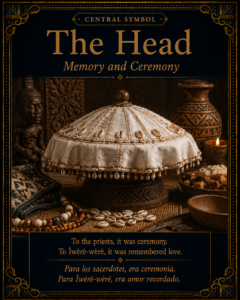
The Head
The head is the central symbol of the story.
It is a portion of food.
It is a memory of poverty.
It is a sign of household recognition.
It may also carry ceremonial meaning.
Spiritually, it points toward authority, place, and destiny.
The cow’s head becomes the place where private memory and public ceremony collide.
The Cow
The cow represents the height of prosperity. In poverty, the household could only afford smaller animals. By the time Ejiogbe can provide a cow for thanksgiving, his condition has changed.
The cow therefore marks public abundance. It is also the moment when prosperity tests whether the memory of hardship will be honored.
The Goat
The goat appears twice in the story’s pattern. First, it appears as one of the animals whose head was given to Iwere were during the household’s improving condition. Later, it appears in the condition of appeasement and in the divinatory instruction connected to the senior wife’s head.
This shows that the goat is not merely an animal in the story. It becomes tied to correction, recognition, and the repair of the household relationship.
White Cloth and Money
Iwere were requires white cloth, money, and the serving of her head with a goat as part of the appeasement.
The article can name these materials because the story names them. But their practical ritual handling is not explained here. They belong to the ritual and divinatory context of the story and should not be treated as a public ritual recipe.
Iroko’s House
Iroko’s house functions as refuge. It is the place where Iwere were is received after the dishonor. It creates distance from the feast and allows the matter to be addressed with seriousness.
The movement to Iroko’s house shows that repair sometimes requires leaving the place where the wound occurred.
The Poem
Iwere were’s poem is sacred speech within the story. It teaches through comparison: elephant, buffalo, king, crown, elders of the night, hand, head, bell, and palm tree.
The poem explains that everything has its proper place. Its repeated images of height, influence, width, and authority return the conflict to the symbol of the head.
RITUAL / CEREMONY PUBLIC EDUCATION LAYER
This story contains thanksgiving, sacrifice, offering, appeasement, and divinatory instruction. It also refers to Ugbodu, the initiation context in which Ejiogbe may appear for a person.
The public teaching is clear: ritual and ceremony are not only about materials. They also involve order, relationship, memory, and responsibility.
The cow belongs to a public thanksgiving ceremony. The head of the cow becomes the contested object because it carries ceremonial weight and household memory at the same time.
The story also names a later correction involving white cloth, money, and a goat connected to the head of the senior wife. This is presented as part of the story’s ritual and divinatory continuation.
This story preserves ritual importance, but it does not teach ritual procedure.
It shows what the ritual, offering, ceremony, or sacred work means within the story.
It does not provide a complete ritual manual.
Any practical ritual explanation would require source verification, proper lineage instruction, and practitioner review.
PRAYER / REZO / CHANT / SACRED SPEECH STATUS
No explicit prayer, rezo, chant, or súyẹ̀rẹ̀ is preserved in this story segment as formal liturgical text.
Because no sacred chant is preserved, this article does not create one.
However, sacred force is carried through Iwere were’s poetic speech. Her words are not casual complaint. They are structured, symbolic, and spiritually serious. The poem functions as sacred reasoning within the story.
It teaches through comparison and hierarchy. It names the elephant, buffalo, king, crown, elders of the night, the hand, the head, the bell, and the palm tree. Through these images, Iwere were explains proportion, authority, and the spiritual importance of proper place.
Because these lines are preserved in source-based narrative form, their meanings should be heard as cautious interpretive glosses, not strict word-for-word liturgical translations.
CULTURAL AND DIVINATORY CONTEXT
This story belongs to the divinatory and ethical world of Ejiogbe. It is not only a household story. It becomes instruction for those born by Ejiogbe at Ugbodu and for cases where a senior wife has left the household.
The source connects the story to a specific divinatory concern: the relationship between the man born by Ejiogbe and his senior wife.
When the sign appears, the person may be asked whether he has served the head of his senior wife with a goat. If the senior wife has left, the instruction is to beg her to return without delay, so that the person does not fall back into poverty.
This must be understood within the specific Odù and divinatory frame. It should not be turned into a universal rule about every marriage or every domestic conflict.
The story shows that prosperity and household stability are connected to recognition, humility, and proper correction. It also shows that religious ceremony can affect household relationships when expectations are not explained carefully.
WHEN THIS ODÙ APPEARS
When this story appears in divination, it may point to a household issue connected to prosperity, the senior wife, forgotten recognition, or an unresolved breach in the marriage.
It may warn that a person has allowed public success, religious formality, family pressure, or community authority to overshadow the person who endured hardship with them.
It may also point to a spouse who feels publicly dishonored, unseen, or denied the recognition once given in private life.
Within this specific Odù and divinatory frame, the story may ask:
Has the senior wife been properly honored?
Has prosperity caused the memory of hardship to be forgotten?
Has a private household pattern been brought into public ceremony without explanation?
Has religious duty been fulfilled outwardly while relational responsibility was neglected?
Has a spouse left because pain was not addressed?
Is correction still possible through humility, apology, and proper appeasement?
The divinatory warning is serious, but it should be handled responsibly. It should not be used to silence pain, force reconciliation where harm or danger is present, or judge every modern marriage by one traditional pattern.
When harm, danger, or abuse is present, safety must come first.
MODERN ETHICAL EXPLANATION
This story includes sensitive themes: marriage, gender, polygyny, witchcraft language, public humiliation, religious authority, and household rupture.
Modern readers must approach these themes carefully.
The story should not be used as a blanket accusation against women. It should not be used to turn the word “witch” into fantasy, insult, or suspicion toward living people. It should not be used to romanticize unequal treatment in marriage. It should not be used to dismiss the dignity of a wife because the story comes from a traditional setting where multiple wives appear.
The word “witch” in this story should be heard within the sacred narrative language of Ifá. It may point to powerful feminine spiritual force, another spiritual orientation, or an authority that does not move in the same way as public priestly order. The article should not overstate what the source does not fully explain.
The modern ethical teaching is not that a spouse should endure humiliation silently. Iwere were leaves after the dishonor is left uncorrected. Her departure forces the matter to be addressed.
The story also does not teach that religious elders should humiliate people who misunderstand ceremony. Correction should be given with patience. Explanation should come before rebuke. Sacred order can be protected without destroying dignity.
This story is especially useful for understanding marriages and families where people come from different religious, cultural, or spiritual backgrounds. One spouse may understand ritual objects, sacred foods, offerings, seating order, family hierarchy, or ceremonial roles. The other may not.
The lesson is not that such marriages cannot work. The lesson is that communities must learn to explain, not shame.
Sometimes what appears as disorder is really a lack of preparation.
Sometimes what appears as arrogance is really emotional memory.
Sometimes what appears as disrespect is really a person holding on to the only meaning they were ever taught.
Sacred communities must become better at translation — not only translation from one language to another, but translation from one world of meaning to another.
WHAT MUST NOT BE MISUNDERSTOOD
This story should not be reduced to “Ejiogbe ignored Ifá.” He did not ignore Ifá. He performed thanksgiving. The issue is that public religious duty was not joined to careful household communication.
This story should not be used to blame Iwere were as the sole cause of rupture. Her action must be understood through the pain of public humiliation and remembered hardship.
This story should not be used to demonize women, wives, or those associated with witchcraft language in traditional stories.
This story should not be used as a universal rule about all marriages. Its warning belongs to this specific Odù and divinatory frame.
This story should not be used to force reconciliation where there is danger, abuse, or harm. Safety must come first.
This story preserves ritual importance but does not teach ritual procedure.
This story does not say that sacred order is wrong. It says sacred order must be communicated with care.
This story does not say that private memory should always override ceremony. It says that when private memory and public ceremony meet, they must be explained to one another before misunderstanding becomes injury.
REFLECTION QUESTIONS
- Why did the head become so important to Iwere were during the years of poverty?
- How did the meaning of the head change when the story moved from the private household to the public thanksgiving feast?
- What responsibility did Ejiogbe have as the person standing between his wife and the priests?
- How does Iwere were’s poem explain order, authority, and spiritual proportion?
- Why is it important that Iwere were leaves the house rather than accepting the humiliation silently?
- What does Ejiogbe’s apology teach about humility in marriage and religious responsibility?
- How can modern families and religious communities explain sacred customs without humiliating people who do not yet understand them?
- What does this story teach about remembering those who stood with us before prosperity arrived?
CONCLUSION
The Second Marriage of Ejiogbe is not simply a story about prosperity. It is a story about memory, ceremony, humility, and the danger of failing to translate meaning between worlds.
To the priests, the cow’s head belonged to public ceremonial order. To Iwere were, it carried the memory of poverty, loyalty, and recognition. To Ejiogbe, it became the test of whether he could honor both.
His failure was silence. His correction was humility.
The story teaches that religious duty must not be separated from care. A ceremony may be correct in form and still become painful if the people closest to it are not prepared, protected, and respected.
The final teaching is clear: before prosperity gathers witnesses around you, remember the one who stood beside you when there was almost nothing.
Marriage requires more than love. It requires translation between worlds. It requires humility before misunderstanding becomes injury. And it requires the courage to repair what public silence has allowed to break.
DOWNSTREAM SUMMARY BLOCK
Core Story Tension:
Private household memory collides with public ceremonial order when Iwere were expects the cow’s head during Ejiogbe’s thanksgiving feast.
Core Ritual Dynamic:
Thanksgiving to Ifá, the ceremonial meaning of the cow’s head, and the later appeasement involving white cloth, money, and a goat connected to the senior wife’s head.
Core Character Dynamic:
Ejiogbe stands between his wife’s remembered recognition and the priests’ public ceremonial order. His silence wounds the household; his humility opens the road of repair.
Core Teaching:
What was honored in hardship must not be denied in abundance. Sacred duty requires communication, humility, and care for those affected by ceremony.
Core Divinatory Warning:
When this story appears for one born by Ejiogbe, the person may need to examine whether the senior wife has been properly honored. If she has left, the story warns that he should beg her to return without delay, within the specific Odù and divinatory frame.
Prayer / Sacred Speech Status:
No formal prayer, rezo, chant, or súyẹ̀rẹ̀ is preserved in this story segment. Iwere were’s poem carries sacred narrative force and should not be treated as casual complaint.
Ritual / Ceremony Boundary:
The story preserves ritual importance but does not teach ritual procedure. Practical ritual explanation requires source verification, proper lineage instruction, and practitioner review.
Modern Ethical Flag:
Sensitive themes include marriage, gender, polygyny, witchcraft language, public humiliation, and household rupture. The story should not be weaponized against women, spouses, or vulnerable people, and should not be used to silence harm or danger.
Terms Requiring Diacritic Review:
Ejiogbe / Èjìogbè; Iwere were / possible Ìwèrè-wèrè; Iroko / possible Ìrókò; Ugbodu / possible Ìgbòdù. Source spelling should be preserved unless the user confirms preferred diacritics.
IFAStories Website Story Article Complete
Leave a Reply