
1. TITLE
Oyeku-Obara’s Works on Earth
Alternate source-name variants preserved for review:
- Oyeku-Obara
- Oyeku-kpalaba
- Oyeku-kpo-bara
- Ifa Oyeku Kpalaba
These forms are preserved because the source uses more than one spelling. Final orthography, diacritics, and canonical placement require later review.
2. STORY REFERENCE
This article is respectfully adapted from a traditional Ifá story attributed to C. Osamaro Ibie in:
IFISM, Volume Three: The Complete Works of Òrúnmìlà — The Odù of Òyèkú Méjì
by C. Osamaro Ibie.
Within IFAStories, this account is presented as a sacred Ifá narrative for spiritual education, cultural preservation, and reflective study. The narration and commentary are original to IFAStories, while the article preserves the ritual boundaries, divinatory frame, sacred character functions, and source-based story structure.
This website adaptation does not present ritual procedure. It explains the story’s meaning, teaching, and divinatory importance while leaving practical ritual matters under verified source guidance and practitioner review.
3. INTRODUCTION
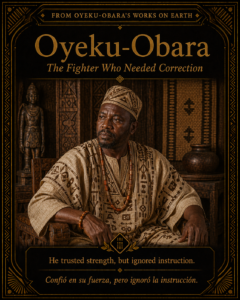
This traditional Ifá story follows Oyeku-Obara, an Ifá priest whose road begins with conflict and ends with correction. He is a person who carries sacred knowledge, but he also carries a strong fighting nature. The story does not present that fighting nature as something to admire. It presents it as something that must be disciplined and brought back under Ifá’s instruction.
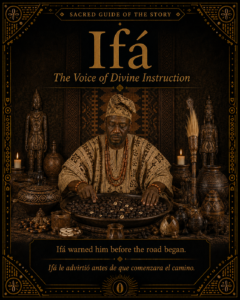
Before Oyeku-Obara travels toward Ògún, he consults Ifá. He receives a clear warning: he should not proceed unless he first serves his head and Èṣù. But he dismisses the sacrifice because he trusts his past strength in combat. He has fought before. He has not been overcome before. So he places confidence in past success instead of present divinatory guidance.
The story then carries him through disorder, hiding, the wisdom of a Boa, smoke, capture, public authority, the hidden power of Uja, renewed consultation, and final ritual correction. Its deepest lesson is not that a fighter proves himself stronger than others. Its deepest lesson is that sacred instruction remains unfinished until the required obligation is fulfilled.
4. QUICK TAKEAWAY
Sacred instruction is not complete because it has been heard. It becomes complete when the required obligation is fulfilled.
Oyeku-Obara’s story teaches that strength without restraint can lead to exposure, while correction, humility, and obedience to Ifá restore the road.
5. THE STORY
Oyeku-Obara was an Ifá priest known for a combative nature. He often fought those who crossed his path. One day, he decided to travel to the land of Ògún in order to fight him.
Before beginning the journey, Oyeku-Obara consulted Ifá. Ifá advised him not to proceed unless he first served his head and Èṣù. Oyeku-Obara did not perform the sacrifice. He considered it unnecessary because no previous battle had overcome his fighting ability.
When he reached the town, he found it in great disorder. After asking what had caused the commotion, he learned that someone had just been murdered there. He then hid beside a palm tree.
While hiding, he removed his ìkín from his waist and asked what he should do. His own Odù, Ifá Oyeku Kpalaba, appeared. He was told that the side of the palm tree would not give sufficient protection and that he should hide inside a hole.
Oyeku-Obara entered a concealed hole. Unknown to him, a Boa was already inside. He sat on the Boa’s head. The Boa complained that battle had driven it into the hole and questioned who had dared to sit on its head.
Oyeku-Obara answered that he had entered the hole for refuge because the people of the town were searching for a stranger who had come into their territory. The Boa told him that the people were watchful and would soon search for both of them inside the hole.
Soon afterward, smoke began to enter the hole. The smoke forced Oyeku-kpalaba out. The Boa refused to leave, saying:
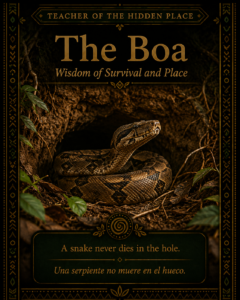
“a snake never dies in the hole”
The Boa then dug further inside the hole and placed its head there to protect itself from the smoke.
When Oyeku-kpalaba came out of the hole, he was apprehended. He warned those who seized him not to arrest, molest, imprison, or kill him because he was an Ifá priest. The source states that it is forbidden to arrest, manhandle, or jail an Ifá priest. Even so, his captors insisted on taking him to the Ọba’s palace.
At the palace, the Ọba asked him to identify himself. He said that he was an Ifá priest and that his name was Oyeku-kpo-bara. The Ọba ordered that a house be prepared for him and that he be persuaded to explain why he had come to the town.
Oyeku-kpo-bara then revealed that he had come to fight Ògún. He was told that the place was not Ògún’s town. It was the town of Uja, the wife of Ògún, who was described as the force and power behind him.
The people then urged Oyeku-kpo-bara to remain in the town and practice Ifá there.
Oyeku-kpo-bara prospered in the town. However, he still did not perform the sacrifice to his head and Èṣù.
Later, he arranged for a wife to be sent to him from his own town. He was told that a bride could not be brought into the town unless he went to another town to marry her. Because of this matter, he consulted Ifá again.
When he consulted Ifá, he was reminded of the sacrifices he had earlier been instructed to perform. He then served his head with a cock and served Èṣù with a he-goat.
After this correction, Oyeku-kpo-bara prospered greatly.
The source then gives further divinatory instructions connected to this Odù. When this Odù appears at Ugbodu, the person should serve Ifá with another goat because of an impending catastrophe. The person should also be told that there is a sick person in the house where the Ifá initiation ceremony is taking place. The initiate should be told never to arrange a wife for anyone because his Ifá forbids it. At ordinary divination, the person should serve Èṣù with a he-goat without delay in order to avoid the danger of attack by robbers.
These instructions belong to the divinatory frame of this Odù. They should not be turned into public ritual procedure or broad modern rules.
6. STORY STRUCTURE
Initial Desire or Condition
The story begins with Oyeku-Obara’s fighting nature. He is an Ifá priest, but he is also described as someone who often fights those who cross his path. His desire to fight Ògún moves the story forward.
Divination Before Movement
Before traveling, he consults Ifá. This places the journey under divinatory authority before it becomes physical movement.
Sacrifice and Warning
Ifá tells him not to proceed unless he first serves his head and Èṣù. This instruction addresses both the person and the road. The head points to inner alignment, judgment, and destiny. Èṣù points to boundary, movement, consequence, and the correct order of action.
Forgotten Obligation
Oyeku-Obara ignores the instruction. He trusts past victories more than the warning he has received. This is the first major fracture in the story.
Exposure and Testing
He enters a town already marked by disorder. Someone has been murdered. He hides beside a palm tree, consults through his ìkín, enters a hole, encounters the Boa, is driven out by smoke, and is apprehended.
Recognition Before Authority
When taken to the Ọba, he identifies himself as an Ifá priest. The Ọba receives him, orders that a house be prepared for him, and asks why he came. Capture becomes a doorway to recognition and accountability.
Redirection
Oyeku-kpo-bara learns that he has not entered Ògún’s town. He has entered Uja’s town. His journey toward conflict is redirected into settlement and Ifá practice.
Ritual Correction
Even after prospering, the original sacrifice remains unfinished. A later marriage-related restriction sends him back to Ifá. He is reminded of the neglected instruction, serves his head and Èṣù, and then prospers greatly.
7. MAIN CHARACTERS AND RELATIONSHIP ROLES
Oyeku-Obara / Oyeku-kpalaba / Oyeku-kpo-bara
Oyeku-Obara is the main figure of the story. He is an Ifá priest with a combative nature. His journey shows the danger of carrying sacred responsibility while still being ruled by pride, aggression, or overconfidence.
The different name forms appear at different points in the story. Oyeku-kpalaba appears during the danger and capture sequence. Oyeku-kpo-bara is the name he gives before the Ọba. These variants are preserved because they appear in the source and require later review.
Ifá
Ifá is the sacred authority that warns, guides, and later reminds Oyeku-Obara of his unfinished obligation. Ifá does not disappear after the first warning is ignored. The instruction remains active until it is completed.
Èṣù
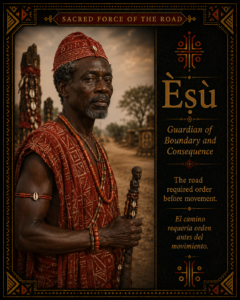
Èṣù is named as a required ritual recipient. In this story, Èṣù is connected to movement, boundary, consequence, and the correct ordering of the road. Èṣù must not be treated as demonic or villainous.
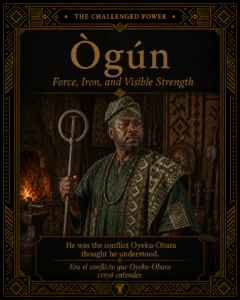
Ògún
Ògún is the figure Oyeku-Obara intends to fight. The expected confrontation never becomes the final purpose of the story. Instead, the road toward Ògún reveals Oyeku-Obara’s lack of preparation and redirects him elsewhere.
Uja
Uja is described as the wife of Ògún and the force and power behind him. She should not be reduced to a passive spouse. In the story, Uja reveals hidden authority and the deeper power behind visible force.
The Boa
The Boa is the animal inside the hole. It is not a monster. It is a teacher through nature. The Boa knows the hidden place in a way Oyeku-Obara does not. Its line, “a snake never dies in the hole,” teaches survival through nature, place, depth, and restraint.
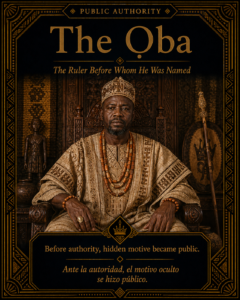
The Ọba
The Ọba is the ruler who receives Oyeku-kpo-bara after his capture. His palace becomes the place where danger is reordered into recognition and accountability.
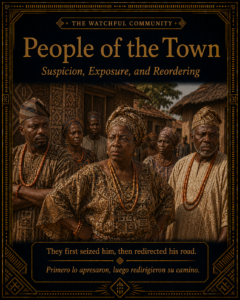
The People of the Town
The people first appear as a force of suspicion and apprehension. Later, they become part of the reordering of the story by explaining the town’s identity and persuading Oyeku-kpo-bara to remain and practice Ifá.
8. HUMAN CONDITIONS REVEALED
Combativeness
Oyeku-Obara is known for fighting. His desire to fight Ògún reveals a pattern of confrontation. The story warns that power without discipline can lead a person into danger.
Overconfidence
He trusts his past victories more than Ifá’s present instruction. This shows the danger of believing that previous success cancels the need for sacred preparation.
Ritual Neglect
He hears the instruction but does not fulfill it. The story carefully separates hearing from completion. What is neglected at the beginning returns later.
Vulnerability
The one who came to fight becomes the one who hides. He hides beside a palm tree, then inside a hole, and is finally driven out by smoke. His vulnerability exposes the weakness of unprepared movement.
Environmental Ignorance
Oyeku-Obara enters both the town and the hole without understanding what is already there. He does not know the town’s crisis. He does not know the Boa is in the hole. The story teaches that not every place can be entered through force.
Accountability
When he is captured, he cannot simply disappear. He must stand before the Ọba, identify himself, and explain why he came. This makes his sacred identity a responsibility, not an escape.
Delayed Correction
Even after he prospers, the sacrifice remains unfinished. The story shows that success is not the same as completion.
9. MORAL AND SPIRITUAL TEACHINGS
The first major teaching is that sacred instruction must be fulfilled, not merely heard. Oyeku-Obara consults Ifá, but consultation alone does not settle the matter. Ifá’s instruction remains unfinished until he completes the required obligation.
The second teaching is that strength without restraint can block blessing. Oyeku-Obara’s fighting nature does not bring him victory. It brings him into disorder, hiding, capture, and accountability. His true correction comes when he returns to Ifá’s original instruction.
The third teaching is that survival is not the same as spiritual completion. Oyeku-kpo-bara survives the danger of the town. He is recognized by the Ọba. He is given a place to live. He practices Ifá and prospers. Yet the first obligation still remains open.
The fourth teaching concerns hidden power. Oyeku-Obara thinks he is traveling toward Ògún, but he arrives in the town of Uja, who is described as the force and power behind him. This shows that visible strength may depend on deeper, relational, household, or hidden authority.
The story should therefore be read as a story of correction, not conquest. Oyeku-Obara’s real victory is not defeating Ògún. His real victory is being redirected away from reckless combat and returned to what Ifá first commanded.
10. SYMBOLS AND SACRED ELEMENTS
The Head
The head is a ritual focus and a sacred center of alignment, judgment, destiny, and personal spiritual order. Oyeku-Obara is told to serve his head before the journey, and later he does so as part of the correction.
Èṣù
Èṣù represents boundary, movement, consequence, and the proper order of action. The story connects Èṣù to the road before the journey and to danger in ordinary divination.
Ìkín
Ìkín appears when Oyeku-Obara removes it from his waist and seeks guidance during danger. This moment shows that divinatory guidance remains necessary when human judgment is not enough.
The Palm Tree
The palm tree is the first hiding place. In this story, it represents insufficient protection. Oyeku-Obara needs deeper guidance than improvised concealment.
The Hole
The hole becomes a place of refuge, hidden danger, and exposure. It shows that concealment is not automatically safety.
The Boa
The Boa is a symbol of environmental wisdom. It survives because it knows its own place and nature. Its teaching contrasts with Oyeku-Obara’s tendency to move outward through confrontation.
Smoke
Smoke forces Oyeku-kpalaba out of concealment. It turns hiding into exposure.
The Ọba’s Palace
The palace is the place of public authority. It changes the meaning of the capture by placing Oyeku-kpo-bara before recognized leadership.
Uja’s Town
Uja’s town reveals hidden authority. Oyeku-Obara thought he understood the conflict, but the town teaches him that he did not understand the deeper structure of power.
11. RITUAL / CEREMONY PUBLIC EDUCATION LAYER
This story preserves ritual importance, but it does not teach ritual procedure.
The source states that Oyeku-Obara was told to serve his head and Èṣù before proceeding on the journey. It later states that he served his head with a cock and served Èṣù with a he-goat. The story also states that when this Odù appears at Ugbodu, Ifá should be served with another goat, and that at ordinary divination Èṣù should be served with a he-goat without delay.
These are ritual and divinatory details, but they are not a public ritual manual. The story names obligation, warning, and correction. It does not provide complete procedure, sequence, authorization, chants, ritual handling, or practitioner instruction.
The public teaching is that ritual obligation matters within the story. Oyeku-Obara’s mistake is not simply that he “missed a sacrifice and was punished.” That is too narrow. His neglected obligation reveals a deeper condition: pride, fighting ambition, and movement without proper alignment.
Any practical ritual explanation would require source verification and practitioner review.
12. PRAYER / REZO / CHANT / SACRED SPEECH STATUS
No explicit prayer, rezo, chant, or súyẹ̀rẹ̀ is preserved in this story segment as sacred speech text.
Because no sacred chant is preserved, this article does not create one.
However, sacred force is still carried through instruction, warning, divination, ritual obligation, taboo, direct speech, and divinatory continuation.
The only direct line preserved from the story is:
“a snake never dies in the hole”
This line is not presented as a chant. It functions as a teaching spoken by the Boa within the narrative.
13. CULTURAL AND DIVINATORY CONTEXT
This story shows that movement should not be separated from divination. Oyeku-Obara does not simply travel. He first consults Ifá. The problem is not that he lacked access to guidance. The problem is that he received guidance and did not complete what was required.
The story also shows that sacred identity carries responsibility. When Oyeku-kpalaba is apprehended, he identifies himself as an Ifá priest. But this does not erase the consequences of his actions. He is still taken before the Ọba. He must still explain why he came. He must still eventually return to the instruction he neglected.
The Boa’s teaching deepens this lesson. Oyeku-Obara enters the hole as a stranger, but the Boa knows the hole as its own place. The snake survives by knowing its environment, its nature, and when to go deeper. This becomes a mirror for Oyeku-Obara, who entered the town without understanding the danger already present there.
Uja’s role also deepens the divinatory teaching. Oyeku-Obara thought the matter was simply about Ògún, but he learns that the town belongs to Uja, the force and power behind Ògún. The story shows that a person may misread a conflict when they do not understand the hidden authority, relationships, and forces behind what they see.
Ugbodu and ordinary divination appear in the closing instructions. These final teachings show that the story is not only narrative memory. It also functions as divinatory guidance when the Odù appears in specific contexts.
These instructions must remain context-bound. They should not be turned into rigid fortune-telling, public ritual procedure, or broad social rules.
14. WHEN THIS ODÙ APPEARS
When this Odù appears, the story may warn about a person who receives guidance but does not complete the required obligation. It may point to a situation where confidence, past success, reputation, or fighting ability causes the person to dismiss sacred instruction.
It may also point to danger connected with movement, conflict, travel, exposure, or entering a troubled place without understanding what has already happened there.
The story may diagnose a pattern where someone thinks they are confronting one visible force, but the deeper structure of power is elsewhere. Oyeku-Obara thought he was going toward Ògún, but he arrived in Uja’s town.
The source itself gives specific divinatory instructions:
- At Ugbodu, Ifá should be served with another goat because of impending catastrophe.
- A sick person in the initiation house is mentioned as part of the warning.
- The initiate should never arrange a wife for anyone because his Ifá forbids it.
- At ordinary divination, Èṣù should be served with a he-goat without delay to avoid attack by robbers.
These instructions belong to the sacred and divinatory frame of this Odù. They should not be generalized into ordinary modern advice.
15. MODERN ETHICAL EXPLANATION
For a modern reader, this story is not simply saying, “A person missed a sacrifice, so danger came.” That reading is too narrow. The story is showing how a pattern of behavior can carry a person toward consequence.
Oyeku-Obara’s pattern is fighting. He is used to conflict. He trusts his ability to win. He moves toward Ògún because that is his nature. But Ifá warns him that the road requires preparation first. He hears the warning and still moves forward.
In modern life, a person may not be going to fight an Òrìṣà, but they may enter a workplace argument, family dispute, public confrontation, community conflict, or spiritual disagreement with the same emotional pattern: “I know how to win. I know how to handle this. No one has defeated me before.”
The story warns that this mindset can be dangerous. Past victory does not mean present wisdom. Strength should not move faster than reflection. Anger should not move faster than guidance. A title, role, education, spiritual gift, or public reputation should not be used to avoid accountability.
The story also includes sensitive themes: murder, capture, death-related warning, marriage restriction, and danger from robbers. These should be handled carefully. The warning about the sick person should not be dramatized as horror or used to blame anyone who is ill. The wife-arrangement prohibition should not be turned into a universal rule about marriage. The warning about robbers should not be exaggerated or treated casually.
The modern ethical lesson is not fear. It is responsibility. When harm or danger is present, safety matters. When conflict is present, restraint matters. When sacred instruction is present, completion matters.
The story teaches that a person can survive danger and still have unfinished obligations. A person can be publicly recognized and still need private correction. A person can prosper outwardly and still carry an unresolved command from Ifá.
16. WHAT MUST NOT BE MISUNDERSTOOD
This story should not be read as a heroic fight story. Oyeku-Obara’s desire to fight Ògún is not the virtue of the story. The virtue is correction.
This story should not be used to present Èṣù as demonic. Èṣù is a sacred force connected to boundary, movement, and consequence.
This story should not present the Boa as a monster. The Boa is a teacher through nature and environment.
This story should not reduce Uja to a passive wife. In the source, Uja is described as the force and power behind Ògún.
This story should not be used as public ritual instruction. It preserves ritual importance, but it does not teach ritual procedure.
This story should not turn Odù-specific warnings into broad modern rules about illness, marriage, women, men, punishment, or danger.
This story should not confuse success with completion. Oyeku-kpo-bara prospered before the original obligation was completed, but the matter was still unfinished.
17. REFLECTION QUESTIONS
- Why does Oyeku-Obara consult Ifá but still ignore the instruction he receives?
- What does the story teach about the difference between hearing sacred instruction and fulfilling it?
- How does Oyeku-Obara’s fighting nature shape the danger he enters?
- What does the Boa’s line, “a snake never dies in the hole,” teach about place, nature, and survival?
- Why is it important that Oyeku-Obara is brought before the Ọba instead of simply escaping?
- What does Uja reveal about hidden power and incomplete understanding?
- Why does prosperity not mean that Oyeku-kpo-bara’s obligation has been completed?
- Which parts of this story require ritual boundary and practitioner review before any practical explanation is attempted?
18. CONCLUSION
Oyeku-Obara’s story teaches that sacred instruction remains active until it is fulfilled. A person may be strong, skilled, publicly recognized, or even prosperous, yet still carry an unfinished command from Ifá.
The story does not ask us to admire the fighting. It asks us to study the correction. Oyeku-Obara enters the road as a fighter, but the road exposes him, redirects him, and eventually brings him back to the obligation he first ignored.
His true resolution is not the defeat of Ògún. His true resolution is the return to Ifá’s instruction. The forgotten obligation is remembered. The head is served. Èṣù is served. And only then does the story come into its final order.
The final teaching is clear: strength without restraint can lead to consequence, but humility, discipline, and completed instruction restore the road.
19. DOWNSTREAM SUMMARY BLOCK
Core Story Tension: Oyeku-Obara’s fighting nature leads him to ignore Ifá’s instruction before traveling toward Ògún.
Core Ritual Dynamic: The story turns on divination, neglected sacrifice, renewed consultation, ritual correction, and divinatory continuation.
Core Character Dynamic: Oyeku-Obara moves from combative confidence to vulnerability, exposure, recognition, settlement, renewed divination, and final correction.
Core Teaching: Sacred instruction is not complete until the required obligation is fulfilled.
Core Divinatory Warning: At Ugbodu and ordinary divination, the source preserves specific warnings connected to Ifá, Èṣù, impending catastrophe, a sick person in the initiation house, wife-arrangement prohibition, and danger from robbers.
Prayer / Sacred Speech Status: No explicit prayer, rezo, chant, or súyẹ̀rẹ̀ is preserved. The direct line “a snake never dies in the hole” is preserved as narrative speech.
Ritual / Ceremony Boundary: Ritual details are source-preserved but partial. The article does not teach procedure. Practical ritual explanation requires source verification and practitioner review.
Modern Ethical Flag: Sensitive themes include violence, murder, capture, death-related warning, marriage restriction, and robbery danger. These must not be generalized, dramatized as horror, or used to blame vulnerable people.
Terms Requiring Diacritic Review: Oyeku-Obara, Oyeku-kpalaba, Oyeku-kpo-bara, Ifa Oyeku Kpalaba, Uja, Ugbodu. Known website forms used where appropriate: Ifá, Odù, Èṣù, Ògún, Ọba, ìkín.
IFAStories Website Story Article Complete
Leave a Reply