Odù Context
This narrative belongs to Baba Ejìogbè and reveals one of the foundational patterns associated with that sacred Odù: before great power is publicly recognized, it is first brought into the proper field of manifestation. In this account, Ejiogbe’s first earthly works do not begin with spectacle for its own sake. They begin with placement, revelation, correction, and the restoration of order.
A central law of the story is that sacred authority does not only solve visible problems. It exposes what is hidden, corrects what is disordered, and returns life to right alignment. That is why this narrative moves from sacred setting into revealed affliction, and from revealed affliction into healing, gratitude, and instruction. Ejiogbe does not simply perform wonders on the road. He establishes a pattern of sacred correction that joins truth, sacrifice, thanksgiving, and moral order.
Story Reference
This article combines three linked narrative units preserved in the Baba Ejìogbè stream of the Ejiogbe traditions: The Earthly Works of Ejiogbe, The Miracle at the Market, and The Miracle of the Cripple and the Blind. Together, these accounts show the beginning of Ejiogbe’s public earthly manifestation: his entry into the shared world where heaven and earth meet, his revelation of a hidden affliction, and his healing of denied suffering on the way to the market.
Introduction
The First Earthly Works of Ejiogbe is a story about sacred emergence, hidden suffering, and the kind of correction that restores more than the body. It begins quietly. Before there is a public miracle, there is a setting. Before there is intervention, there is entry into the right world.
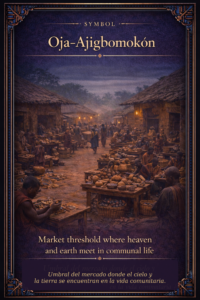
That is what gives this account its depth. The story first places Ejiogbe in Oja-Ajigbomokon, the only market that existed at that time, a place where heaven and earth met and where goods, arts, skills, technologies, and divination were all part of one shared communal order. The narrative is already teaching before the first healing appears: sacred life is not outside human life. It moves within it.
From there, the story becomes more urgent. A woman carrying a hidden burden is stopped and diagnosed before she can speak. A cripple and a blind man are healed after denying their own condition. Yet the story is not merely about wonder. In each case, Ejiogbe does more than intervene. He directs, warns, and reorders. That is why these linked episodes matter in living Ifá understanding. They show that sacred correction is not only about relief. It is about truth, obedience, gratitude, and alignment after help has been given.
Quick Takeaway
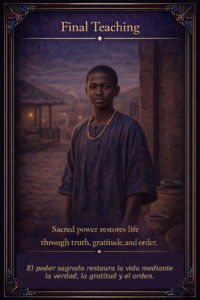
Sacred power becomes visible in the proper field, not in random disorder. In this story, hidden affliction is revealed, denied suffering is corrected, and healing is completed through gratitude, instruction, and right alignment.
The Story
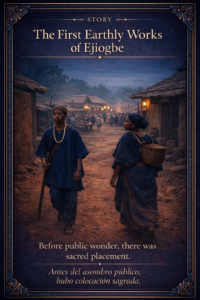
At the age of fifteen, Ejiogbe was taken by his mother to Oja-Ajigbomokon. He had already done many mysterious things while growing up, but this journey marked the first major public phase of his earthly works. The market itself was no ordinary place. It was the only market in existence at that time, and in it, traders from heaven and earth carried out many kinds of exchange. Goods were sold there, but so were arts, skills, technologies, and divination. In this way, the story first establishes the world in which Ejiogbe’s works would become visible. He was not simply traveling. He was entering the field where hidden force would begin to take public form.
But before he even reached the market, the work had already begun.
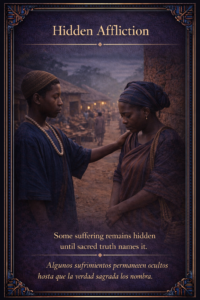
On the way, Ejiogbe met a woman and stopped her. He told her that she had a problem. Before she could explain herself, he told her not to speak, because he already knew the matter better than she did. He then revealed the burden she had been carrying in silence: she had been pregnant for three years, yet the pregnancy had not developed.
Ejiogbe prescribed sacrifice with sixteen snails, one hen, one pigeon, five laughing kolanuts, and honey. He also directed that a he-goat, akara, and eko be offered to Esu. The woman obeyed, brought the required materials, and the sacrifice was performed. After this, Ejiogbe declared that her problem had come to an end. Yet he did not allow the story to end with immediate relief alone. He instructed her that after she had safely delivered, she must bring a small boa in thanksgiving to Orunmila, together with a snail and whatever else she could afford. The serpent was called Oka in Yoruba and Arumwotan in Bini. In this way, the narrative makes one of its deepest points: blessing received through sacrifice must be completed through gratitude.
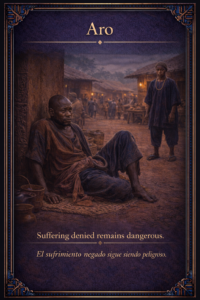
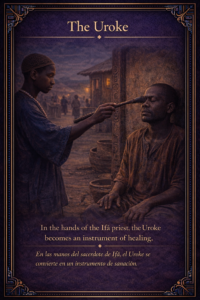
After this, Ejiogbe continued on his way and met a cripple called Aro. He told Aro that he had a problem, but Aro denied it and answered that it was Ejiogbe who had the problem. Ejiogbe then brought out his Uroke and pointed it at Aro’s hands and legs. At once, Aro rose and began to walk. Only then did he realize that Ejiogbe was not an ordinary boy, but a priest, and he knelt in gratitude for the healing of the deformity with which he had been born. Ejiogbe then instructed him to serve Orunmila and warned him never again to conceal his problems, because one does not know when God will answer prayer. He added that if a person concealed an ailment, that ailment might bury the sufferer in the ground. The healing, then, was not only physical. It was moral and spiritual instruction.
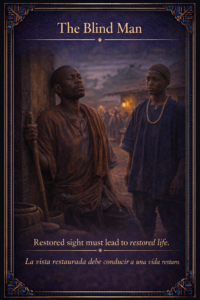
Soon after, Ejiogbe met a blind man and asked him whether he had a problem. The man also denied it. Ejiogbe then stretched out the Uroke toward his eyes, and immediately the man regained his sight. He was filled with joy. But again, Ejiogbe did not leave the matter there. He instructed the man to become a follower of Orunmila so that his troubles with mankind might be reduced, and he told him that when he got home, he should serve his head with a cock. Only after these things did Ejiogbe finally reach the market. And the story carefully notes that he performed these miracles without asking for reward. His acts were not trade. They were sacred correction joined to truth and right order.
Main Characters
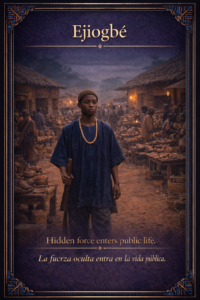
Ejiogbe
Ejiogbe is the central sacred figure of the story. He appears first as a youth already marked by mysterious force, then as revealer of hidden affliction, healer of denied suffering, and authoritative guide who joins intervention to instruction. Spiritually, he represents sacred correction that does not stop at outward change, but restores life to right order.
Ejiogbe’s Mother
His mother plays a brief but essential role. She is the one who brings him into Oja-Ajigbomokon, making the movement from hidden formation to public manifestation possible. Spiritually, she represents transitional mediation: the force that carries hidden destiny into the place where it can be seen.
The Woman on the Road
The woman represents hidden affliction carried in silence for too long. Her role is important because her case shows that some conditions require revealed diagnosis, exact ritual order, and remembered thanksgiving. Her story teaches that relief may begin with sacrifice, but it is completed by gratitude.
Aro
Aro is the cripple healed on the road. His condition is visible, but he still denies it. This makes him a powerful figure of resisted truth. After healing, he becomes a figure of recognition, gratitude, and warning, because his story shows that denied suffering remains dangerous until it is exposed and corrected.
The Blind Man
The blind man confirms and deepens the pattern already established with Aro. He also denies his condition, is healed through the Uroke, and is then instructed to reorder his life through service, following Orunmila and serving his head. His role shows that healing is not self-sufficient. It must be followed by alignment.
Esu and Orunmila
Esu and Orunmila show that sacred correction has direction and order. Esu receives a specific offering within the woman’s sacrificial sequence, while Orunmila receives thanksgiving and becomes the axis of life after healing. Their presence prevents the story from being reduced to general spirituality. It is structured, relational, and exact.
Moral and Spiritual Teachings
One major teaching in this story is that sacred destiny often exists before public proof. Ejiogbe is already a wonder-child before his public works fully appear. The story therefore teaches that hidden force may already be active long before the world knows how to name it.
A second teaching is that some afflictions require revealed diagnosis. The woman’s condition is not corrected by guesswork, vague sympathy, or general desire. It is named clearly and treated through precise sacrifice. The story insists that sacred order matters.
A third teaching is that gratitude completes restoration. Ejiogbe does not allow the woman’s relief to stand by itself. Safe delivery must be followed by thanksgiving to Orunmila. In this way, the story teaches that blessing should not end in forgetfulness.
A fourth teaching is that denial deepens danger. Both Aro and the blind man deny having a problem. Ejiogbe’s warning is severe: concealed ailment does not become harmless because it is denied. It may instead bury the sufferer in the ground.
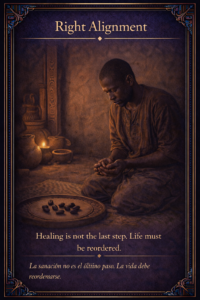
Finally, the story teaches that healing must lead to alignment. Both healed men are directed toward Orunmila, and the blind man is told to serve his head with a cock. Restoration is therefore not the final step. It is the beginning of reordered life.
Symbols and Sacred Elements
One of the strongest sacred symbols in this narrative is Oja-Ajigbomokon. It is more than a market. It is a threshold where heaven and earth meet within communal life, the field in which destiny becomes publicly legible. By placing Ejiogbe there, the story teaches that sacred manifestation does not occur outside the world, but within an ordered communal setting.
The woman’s undeveloped pregnancy symbolizes hidden blockage, prolonged delay, and suffering that cannot be resolved without revelation and order. It is not only a personal affliction. It becomes an image of a condition that remains suspended until sacred diagnosis and correction are given.
The Uroke symbolizes direct sacred intervention. In both healings, it is the focused instrument through which bodily restoration takes place. Its repeated use shows that correction is not vague or accidental. It is deliberate, exact, and authoritative.
The later thanksgiving offering shows that blessing should not end in forgetfulness. It embodies remembered obligation and the completion of received help. In this way, the story teaches that relief alone is not the final step. Gratitude is part of restoration.
Finally, service to Orunmila and service to the head show that healing is not the last step. The restored life must be reordered. What is corrected outwardly must also be aligned inwardly and spiritually.
Divinatory Pattern
This narrative does not preserve a single ritual law in the same direct form as some other Baba Ejìogbè stories, but it does leave a clear divinatory pattern.
First, it shows that proper placement matters. What is hidden may already be real, but it still requires the right environment in order to become visible and effective.
Second, it shows that long-standing blockages may require exact instruction. The woman’s affliction is not treated casually. Diagnosis, sacrifice, offering, and thanksgiving each have their place.
Third, it shows that correction must be followed by ordered life. Healing is not treated as spectacle. It creates obligation: gratitude, service to Orunmila, truthfulness about one’s condition, and alignment of the head. In that sense, the story functions divinatorily as a warning against delay, concealment, forgetfulness, and disorder after help has already come.
When This Odù Appears
When this Odù appears, this story may point to something important that is present but has not yet entered the proper field of recognition. It can suggest hidden ability, hidden calling, or sacred formation that is real even before it becomes publicly visible.
It may also warn about a condition that has lasted too long without proper diagnosis. One lesson drawn from the woman’s story is that long unresolved burdens may require revealed order, exact obedience, and seriousness rather than general effort alone.
This story may also confront denied vulnerability. A person may be suffering openly and still refuse the truth of the condition. The story warns that denial does not remove danger.
Finally, it may indicate that relief is not the same as completion. Help may come, but what follows still matters: thanksgiving, service, truthfulness, and the reordering of life after intervention.
Reflection Questions
Why does the story begin with sacred setting before it moves into miracle?
What does Oja-Ajigbomokon represent beyond being a market?
Why is it important that the woman’s condition is revealed before she speaks?
What is the difference between immediate relief and completed restoration in the woman’s story?
Why do both Aro and the blind man deny having a problem?
Why is Ejiogbe’s warning against concealment so severe?
What does the Uroke represent in these acts of healing?
Why does healing in this story always lead into service, gratitude, or alignment afterward?
How does this narrative show that sacred power restores order, not just conditions?
Conclusion
The First Earthly Works of Ejiogbe is not a random collection of wonders. It is a structured beginning.
First comes placement. Then comes revelation. Then a warning. Then sacrifice. Then relief. Then gratitude. Then healing. . Then right alignment.
That sequence is the wisdom of the story. Ejiogbe does not reveal sacred power merely by changing outward circumstances. He reveals it by restoring life to order. Hidden destiny is brought into the proper field. Hidden affliction is exposed. Denied suffering is corrected. And healing becomes complete only when it is joined to gratitude, instruction, and spiritual reordering.
That is why this story matters in living Ifá understanding. It teaches that truth must interrupt what is hidden, that blessing must be remembered, and that sacred correction is not only about rescue. It is about making life rightly ordered again.
Source Reference
This narrative is drawn from the Baba Ejìogbè material preserved in IFISM: The Complete Work of Orunmila by Mr. C. Osamaro Ibie. In this article, the combined account is presented within the framework of traditional Ifá practice, sacred study, and cultural preservation.
This adaptation treats the account not as fiction, but as part of the living wisdom of Ifá. It is respectfully presented for spiritual education, reflective study, and the continuity of Yoruba sacred knowledge.
Leave a Reply