


Odù Context
This story belongs to Èjìogbè, the Odù that often reveals how sacred truth appears before visible consequence. In this narrative, danger is not allowed to arrive without warning, and destruction does not come without prior instruction. The squirrel is warned. The boa is warned. The thick bush is warned. The palm-tree is warned. What separates them is not access to knowledge, but the way each one responds to it.
One of the deepest teachings of this Èjìogbè pattern is that warning is already mercy. Sacred counsel comes before open disaster. Correction is prescribed before exposure occurs. Because of that, the story is not merely about punishment. It is about the seriousness of divine instruction, the danger of delay, and the consequences of failing to respond when help has already been given.
Story Reference
This narrative is drawn from the Baba Ejìogbè section of IFISM: The Complete Work of Orunmila by Mr. C. Osamaro Ibie. In this article, the story is presented within the framework of traditional Ifá practice, sacred study, and cultural preservation.
This adaptation treats the account not as fiction, but as part of the living wisdom of Ifá. It is respectfully presented for spiritual education, reflective study, and the continuity of Yoruba sacred knowledge.
Introduction
Some Ifá stories begin with visible crisis. Others begin earlier, at the hidden moment when mercy has already spoken but consequence has not yet arrived. This story belongs to the second kind. Its weight lies not only in what happens later, but in the fact that instruction is clearly given before danger becomes visible.
In this account, Ejiogbe encounters several beings on the road and tells each one what must be done. The squirrel is warned. The boa is warned. The thick bush is warned. The palm-tree is warned. Yet their endings are not the same, because their responses are not the same. One acts in time and is preserved. Others refuse, delay, or fail to maintain the sacred condition that was required.
The story reaches even deeper than a lesson about sacrifice alone. It places two powers of speech side by side. In one moment, sacred utterance helps a woman safely give birth. In another, speech exposes concealment, breaks protection, and leads directly to death. In this way, the narrative teaches not only about ritual obedience, but also about the spiritual responsibility of the mouth.
Quick Takeaway
In Èjìogbè, warning becomes protection only when it is obeyed in time. Timely sacrifice preserves, while refusal, delay, and careless speech turn hidden danger into open destruction.
The Story
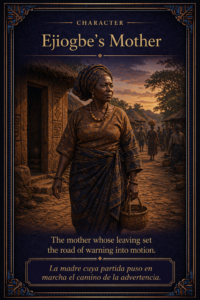
On the way home from the market, Ejiogbe was left behind by his mother. As he continued alone on the road, he first came upon the squirrel, known as OTAN in Bini and Okere in Yoruba. He warned the squirrel to make sacrifice to Esu with a he-goat so that the words from its own mouth would not become the cause of its destruction. The squirrel rejected the warning and treated it lightly.
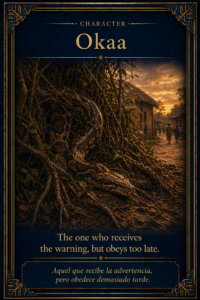
Ejiogbe then met the boa, called Okaa in Yoruba and Aru in Bini. He warned the boa that death was near and that it would come through a talkative neighbour. To prevent that calamity, he instructed the boa to serve his head privately with a snail and not to allow anyone to answer “Amen” while he was praying. This was not a general instruction. It was exact, guarded, and conditional.
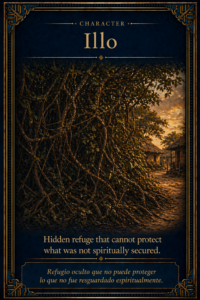
After this, Ejiogbe met the thick bush, known as Eti in Bini and Illo in Yoruba, and instructed it to offer a he-goat to Esu so that it might avoid unwarranted trouble. He also met the palm-tree and told it to make sacrifice so that another being’s problem would not break its neck. The palm-tree obeyed immediately. Illo did not. From the beginning, the story establishes the difference between timely obedience and neglected counsel.
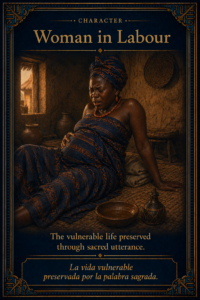
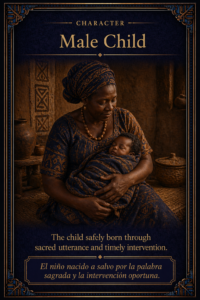
When Ejiogbe returned home, he received word that the woman he had earlier met on the way to the market was in labour. He went quickly to her house and delivered her through sacred utterance. The source notes that the exact incantation is not reproduced. The woman safely gave birth to a male child. This episode is important because it shows speech functioning as life-giving power before the narrative later shows speech functioning as exposure and destruction.
As soon as the woman delivered, her husband took his hunting boomerang, called Ekpede in Bini and Egion in Yoruba, and went into the forest looking for the boa and for meat to feed his wife. When the boa heard that the woman had delivered, he understood that the danger Ejiogbe had foretold was now close at hand. Only then did he go into the house of Illo so that he could serve his head in secret. His obedience came, but it came late.
While the boa was there praying to his head, the squirrel entered Illo. As the boa prayed, the squirrel repeatedly answered, ASE, ASE. The boa objected, because he had been instructed not to allow any Amen response during the ritual. The squirrel then changed its voice and began to sing: “Okaa, Jokoo Kpekpe re kpe.” The source preserves the line but does not provide a translation. The effect, however, is unmistakable: the boa’s hidden location was being made known.
The hunter heard the squirrel’s shouting and followed the sound to its location. As the squirrel continued to cry out, the boa killed it. But the hunter then cut a fork-stick, cleared the thick bush, found the boa on the ground, and killed him also. Beside the boa lay the dead squirrel and the snail with which the boa had intended to serve his head. Hidden ritual had become public exposure, and delayed correction had failed to preserve life.
After the weeds were cut away, the palm-tree rejoiced and received relief, because it alone had made sacrifice at the proper time. For that reason, the story explains that the mouth of the squirrel is what kills it, and that the same mouth reveals where the boa is hiding and brings death upon him as well. The account then extends into divinatory teaching, showing that the narrative is meant to instruct future interpretation, not merely retell an old event.
Main Characters
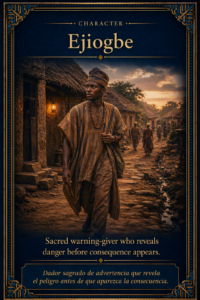
Ejiogbe
Ejiogbe is the sacred warning-giver and revealer of hidden danger. He sees what is coming before others do, and he gives exact instructions for correction. His role also goes beyond warning, since he delivers the woman in labour and shows that sacred authority can preserve life as well as diagnose disorder. Spiritually, he represents revealed truth joined to corrective wisdom.
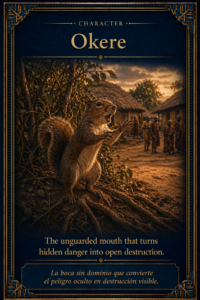
The Squirrel / OTAN / Okere
The squirrel is the clearest figure of refusal and destructive speech. It rejects sacrifice outright, later interrupts the boa’s prayer, and finally reveals the boa’s location through its own voice. In spiritual terms, it represents the ungoverned mouth, the careless tongue, and speech that turns protection into exposure.
The Boa / Okaa / Aru
The boa is warned clearly, but he delays action until danger is already near. He does not entirely reject the instruction, yet his correction comes too late. He stands as a figure of delayed obedience, showing that knowing the remedy is not the same as applying it in time.
Illo / The Thick Bush
Illo is both a being in the story and a place of concealment. It receives warning, fails to sacrifice, and later becomes the hiding place where the boa attempts protection. In the end, it is cut open. Spiritually, Illo shows that concealment cannot protect what sacrifice has failed to secure.
The Palm-Tree
The palm-tree is the story’s positive contrast. It hears, obeys, and sacrifices at once. Later, when the bush is cleared away, it alone receives relief and rejoices. It stands as the clearest proof that timely obedience changes outcome.
The Woman and the Hunter
The woman in labor introduces the life-preserving side of sacred utterance. Her husband, the hunter, becomes the worldly agent through which neglected warning turns into visible consequence. Together, they connect healing, need, provision, and judgment in a single narrative movement.
Moral and Spiritual Teachings
One major teaching in this story is that warning is mercy. None of the figures are overtaken without prior instruction. The squirrel is told. The boa is told. Illo is told. The palm-tree is told. The difference lies in how each responds. The story therefore rejects the idea of random fate. Outcome unfolds through response.
A second teaching is that timing matters. The palm-tree obeys at once and is preserved. The boa acts only when danger is already approaching. The squirrel rejects the warning outright. These are not treated as equal failures. The narrative carefully distinguishes refusal, delay, and immediate obedience.
A third teaching concerns the moral power of speech. Sacred utterance helps deliver the woman safely in childbirth, yet careless utterance later exposes the boa and brings death. Speech in this story is not neutral. It can protect life, or it can destroy it. The mouth is therefore treated as a spiritual responsibility.
A fourth teaching is that ritual protection depends on proper condition. The boa’s instruction is not simply to pray or to offer a snail. He is told to do it privately and without interruption. The failure of that guarded condition becomes part of the collapse. The story makes clear that sacred action must be done rightly, not merely attempted.
Finally, the narrative teaches that one may suffer from another being’s disorder. The palm-tree is warned so that another problem will not break its neck. This is one of the story’s subtler lessons: not every burden begins from one’s own direct wrongdoing. Some dangers come through surrounding disorder unless protection is made in time.
Symbols and Sacred Elements
The mouth is one of the strongest symbols in the story. In the squirrel, it becomes the cause of destruction. It reveals what should have remained hidden and turns danger into death. The narrative treats careless speech not as a minor fault, but as a spiritually serious act.
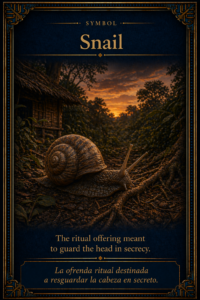
The snail represents ritual precision. It is the exact material prescribed for the boa’s private head-service. Its presence beside the dead boa at the end is especially powerful, because it shows that knowing the ritual material is not enough when the time and condition have already been broken.
The head-service represents guarded destiny. The instruction to serve the head privately shows that sacred correction sometimes requires protected boundaries, not public participation. What is holy is not always meant to be interrupted, echoed, or exposed.
The palm-tree symbolizes preserved stability through obedience. It stands upright when others fall because it responded while warning was still mercy and before danger became visible.
The fork-stick and the cutting open of Illo symbolize forced exposure. What was hidden is laid bare once sacred protection has failed. Concealment is shattered, and the truth of neglected instruction becomes visible in the open world.
Divinatory Pattern
This Èjìogbè teaching leaves a clear divinatory pattern. First, danger may already be present even before it appears on the surface. Second, the correction may already be known, but response may still be delayed. Third, outcome depends not only on hearing the remedy, but on carrying it out in time and under the right sacred condition.
The story also suggests warnings about destructive speech, broken ritual privacy, delayed correction, and burdens that come through surrounding disorder. In that sense, it functions as more than narrative memory. It becomes practical spiritual instruction, showing how hidden danger becomes visible consequence when sacred counsel is neglected.
When This Odù Appears
When Èjìogbè appears through this teaching, it may point to a condition in which a person already knows what must be done but has not yet acted. The danger may still be hidden, yet the story suggests that hidden trouble is often already moving before it becomes visible.
This appearance of Èjìogbè may warn against ignored counsel, delayed sacrifice, careless or destructive speech, broken boundaries around private healing work, and burdens entering one’s life through the disorder of others. It also teaches that the difference between preservation and destruction is not knowledge alone, but timing, obedience, and the faithful keeping of sacred condition.
Reflection Questions
Why does the story treat warning as mercy rather than fear?
What is the difference between refusing instruction and obeying too late?
Why is the squirrel’s speech treated as spiritually dangerous rather than merely troublesome?
What does the boa’s failure reveal about timing and ritual condition?
Why is the palm-tree the only one left in relief?
How can another being’s disorder become a burden in one’s own life?
What does this story teach about the responsibility of the mouth?
Conclusion
The power of this Èjìogbè story lies in its clarity. Warning is given. Instruction is made plain. The outcomes differ because the responses differ. One obeys and is preserved. Others refuse, delay, or violate the condition that was required. The lesson is not hidden: sacred knowledge must be answered.
It is also a story about the seriousness of speech. The same narrative world that allows sacred utterance to deliver life also shows how careless utterance can expose and destroy. In the end, the teaching is unmistakable: warning is already grace, but grace must be answered. What is corrected early may still be preserved. What is ignored often returns later in visible consequence.
Leave a Reply