Odù Context
This narrative belongs to Baba Ejìogbè and reveals one of the clearest sacred patterns associated with that foundational Odù: life is preserved when hidden destruction is interrupted by timely truth. In this account, the birth of the child does not simply mark a beginning. It becomes the moment in which concealed danger is exposed, mutual retaliation is stopped, and salvation is transformed into lasting ritual memory.
A central law of the story is that sacred warning can preserve life before catastrophe is completed. The child later named Ejiogbe does not arrive merely to be born. He arrives to save. That is why the story moves beyond household conflict and ends in ritual instruction. What was rescued in the moment becomes something remembered in sacred form.
Story Reference
This article is based on a narrative preserved in the Baba Ejìogbè section of IFISM: The Complete Work of Orunmila by Mr. C. Osamaro Ibie. The account tells how a day-old child saves both parents from hidden retaliation, reveals the truth behind their actions, and becomes the reason a lasting ritual instruction is remembered in doubled form.
Introduction
The Birth of Ejiogbe is a story about danger inside the household, sacred warning at the threshold of destruction, and the way one moment of salvation becomes lasting ritual law. It begins with a husband and wife already living under strain. Their child is born into that tension, but the birth does not calm the house. Instead, it becomes the moment in which what was hidden is brought to light.
What makes this account especially powerful is that the danger does not first come from an enemy outside the home. It comes from two people already bound to one another. Each carries a personal prohibition. Each becomes vulnerable through that prohibition. And each, in turn, becomes willing to use the other’s vulnerability as a weapon.
Yet the story does not end in mutual destruction. A day-old child intervenes before either parent can complete the act. Through that intervention, the story reveals one of its deepest teachings: sacred warning can preserve life before catastrophe is finalized. What is saved in the moment is later preserved in ritual, so that the lesson is not forgotten.
This is why the story matters in living Ifá tradition. It is not only a narrative about a miraculous child. It is an account of how truth interrupts hidden violence, how order returns after disorder, and how a birth event becomes ritual instruction.
Quick Takeaway
Hidden retaliation destroys order, but sacred warning can preserve life before the damage is complete. In this story, the saving of two lives becomes the reason Ejiogbe is remembered through doubled ritual materials.
The Story
Afin, the wife of Orisa Nla, became pregnant on earth. Orisa Nla forbade palm wine, while Afin forbade salt. The pregnancy did not remove the tension between them, and Afin became more pugnacious as the months advanced.
After nine months, she gave birth to a male child. Soon after the delivery, Orisa Nla saw that there was no food in the house for the nursing mother. He went to the farm to bring back yams, okro, and vegetables. He returned later than expected, and this angered Afin. She complained that he had left her hungry on the very day she delivered and took it as proof that he had no love for her.
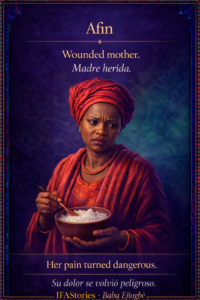
Afin then resolved to end the marriage by ending his life. Knowing that Orisa Nla forbade palm wine and that drinking it could end his life, she put palm wine into his drinking water pot. After doing so, she left the day-old child on the bed and went out to visit her neighbours.
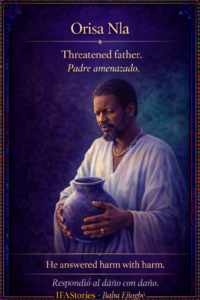
When Orisa Nla returned from the farm, he began to prepare food for his wife. While the yam was on the fire, he went into the room and used his traditional cup, a snail’s shell, to take water from the pot into which palm wine had been put. As he was about to drink, the day-old child spoke and warned him not to drink the water because his mother had added palm wine to it. Orisa Nla was surprised that a child of one day could speak, but he obeyed the warning.
He finished the cooking, but in retaliation he added salt to the soup, knowing that salt was forbidden to his wife. He then kept the food for her and went out to play Ayo with his friends.
When Afin returned, she went to the place where her food had been kept. As she was about to eat, the child spoke again and warned her not to eat the food because her father had added salt to the soup. After hearing this, Afin became hysterical and called on the neighbours to save her from a husband who was trying to kill her for bearing him a child. Her cries drew spectators from the neighbouring houses.
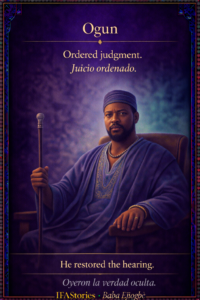
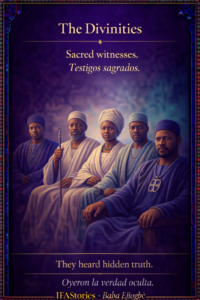
A meeting of the divinities was then convened in the house of Orisa Nla. He was called back from where he was playing Ayo, and he remained calm even while Afin held onto him and tore at him. Ogun took the chair at the conference because Orisa Nla, who would ordinarily preside, was himself the one being accused.
Ogun invited Afin to state what had happened. She said that her husband had added salt to her food even though he knew that salt was forbidden to her. When she was asked how she knew that salt had been added and how she knew that he was the one who had done it, she said that her day-old infant child had told her. The divinities thought she was mad because they could not understand how a child of one day could speak to its mother.
Orisa Nla was then invited to answer the accusation. He confirmed that he had indeed added salt to the soup, but said that he had done so in retaliation for what his wife had already done to him that same day. He accused Afin of putting palm wine into his drinking water pot even though she knew that palm wine was forbidden to him. When he was asked how he knew this, he said that his day-old child had warned him not to drink from the water pot because his mother had added palm wine to it.
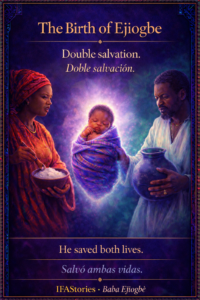
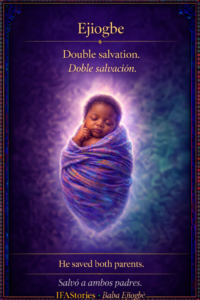
All eyes then turned to the child, who was already being regarded as a mysterious being. Without being directly asked, the child supplied the missing explanation by declaring why he had come. The meaning of his declaration was that he had come into the world to save the lives of both of his parents, and that this was why he warned each of them and prevented their mutual destruction.
Seven days later, when the child was to be named, his parents called him EJIOGBE, that is, Double Salvation.
Sacred Lines
Orisa koi mu emo. Afin koi je iyo.
Eji mogbe mi ogbe enikon.
Translation of the Sacred Declaration
He came to the world to save the lives of his two parents, and that is why he gave each of them the warning that preserved them from mutual destruction.
Divinatory Instruction
Because this was the first earthly work of Ejiogbe, when Ejiogbe comes out during initiation ceremony at Ugbodu, all sacrificial materials are required to be produced in doubles.
The prescribed materials are:
- 2 goats
- 2 hens
- 2 snails
- 2 fishes
- 2 rats
When Ejiogbe comes out at Ugbodu, salt and palm wine are also added to the initiation materials in commemoration of the events that took place on the day Ejiogbe was born.
Main Characters
Afin
Afin is the wife of Orisa Nla and the mother of the newborn child. Her anger after childbirth becomes the first active movement toward destruction. Spiritually, she reveals how emotional injury can become dangerous when it is not restrained. Her role in the final outcome is essential because one half of the child’s double salvation is her own life.
Orisa Nla
Orisa Nla is both husband and father, and in the story he appears first as provider, then as endangered husband, then as retaliator, and finally as respondent in the hearing. His significance lies in showing that status and authority do not remove vulnerability or moral exposure. He helps complete the story’s meaning because he is the second life preserved.
The Child Later Named Ejiogbe
This miraculous child is the central figure of the story. Though only one day old, he speaks, reveals hidden acts, saves both parents, and explains the reason for his coming. Spiritually, he stands as the vessel of timely salvation and truth. His function in the final outcome is decisive: without him, there is no rescue, no naming, and no ritual continuation.
Ogun
Ogun serves as the presiding authority when the case is brought before the divinities. Because Orisa Nla is himself implicated, Ogun takes the chair. His significance lies in restoring order and making formal hearing possible. He represents structured judgment rather than chaos.
The Divinities
The divinities gather as the hearing body. They are witnesses, evaluators, and part of the public sacred recognition of the event. Their role helps move the story beyond a private quarrel into a matter of communal and spiritual significance.
Moral and Spiritual Teachings
One of the clearest teachings in this story is that hidden violence destroys order from within. The danger does not come first from war, strangers, or open enemies. It comes from inside the household, through secrecy and retaliation. This makes the story especially serious, because it shows how the place meant for nourishment and continuity can become the place of danger.
The story also teaches that suffering does not automatically make a person righteous. Afin’s pain is real, but her pain does not justify her action. Orisa Nla is endangered, but even that does not justify his retaliation. The story does not flatten moral responsibility into a simple innocent-versus-guilty pattern. It shows both parents entering disorder.
Another major teaching is that sacred warning can preserve life before destruction is complete. The child does not save one parent against the other. He saves both. This matters. His role is not partisan. It is corrective, revelatory, and life-preserving.
The final teaching is that true sacred events do not remain at the level of memory alone. They become ritual instruction. The doubled materials at Ugbodu, along with salt and palm wine, preserve the meaning of the story in repeated form. Ifá remembers not only by telling but also by doing.
When This Odù Appears
When this Odù appears, this story may warn about conflict inside close relationships that has moved beyond complaint and toward hidden retaliation. It can point to a condition in which each side has become vulnerable, injured, or reactive, and where silence is no longer safe because danger may already be prepared.
This story may also point to a situation in which the real threat is not open hostility but concealed action. One lesson drawn from this account is that what destroys a household is not always the visible quarrel. Sometimes it is the hidden act carried out in the middle of ordinary life.
It can also suggest that timely warning is present but must be obeyed quickly. In the story, salvation comes before consumption, not after. So when this Odù appears, it can point to the need to listen carefully to correction before consequences become irreversible.
It may further indicate that a matter requires reordering through witness, authority, or formal truth. What begins inside the house may need to be examined in a wider moral or spiritual frame. Above all, this story warns against mirrored retaliation and points toward preservation of life over revenge.
Reflection Questions
Why does the story begin by emphasizing the prohibitions around palm wine and salt?
What does the story reveal about the danger of turning emotional injury into hidden retaliation?
Why is the child’s role more than simply miraculous speech?
How does the story change once the conflict moves from the household into public and divine hearing?
Why is “Double Salvation” the right name for the child in structural terms?
What is the significance of the story continuing into Ugbodu rather than ending with the child’s naming?
How do palm wine and salt function both as dangerous substances and as ritual memory?
What kinds of modern situations reflect the pattern of hidden mutual destruction found in this story?
Conclusion
The Birth of Ejiogbe is a story of severe household danger, but it is also a story of timely rescue. Two parents move toward destruction through secrecy and retaliation. A child, one day old, stands between them and interrupts what neither of them can see clearly enough to stop alone.
Its lesson is not shallow comfort. The story is stern. It shows that pain does not excuse wrongdoing, and that being wronged does not justify revenge. But it also shows that sacred warning can arrive before life is lost, and that obedience in that moment matters.
What was saved on the day of the child’s birth did not remain a private memory. It entered ritual law. That is why the story continues to matter. It teaches that truth can expose hidden harm, preserve life, and turn one moment of rescue into lasting sacred remembrance.
Source Reference
This narrative is drawn from the Baba Ejìogbè section of IFISM: The Complete Work of Orunmila by Mr. C. Osamaro Ibie. In this article, the story is presented within the framework of traditional Ifá practice, sacred study, and cultural preservation.
This adaptation treats the account not as fiction, but as part of the living wisdom of Ifá. It is respectfully presented for spiritual education, reflective study, and the continuity of Yoruba sacred knowledge.
Leave a Reply