ODÙ CONTEXT
This story belongs to the sacred stream of Oyekun Iroso, where hidden danger, spiritual protection, ritual timing, and the reversal of harmful force become central teachings.
At the heart of this account are two sons and two lines of power.
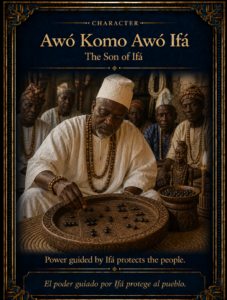
One is the son of Ifá, who stands under the authority of Orunmila. His power is not used to frighten the people. It is used to feed them, strengthen them, cleanse the land, and protect the community through sacred order.
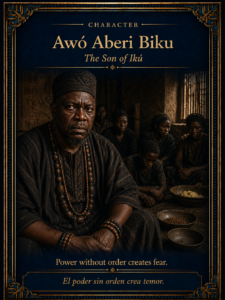
The other is the son of Ikú, Awó Aberi Biku. His power is connected to fear, restriction, and instability. The people around him do not live in fullness. They live under anxiety and limitation.
This contrast is one of the deepest teachings of the story. It shows that spiritual power must be judged not only by its force, but by what it produces. Power aligned with Ifá brings order, protection, and communal well-being. Power driven by fear may appear strong, but it cannot create lasting peace.
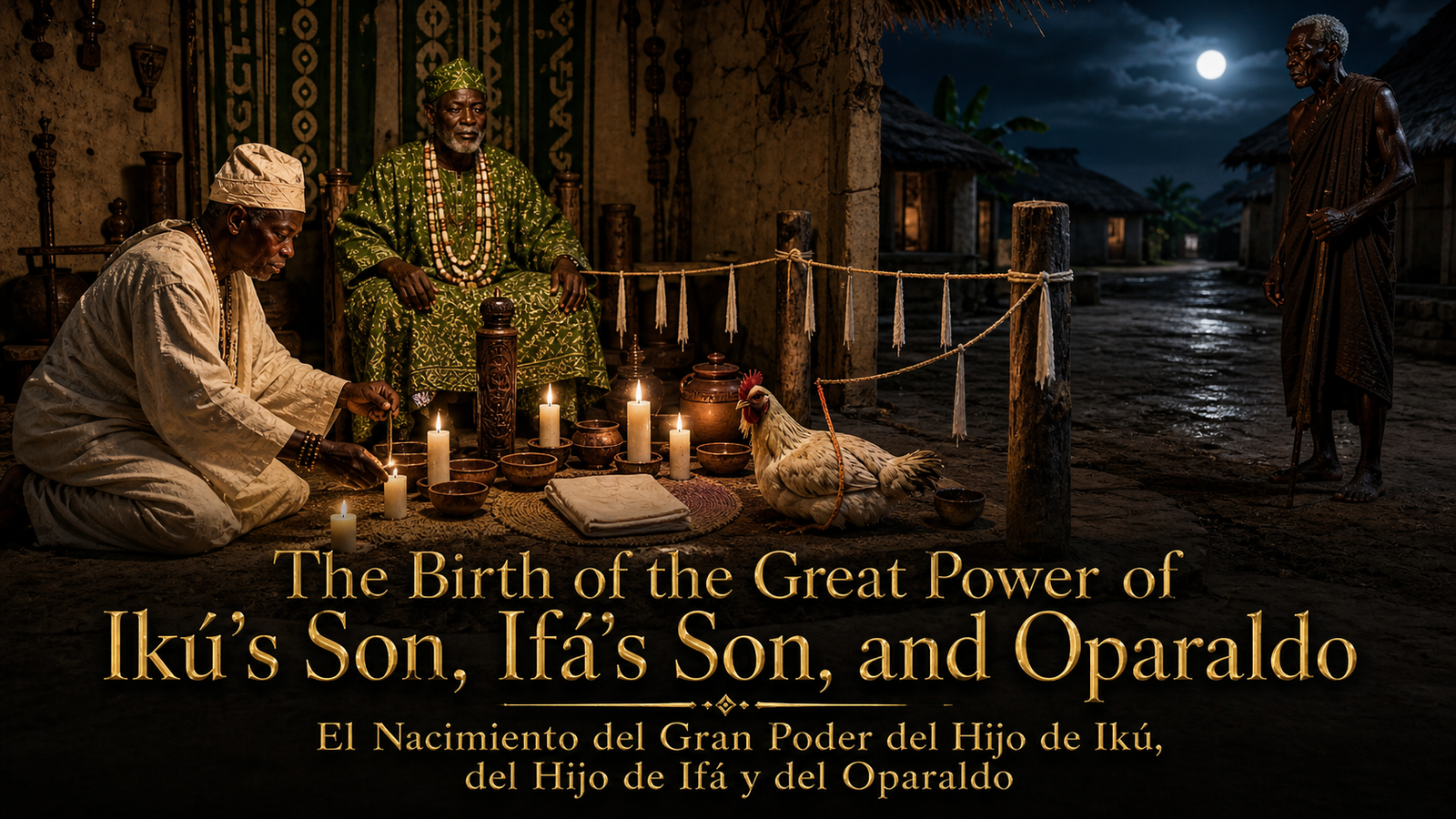
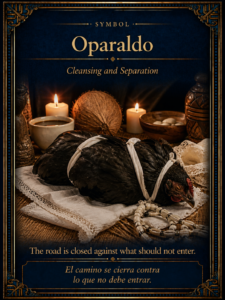
This Odù also reveals the birth of oparaldo as a sacred response to danger. When Ikú moves against the people, Ifá provides a ritual means of protection: the tied hen, the coconut, the candles, the cloth, and the rite that blocks death-force from entering the protected space.
STORY REFERENCE
This retelling draws on a traditional account preserved in Caminos de Ifá, edited by Ernesto Valdés Jane under Proyecto Orunmila, a collaborative Cuban project dedicated to collecting, comparing, preserving, and publishing Osha-Ifá source materials.
The narration, adaptation, and commentary presented here are original to IFAStories.
This article presents the account for spiritual education, cultural preservation, and reflective study. It is not offered as ritual instruction or as a substitute for proper guidance from initiated elders within the tradition.
INTRODUCTION
Some Ifá stories reveal danger through open conflict. Others reveal it through what is hidden, prepared in secrecy, and timed to arrive when the people are most vulnerable.
This story begins in the land of Abonire, where the son of Ifá performs sacred work for the people. After they eat, they fall asleep, and while they sleep, he performs his great secret with adié dundún, the black hens. Through Ifá, sacrifice, sacred speech, and ashé, he gives strength and virtue to the land.
But another power watches from the side of resentment.
Ikú sees that his son, Awó Aberi Biku, no longer holds the power he once had as an Awó. This wounds Ikú deeply, not only because his son has lost authority, but because a father’s pride is tied to the strength of his lineage. Ikú does not simply want power for himself. He wants his son to be feared, recognized, and restored.
This is why the relationship between Ikú and his son matters. Ikú acts from attachment, shame, and resentment. When Obatalá asks him why he has given so little power to his own son if he possesses so much power in the world, the question exposes the imbalance. Ikú’s response is not humility. He seeks a hidden work through Osain.
On the other side, the relationship between Orunmila and the son of Ifá is different. The son of Ifá does not stand alone. His authority comes through obedience, divination, and alignment with Ifá. When danger approaches, he does not invent his own defense. He goes before Ifá, receives instruction, and follows it with precision.
This makes him not only a powerful Awó, but a true son of Ifá: one who protects the people by listening before acting.
This is not only a story about conflict. It is a teaching about how hidden danger is exposed, how spiritual order answers destructive force, and how what was prepared for harm can be brought under the authority of Orunmila and transformed into a great secret.
QUICK TAKEAWAY
Power that protects life is different from power that rules through fear.
Ikú moves to restore his son’s power through secrecy and danger. The son of Ifá protects the people through divination, sacrifice, candles, coconut, cloth, the tied hen, and oparaldo.
This story teaches that Ifá provides sacred means of defense when danger moves in secret, and that rightful authority can reveal, judge, and transform what was prepared for harm.
THE STORY
Rezo
Oyeku Biroso Awó Kome Awó Ifá Abinere Awó Komo Awó Akeremi Ikú Awó Komo Awó Aye Adié Dundún Abonire Kumo Awó Paka Do Obani Shawe Komo Awe Ikú Aberikunlo Ona Baramiregun Awe Komo Awó Omó Eye Ikú Awó Komo Awó Oyerun Biroso Abonire Orunmila Omó Komo Awó Abeya Ifá Awó Ni Orun.
In the land of Abonire, power was already at work.
But not all power moved in the same way. One power gave strength, virtue, and well-being through Ifá. Another power rose through fear, resentment, and hidden work.
In that land there lived a son of Ifá. He held great authority over Abonire, and whenever the people finished eating, they would remain seated and fall asleep.
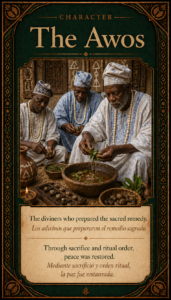
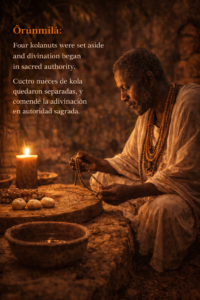
Then the son of Ifá would come forward and perform his great secret with adié dundún, the black hens. He called upon the great power of Ifá and its ashé, and through that work he gave power and virtue to the people of the land.
When he performed the ceremony to remove evil from the land and give it strength, he sang:
Oyekun Birose Kalekun Bawa Ifá Nire
Kalekun Leyere Ikú Babawa
Orunmila Laderi Babawa Ifá Layere
He gave the two adié dundún to Ifá so that the people might live well.
He invited the people of that land to eat from those adié. He also placed before Orunmila a gourd with cooked onibonibo, one with yam broth, one with eshinshin, one with eri kinia, and one with eré de carita, together with a small figure covered with plenty of epó.
After everyone had eaten that food, they made ebbó with all of it and sent it on its way.
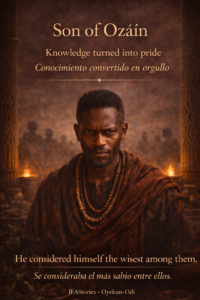
After that, the son of Ikú, whose name was Awó Aberi Biku, would come and eat the food.
But in the land where Awó Aberi Biku lived, the people ate nothing but oshinshin and flour. They lived in great fear because he held power over them.
Ikú was the one who brought that food every day, and sometimes he also brought adié. But when Ikú saw that his son no longer had power as an Awó, he became resentful and upset.
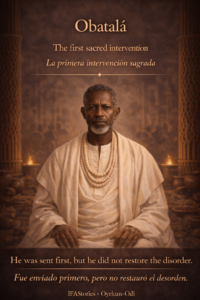
Ikú went to complain before Obatalá.
Obatalá said to him:
If you possess all the power in the world, why have you given so little power to your son?
That question struck Ikú deeply. It exposed the imbalance between the greatness of Ikú’s force and the weakness of his son’s authority.
Ashamed, Ikú went to Osain.
Osain said to him:
I am going to prepare a work for you. But when orubo dundún is asleep, bring me the elese, the root of caimito, vergonzosa, salvadera, maravilla blanca, and seeds. And while he is asleep, take a piece of ekute, earth from different places, different creatures of the earth, and iguí.
Ikú did what Osain instructed.
When he went to the house of Osain, he sang:
Ikú Babare Ikú
Ikú Egun Baragun
Ikú Babare Ikú
Osain heard him and said:
Here comes Ikú.
Osain prepared the work for him and told Ikú to keep it in a salvadera tree. He instructed Ikú that when he arrived in the land where Awó Omó Awó Iña was, he should blow the afoshé that had been given to him.
Then Osain told him:
In seven days, at seven at night, go and snatch away everyone who is asleep, when they fall asleep in the land of Komo Awó Ifá, which was the land of the son of Ifá.
But on the side of protection, another consultation was also opened.
In the land of the son of Ifá, he had already been told that he must always keep that hen tied wherever he might be, and that one day he would be told what he had to do with it.
Awó Komo Awó Ifá began to see what was happening. He became frightened and upset.
He took two coconuts and two adié and went before Ifá.
Ifá said to him:
That adié must be given to the great secret. Plenty of coconut must be grated, and the blood of the adié must be given, together with koborí eledá.
Then Ifá said to him:
Very well. Each one has a candle. It shall be lit at seven at night. And with that hen you have tied, and with this coconut I am going to give you, you are going to perform oparaldo with it and this cloth.
Before the danger entered openly, the story had already established a condition.
The hen had to remain tied wherever the son of Ifá might be. It was not to be released before its appointed purpose.
The night of danger had also been named.
Seven days.
Seven at night.
The threat had its hour, and the response had its hour.
What had been prepared in secret now began to move toward the people. The work had already been made. The salvadera tree had already been chosen. The afoshé had already been given. The time had already been set.
And the people in that land were the same people who, after eating, would remain seated and fall asleep.
Then Ikú came singing:
Ikú Towa Baba Bawa
Ikú Towa Baba Baba
Ikú Egun Ayere
Ikú Baba
Awó Komo Awó Ifá saw him and began to light candles for everyone.
When Ikú saw the candles, he stopped and became frightened.
Then Awó Komo Awó sang:
Onile Onile Baba Ikú Olona
Onire Onire Baba Ikú Olona
Egun Baba Ikú Olona
Awó Koomo Awó Ikú Olona
Ikú Lode Komo Awó
Ikú ran away, and everyone woke up.
When Awó Komo Awó went to place the adié in the salvadera, he found what Ikú had stored there. He took it and brought it to Ifá, saying:
Let us go to the great secret of Ifá and see what we are going to do with this.
When they arrived at the great secret, Orunmila poured ashé over it and said:
Bring me a fish from the river so that blood may be given to it, because this is going to become the great secret.
And he broke a coconut behind ilú.
What had been hidden for harm was now placed under sacred authority. What had been carried in secrecy was now judged in the open presence of sacred power.
Ikú became so frightened when the coconut was broken that he went to where his son was and said to him:
You have no power at all, and to show you that I do, I am going to begin with you.
So the line of fear turned back upon itself.
The sleeping people were not taken.
They awakened.
What had been hidden did not remain hidden.
It was found.
And what had been prepared for harm did not remain in the service of harm.
It became the great secret.
The story leaves behind a final instruction.
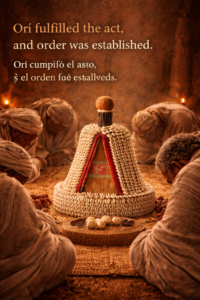
One must have a shell or a pot with its lid, leaving a small opening.
It is fed with a black hen, fish blood, or ologbo.
It carries an otá and a black necklace.
So the story does not remain only as memory.
It remains as instruction.
STORY STRUCTURE
Initial Condition
The story begins in Abonire, where the son of Ifá holds spiritual authority. His power is not shown through domination, but through feeding, ritual work, sacrifice, and the strengthening of the people.
Sacred Empowerment
The son of Ifá performs a secret with adié dundún. Through this rite, he removes evil from the land and gives power, virtue, and well-being to the people.
Rival Power
Awó Aberi Biku, the son of Ikú, belongs to another line of power. The people under him live in fear and eat only limited food. His authority exists, but it does not create peace or fullness.
Complaint and Hidden Work
Ikú becomes upset when he sees that his son lacks power as an Awó. He complains to Obatalá, then goes to Osain, who prepares a hidden work for him.
Protective Consultation
Awó Komo Awó Ifá sees danger approaching and goes before Ifá. Ifá gives exact instructions involving the tied hen, coconut, candles, cloth, blood, and oparaldo.
Confrontation
Ikú arrives at the appointed time, singing as he approaches. Awó Komo Awó lights candles for everyone. When Ikú sees the candles, he becomes frightened, and the chant of resistance keeps him outside.
Discovery and Transformation
Awó Komo Awó finds the hidden work in the salvadera and brings it before Ifá. Orunmila pours ashé over it and declares that it will become the great secret.
Lasting Instruction
The story ends with ritual continuation: a shell or pot with a lid and small opening, fed with black hen, fish blood, or ologbo, carrying an otá and a black necklace.
MAIN CHARACTERS
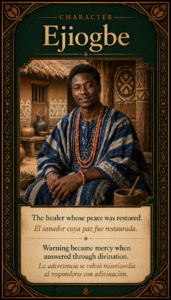
The Son of Ifá / Awó Komo Awó Ifá
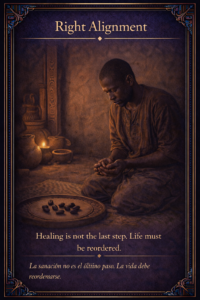
He is the figure of sacred service and ritual protection. He uses the power of Ifá to strengthen the people of Abonire, remove evil, and protect the land. His obedience to Ifá allows him to answer danger at the correct time.
He also represents the proper relationship between an Awó and Orunmila. He does not act from ego or fear alone. When danger appears, he consults Ifá, receives instruction, and follows it. His power comes from alignment, not personal force.
Awó Aberi Biku
He is the son of Ikú. He represents a power surrounded by fear but lacking true stability. His people live under restriction and fear, showing that authority without right order does not produce well-being.
Awó Aberi Biku is also important because he reveals the weakness of inherited force when it is not properly grounded. He is connected to Ikú, but his authority does not bless the people. It confines them.
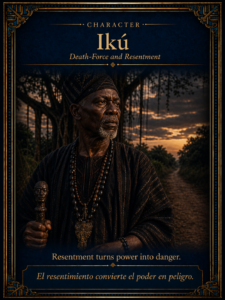
Ikú
Ikú is the force that moves through resentment, fear, and hidden action. When he sees that his son lacks power, he seeks a way to restore that power through dangerous means. His movement creates the central threat of the story.
Ikú’s relationship with his son is one of pride, shame, and force. He wants his son restored, but his method is destructive. Instead of correcting the imbalance through sacred order, he seeks hidden power through Osain.
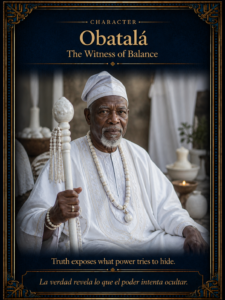
Obatalá
Obatalá exposes the imbalance in Ikú’s complaint. His statement reveals the contradiction: if Ikú possesses great power, why has he given so little to his son?
His role is brief but powerful. He does not prepare the hidden work. He exposes the truth that pushes Ikú into action.
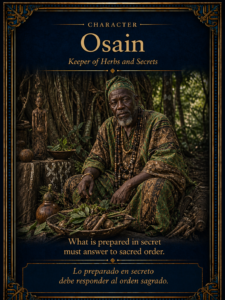
Osain
Osain prepares the hidden work for Ikú. His role is connected to the preparation of spiritual materials, herbs, roots, earth, creatures, and afoshé. In the story, his work becomes part of the danger that later must be exposed.
Osain’s presence shows the seriousness of prepared ritual force. The materials are not random. They are gathered, prepared, hidden, and directed.
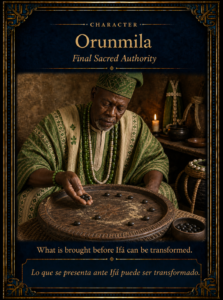
Orunmila
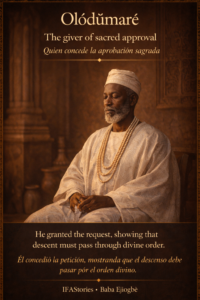
Orunmila is the final sacred authority in the story. When the hidden work is brought before Ifá, Orunmila pours ashé over it and transforms what had been prepared for harm into the great secret.
He represents rightful order. Under his authority, hidden danger is not merely rejected. It is judged, redirected, and transformed.
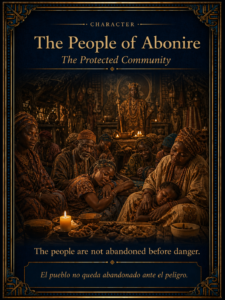
The People of Abonire
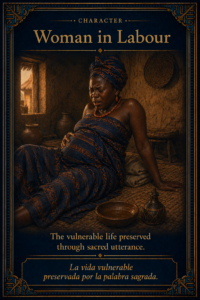
The people receive strength from the son of Ifá. Their sleeping condition makes them vulnerable, but through the ritual action of Awó Komo Awó Ifá, they are protected and awakened.
They represent the community that sacred power must protect.
RELATIONSHIP BETWEEN IKÚ AND HIS SON
The son of Ikú, Awó Aberi Biku, represents a line of power surrounded by fear but lacking stability. His people live under restriction. They eat little. They remain afraid. His authority exists, but it does not nourish the land.
Ikú’s concern for his son is not tender in the ordinary sense. It is a relationship shaped by power, pride, and fear of loss. When Ikú sees that his son no longer holds authority as an Awó, he becomes ashamed and resentful. He does not accept the condition as a lesson. Instead, he seeks a way to restore his son’s influence through hidden force.
Obatalá’s question exposes the spiritual contradiction:
If Ikú possesses so much power, why has he given so little to his own son?
This question strikes at the heart of the story. Ikú’s son is not powerless because power does not exist. He is unstable because his power is not properly ordered. It does not bless, feed, or protect. It produces fear.
So Ikú goes to Osain, and from that moment the father’s concern turns into a dangerous movement. What begins as shame over his son becomes a hidden work aimed at the people of the son of Ifá.
RELATIONSHIP BETWEEN ORUNMILA AND THE SON OF IFÁ
The son of Ifá stands in a very different relationship.
He is not simply someone who possesses ritual knowledge. He is one who belongs to the order of Ifá. His power flows through consultation, obedience, sacrifice, and sacred responsibility.
The people of Abonire are vulnerable because they fall asleep after eating. Yet they are not abandoned. The son of Ifá watches over them. He performs sacred work for their strength. When danger begins to move toward them, he becomes frightened, but he does not act carelessly. He goes before Ifá.
This is what defines his relationship with Orunmila.
A true son of Ifá does not depend only on personal force. He depends on revealed instruction. He listens. He follows. He protects according to what Ifá opens.
When the hidden work is later found in the salvadera tree, the son of Ifá does not keep it for himself. He brings it before Ifá and Orunmila. This shows humility and proper order. The danger is not handled through ego. It is brought before the highest sacred authority.
Then Orunmila pours ashé over it and declares that it will become the great secret.
This moment shows the difference between the two relationships. Ikú seeks to empower his son through hidden danger. Orunmila empowers the son of Ifá through revealed order, sacrifice, and transformation.
HUMAN CONDITIONS REVEALED
Fear
Fear appears in the land of Awó Aberi Biku, where the people live under the power of Ikú’s son. It also appears when Awó Komo Awó Ifá realizes danger is approaching.
The story distinguishes fear that oppresses from fear that leads a person to seek Ifá.
Resentment
Ikú becomes resentful when he sees that his son no longer has power as an Awó. This resentment becomes the doorway through which harmful action is prepared.
Shame
Ikú’s shame is revealed after Obatalá questions him. His shame does not become humility. Instead, it turns into a search for hidden power.
Hidden Danger
The danger in the story does not begin openly. It is prepared in secret, hidden in the salvadera, and timed for the moment when the people are asleep.
Obedience
Awó Komo Awó Ifá survives the danger because he follows Ifá’s instructions. He keeps the hen tied, performs the rite at the appointed time, and uses the prescribed materials.
Vulnerability
The people of Abonire are vulnerable because they fall asleep after eating. Their weakness is not mocked by the story; it becomes the condition that requires protection.
Sacred Responsibility
The son of Ifá does not use his authority for himself alone. He serves the people, feeds them, strengthens them, and protects them from danger.
Reversal
The story reveals a powerful reversal: what Ikú prepared against the people is discovered, brought before Ifá, and transformed into the great secret.
MORAL AND SPIRITUAL TEACHINGS
This story teaches that not all power is the same.
Some power nourishes, protects, blesses, and strengthens. Other power controls through fear and moves through hidden harm.
The son of Ifá represents power aligned with service and sacred order. His work feeds the people, removes evil, and gives them virtue. Awó Aberi Biku represents a different kind of authority, one that surrounds people with fear but does not give them fullness or peace.
The story also teaches that danger may be hidden, timed, and prepared in secrecy. For that reason, protection must come through divination, obedience, and exact ritual action.
Awó Komo Awó Ifá does not defeat Ikú through force alone. He follows what Ifá gives him.
The tied hen, the coconut, the candles, the cloth, and oparaldo become the sacred answer to the advance of Ikú. These are not decorative objects in the story. They are the means by which death-force is blocked and the road is closed against what sought to enter.
The deepest teaching is that rightful sacred order does more than resist danger. It reveals what was hidden, brings it before authority, and transforms what was prepared for harm into enduring spiritual power.
This story also teaches that a parent’s desire to restore a child’s power can become dangerous when it is ruled by shame and resentment. Ikú wants his son empowered, but his path is hidden and destructive.
By contrast, Orunmila’s relationship with the son of Ifá is based on guidance, not force. The son of Ifá is protected because he listens, consults, and obeys.
EXPANDED OPARALDO CONTEXT
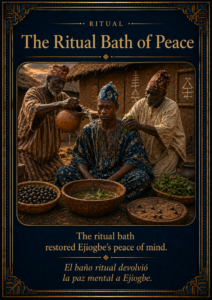
In Afro-Cuban and Lukumí understanding, oparaldo is not a minor ceremony. It is a sacred work of cleansing, expulsion, and spiritual separation, used to confront disturbing dead, harmful influence, and destructive force.
In this story, oparaldo appears at the moment when danger has already been prepared but has not yet fully entered. Ikú has received the hidden work. The salvadera tree has been chosen. The afoshé has been given. The time has been set: seven days, at seven at night.
But Ifá also gives the son of Ifá a response.
The tied hen, the coconut, the candles, and the cloth are not decorative elements in the story. They are part of the sacred defense that blocks the road of Ikú. The candles make protection visible. The tied hen reaches its appointed purpose. The coconut and cloth become part of the separation.
Through oparaldo, the force that sought to enter is confronted and driven back.
For those new to the tradition, this shows that the people are not abandoned before spiritual danger. Ifá provides a way to recognize danger, prepare protection, and defend the community when destructive force approaches.
For those within the tradition, the story reveals something deeper: oparaldo is one of the sacred ritual means a babalawo may possess and perform when Ifá opens the way for protection, cleansing, spiritual defense, and separation from harmful forces.
The story does not present oparaldo as fear.
It presents it as order.
It is the moment when the road is closed against what should not enter.
SYMBOLS AND SACRED ELEMENTS
A. Symbols
The Sleeping People
The sleeping people represent vulnerability. Their condition shows how danger can approach when awareness is lowered and protection has not yet been activated.
The Road
The road appears through the chants that keep Ikú outside. It represents boundary, movement, approach, and refusal. Ikú is not allowed to enter the protected space; he is kept on the road.
The Salvadera Tree
The salvadera becomes the place where the hidden work is stored. It marks the concealed location of danger before that danger is exposed.
The Small Figure Covered with Epó
The small figure covered with palm oil is part of the ritual arrangement before Orunmila. It belongs to the sacrificial and sacred setting through which the son of Ifá works for the land.
The Great Secret
The great secret is the final transformation of the story. What was prepared for harm becomes something placed under Orunmila’s authority.
B. Sacred / Ritual Elements
Adié Dundún / Black Hens
The black hens are central to both empowerment and protection. They are used in the rite of the son of Ifá and later appear in the divinatory continuation.
Coconut
Coconut appears in the protective instruction and in the moment of sacred authority. It is connected to the ritual response and to the breaking behind ilú.
Candles
The candles are lit at seven at night. Their appearance frightens Ikú and marks the moment when protection becomes visible.
Oparaldo
Oparaldo is the rite given by Ifá as the response to Ikú’s advance. In the story, it functions as a work of cleansing, separation, repulsion, and protection.
Afoshé
The afoshé is given to Ikú as part of the hidden work prepared by Osain. It belongs to the movement of danger before Ifá exposes and redirects that danger.
Koborí Eledá
Koborí eledá appears in the instruction given by Ifá. It points to the spiritual care, cooling, strengthening, or alignment of the head. In the story, it belongs to the larger protective response that prepares the son of Ifá for the danger ahead.
Otá and Black Necklace
The final instruction says the shell or pot carries an otá and a black necklace. These items show that the story continues into ritual practice and does not end as narrative alone.
The Number Seven
Seven days and seven at night mark the timing of danger and response. The story gives the threat an appointed hour and gives protection an appointed hour.
CULTURAL AND DIVINATORY CONTEXT
This story shows why divination precedes action in Ifá tradition. Awó Komo Awó Ifá does not respond blindly. When he sees what is happening, he goes before Ifá with two coconuts and two adié. The answer he receives gives the exact ritual response.
Sacrifice also matters because the story presents spiritual order as something enacted through proper materials, timing, and obedience. The black hen, coconut, blood, candles, cloth, and oparaldo are not abstract symbols only. They are ritual means through which danger is answered.
The story also shows how sacred authority is installed and protected. The son of Ifá strengthens the people through ritual feeding and sacrifice. Orunmila later receives the hidden work, pours ashé over it, and transforms it into the great secret.
The divinatory continuation is especially important. The story gives later instruction: one must have a shell or pot with its lid, leaving a small opening. It is fed with a black hen, fish blood, or ologbo. It carries an otá and a black necklace.
This means the story is not only remembered.
It continues as ritual knowledge.
In Afro-Cuban and Lukumí understanding, this is also where the story becomes especially important for explaining oparaldo. The rite appears as a protective response when harmful force, disturbing dead, or destructive influence must be separated from a person, house, or community.
For new listeners, the story makes the concept understandable: Ifá does not leave the people defenseless.
For those within the tradition, it also points to one of the ritual tools a babalawo may possess and perform when Ifá opens the way for cleansing, protection, spiritual separation, and defense.
WHEN THIS ODÙ APPEARS
When Oyekun Iroso appears with this story, it may point to a situation where hidden danger is moving quietly and must be addressed through proper consultation, timing, and ritual protection.
This story may warn about resentment from another person or force that feels weakened, displaced, or deprived of influence. It may also point to a contrast between power used for communal well-being and power used to control through fear.
One lesson drawn from this account is that the person must not ignore warnings or abandon a prescribed protection before its time. The tied hen in the story had to remain tied until Ifá revealed its purpose.
This Odù may also point to the need for spiritual cleansing, separation, and boundary-making. The oparaldo becomes the means by which harmful presence is driven back and the protected space is defended.
It can also teach that what is hidden must be brought before proper authority. The secret work stored in the salvadera does not remain concealed. It is found, taken before Ifá, and transformed through Orunmila’s ashé.
This story may also speak about family, lineage, and inherited power. Ikú wants his son to possess force, but the story shows that force without order becomes unstable. The son of Ifá receives power differently: through consultation, obedience, and sacred responsibility.
REFLECTION QUESTIONS
What is the difference between the power of the son of Ifá and the power of the son of Ikú?
Why does the story show the people of Abonire eating, sleeping, and needing protection?
What does Ikú’s resentment reveal about power that is not properly ordered?
How does Obatalá’s question expose the relationship between Ikú and his son?
Why is the tied hen important before its purpose is fully revealed?
How do the candles change the movement of danger in the story?
What does the chant of Awó Komo Awó teach about boundaries and protection?
Why does Orunmila transform the hidden work instead of simply discarding it?
How does oparaldo function as cleansing, separation, and defense in this story?
How does the final ritual instruction show that the story continues beyond memory?
CONCLUSION
The Path Where the Great Power of Ikú’s Son, the Great Power of Ifá’s Son, and Oparaldo Were Born teaches that sacred power must be measured by what it produces.
The son of Ifá strengthens the people.
The son of Ikú rules within fear.
Ikú moves through resentment, while Ifá provides protection through exact instruction.
The story also teaches that danger may be hidden, but it is not beyond the reach of sacred order. Through the tied hen, coconut, candles, cloth, blood, and oparaldo, Ifá gives the people a way to block what seeks to enter.
At the end, the hidden work is exposed and brought before Orunmila. What was prepared for harm becomes the great secret.
That is the final movement of the story: not only resistance, but transformation under rightful sacred authority.
This is why the story remains powerful. It teaches that harmful force may move in secret, but sacred order can reveal it. It teaches that fear may try to rule, but Ifá protects life. And it teaches that when Orunmila takes authority over what was hidden, even danger can be transformed into sacred knowledge.
DOWNSTREAM SUMMARY BLOCK
Core Story Tension
The son of Ifá strengthens the people through sacred power, while Ikú seeks to restore power to his son through hidden and dangerous work.
Core Ritual Dynamic
Ifá provides protection through the tied hen, coconut, candles, cloth, blood, and oparaldo, while Orunmila transforms the hidden work into the great secret.
Core Character Dynamic
The son of Ifá protects and empowers.
Awó Aberi Biku stands within fear.
Ikú acts through resentment and shame on behalf of his son.
Osain prepares hidden work.
Obatalá exposes imbalance.
Orunmila restores sacred order.
Core Teaching
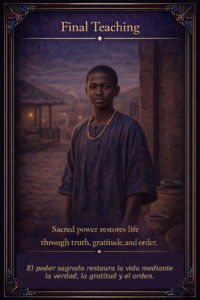
Power aligned with Ifá protects life, reveals danger, and transforms harm into sacred force.
Core Divinatory Warning
This story may warn of hidden danger, resentment, spiritual vulnerability, and the need to follow prescribed protection exactly and at the proper time.
Core Oparaldo Teaching
Oparaldo appears as a sacred work of cleansing, expulsion, separation, and defense. It shows that when spiritual danger approaches, Ifá may open a ritual path to protect the person, the house, the land, or the community.