ODÙ CONTEXT
The Mother of Rain is a traditional Ifá story preserved under the source Odù label Oyeku-Bo-Owanrin.
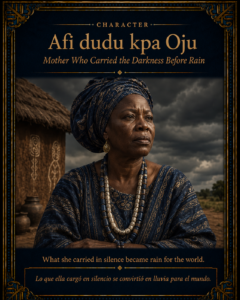
The story tells of Afi dudu kpa Oju, whose name may be understood as She Who Covers the Face with Darkness. She is remembered as the mother of Ojo / Rain.
At the beginning of the story, Afi dudu kpa Oju is seeking a child. Her condition is brought before Ifá through divination. She is instructed to make sacrifice, including an offering to Esu. After making the sacrifice, she becomes pregnant and later gives birth to Rain.
But Rain is not first received with honor. His charcoal-black appearance causes others to mock him. They assume he will not accomplish anything meaningful.
The story then reveals that what the people mocked was not emptiness, shame, or failure. It was the first sign of Rain’s destiny. Through Esu’s preparation, Rain’s black attire becomes the darkness before rain, the soap foam becomes cloud, and the cudgels become showers.
This story teaches that destiny may be hidden before it is recognized. It also teaches that sacred preparation may begin before the public understands what is being prepared.
STORY REFERENCE
This article is respectfully adapted from a traditional Ifá story attributed to C. Osamaro Ibie in the IFISM: The Complete Works of Orunmila tradition.
Within IFAStories, the account is presented as a sacred Ifá narrative for spiritual education, cultural preservation, and reflective study. The article keeps the story readable for a modern audience while preserving its ritual boundaries, divinatory frame, and sacred speech status.
The prayer/chant preserved in the story is included with a cautious interpretive translation. Because the source spelling appears in liturgical or OCR-transcribed form, the translation should be treated as a prayer gloss, not a verified word-for-word academic translation.
INTRODUCTION
There are stories where destiny is hidden before it is recognized.
There are stories where the child who is mocked carries a force greater than the eyes that judged him.
The Mother of Rain is one of those stories.
It tells of Afi dudu kpa Oju, the mother of Rain, whose longing for a child brings her into the sacred order of divination. Through sacrifice and offering, the road to motherhood is opened. But when her child is born, the people do not understand what they are seeing.
They see a charcoal-black child and laugh.
They see darkness and assume emptiness.
They see appearance but do not see destiny.
The story then turns toward revelation. Esu prepares Rain with black attire, soap foam, and cudgels. These signs become the visible form of Rain’s power: darkness before rain, cloud before rain, and showers that strike the earth.
This is not only a story about a mocked child becoming great. It is a story about longing, divination, sacrifice, sacred preparation, misunderstood appearance, and the moment when hidden destiny becomes impossible to deny.
QUICK TAKEAWAY
Destiny may be hidden beneath what the world misunderstands.
Divination sees before the public sees. Sacrifice prepares before recognition arrives. Esu equips what has not yet been understood. And Rain, once mocked, becomes the force that touches everyone.
THE STORY
The story opens in heaven.
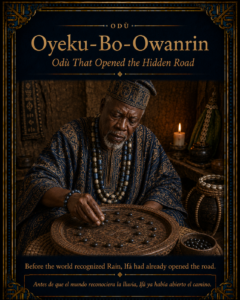
There, Oyeku-Bo-Owanrin made divination for Afi dudu kpa Oju, who was known as the mother of Rain.
Before Rain was born, there was longing.
Before manifestation, there was need.
Before the world could see the greatness of the child, divination had already opened the road.
At that time, Afi dudu kpa Oju was desperate to have a child. Her condition was not treated as ordinary desire alone. It entered the sacred order of divination.
The divination gave a specific path.
Afi dudu kpa Oju was instructed to make sacrifice with a black sheep, a black garment, plenty of soap, and plenty of cudgels. She was also instructed to give a black he-goat to Esu.
These materials must be heard carefully. They are not decorative objects. They are not a public ritual recipe. They belong to the source-specific ritual structure of this Odù and this story.
A sacred chant is preserved near the opening of the narrative. It appears after the divination statement and seems to invoke the Odù itself through sound-play around Oyeku-Bo-Owanrin.
Afi dudu kpa Oju made the sacrifice.
After making the sacrifice, she became pregnant.
The story then preserves a divinatory continuation. When this Odù appears at Ugbodu, the person should be told to make a similar sacrifice in order to avoid the risk of childlessness.
This instruction is serious, but it remains source-specific. The story does not provide a complete ritual procedure, and it should not be turned into public ritual instruction.
Afi dudu kpa Oju then gave birth to a child called Ojo — Rain.
But the child was not welcomed with understanding.
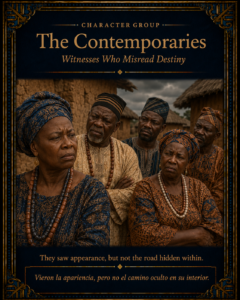
Her contemporaries ridiculed her. They mocked her for having a charcoal-black child, a child they believed would never do anything tangible.
They saw the child’s color, but they did not see his destiny.
The child’s destiny was hidden inside the very sign they misunderstood.
Afi dudu kpa Oju is not remembered only because she gave birth to Rain. She is remembered because she carried longing before manifestation. She endured ridicule before recognition. And she lived to see the hidden destiny of her child revealed before the same community that doubted him.
Then the role of Esu becomes important.
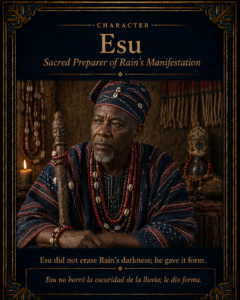
Esu did not appear as a random trickster. Esu had received the prescribed black he-goat. After the sacrifice, Esu prepared Rain for manifestation.
He dressed Rain in black attire.
He rubbed Rain’s face with the foam of soap.
He gave Rain several cudgels.
What Esu placed on Rain would later become visible to everyone.
The black garment would become the darkness before rain.
The foam of soap would become the gathered cloud.
The cudgels would become the showers that strike the earth.
What had first appeared as ritual material became cosmic sign. What had been hidden in divine preparation became visible in the world.
Then Rain began to show his power.
Heaven darkened.
The people wondered what he was about to do.
The cloud gathered.
The foam on his face began to show.
And Rain began to strike all and sundry with the cudgels in his hand.
He struck friends and foes.
Old and young.
High and low.
Day and night.
Trees and animals.
Rain did not choose only those who welcomed him.
Rain touched all.
The story explains the signs directly.
The darkness before Rain represents the black dress with which Esu clothed him.
The cloud before Rain represents the soap foam on his face.
The showers of Rain represent the cudgels in his hand.
Darkness.
Cloud.
Showers.
The child once mocked became the force that no one could ignore.
At that stage, Afi dudu kpa Oju rejoiced. She understood that she had given birth to a great child.
The same child people had mocked was now revealed as a force whose reach extended beyond the household, beyond the community, and beyond the voices that once laughed.
The story says that because people laughed at Rain, it is said that Rain has no friends. And because Rain beats everyone indiscriminately, his force is still felt by all.
Friends and foes.
Old and young.
High and low.
Trees and animals.
Rain’s greatness is not private revenge. It is not the anger of a rejected child. It is the revelation of a destiny whose power belongs to the wider world.
Rain does not fall only on those who understand him. Rain does not fall only on those who welcome him.
Rain reaches everyone.
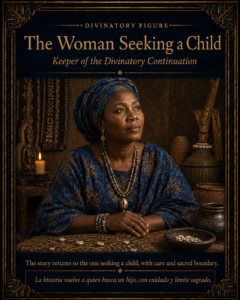
The story closes with further divinatory instruction. At divination for a woman looking for a child, she should be told to make sacrifice. The source says she would give birth to a child whose fame would be felt throughout the face of the earth, and whose greatness would shake the community in which he lives and beyond.
This is preserved as source-specific divinatory guidance. It is not a public ritual manual. It belongs to the sacred frame of this Odù and this story.
SACRED CHANT PRESERVED IN THE STORY
A sacred chant is preserved near the opening of the story.
It appears after the statement that Oyeku-Bo-Owanrin made divination in heaven for Afi dudu kpa Oju.
The source preserves the chant, but no verified translation is supplied. Because these lines are preserved in liturgical and source-based spelling, they require review before final pronunciation, performance, or strict word-for-word translation.
The chant is kept here in a working received form:
Ifá Òyè Wọ̀-rìn-mí. Òyè Wọ̀n-rìn-mí. Òyè Wọ̀n-rìn-jẹ́.
Òyè, bí ó bá balẹ̀, wọ́n rìn mí. Kí ó má wọ̀n ìrìn mí.
Bí ó bá lè wọ̀n, ìrìn sí inú.
Kí ó má wọ̀n ìrìn sí inú.
À kò lè tórí wí pé ó wọ̀n ìrìn mí.
À kò lè sọ wí pé ó wọ̀n ìrìn sí inú.
Kí a máa pè é ní Èjì-Òyè.
SUGGESTED INTERPRETIVE PRAYER TRANSLATION
A careful interpretive meaning may be heard this way:
The chant calls upon Ifá and Òyè.
It invokes Òyè Wọ̀-rìn-mí, the force whose road moves with me.
It invokes Òyè Wọ̀n-rìn-mí, the force whose movement presses upon my journey.
It invokes Òyè Wọ̀n-rìn-jẹ́, the force whose movement carries destiny into being.
It asks that the road not become difficult.
It asks that the journey remain open.
It asks that the inner path not be closed.
It asks that no one be able to say:
My journey has been blocked.
It asks that no one be able to say:
The road within me has been sealed.
And it preserves the sacred name:
Èjì-Òyè.
Let us not name you the Twofold Honor without understanding your power.
PRAYER TRANSLATION NOTE
This translation should be treated as a cautious interpretive prayer gloss. It is shaped for meaning, narration, and spiritual understanding.
It should not be treated as a final literal translation until the source spelling, Yoruba pronunciation, and liturgical context are reviewed.
No additional prayer, chant, rezo, or sacred verse has been invented for this article.
HOW THE CHANT CONNECTS TO THE STORY
The chant prepares the whole story.
It speaks of a road that must not be blocked.
It speaks of an inner path that must remain open.
This reflects the journey of Afi dudu kpa Oju. Before Rain is born, her road to motherhood is obstructed. Through divination and sacrifice, Ifá opens that road.
But the chant also speaks to Rain.
Rain’s destiny is hidden inwardly before the world can recognize it outwardly. The people see darkness and ridicule him. But Esu prepares the hidden road of Rain’s destiny to become visible.
The black attire becomes the darkness before rain.
The soap foam becomes cloud.
The cudgels become showers.
So the chant is not separate from the story. It is the spiritual doorway of the story.
Before Rain can fall, the road must open.
Before destiny can be recognized, the inner path must first be prepared.
STORY STRUCTURE
1. Initial Longing
The story begins with Afi dudu kpa Oju seeking a child. Her longing gives the story its opening movement.
This is important because the story does not begin with public ridicule. It begins with need, vulnerability, and the desire for motherhood.
2. Divination
Oyeku-Bo-Owanrin makes divination in heaven for Afi dudu kpa Oju.
Her condition enters the sacred order of Ifá. This means that before the child appears to the world, Ifá has already opened the road.
Before the people judge the child’s appearance, sacred order has already recognized his coming.
3. Sacrifice and Offering
The divination leads to specific sacrifice instruction: black sheep, black garment, soap, and cudgels. It also includes a black he-goat to Esu.
These details matter because they later become connected to Rain’s manifestation.
The story does not present these items as decoration. It presents them as part of the ritual and symbolic structure through which Rain’s destiny becomes visible.
4. Pregnancy
After Afi dudu kpa Oju makes the sacrifice, she becomes pregnant.
This is the first visible result of the divinatory instruction. The road that had been closed begins to open.
5. Birth and Misrecognition
Afi dudu kpa Oju gives birth to Ojo / Rain.
But the child is not understood. His charcoal-black appearance becomes the basis for ridicule.
The people see darkness and assume failure. They see appearance but do not see destiny.
6. Esu’s Sacred Preparation
Esu prepares Rain for manifestation.
He dresses Rain in black attire.
He places soap foam on Rain’s face.
He gives Rain several cudgels.
Esu does not erase Rain’s darkness. He gives that darkness its form of manifestation.
The people see a dark child and laugh.
Esu sees Rain.
7. Manifestation
Rain begins to show his power.
Heaven darkens.
Clouds gather.
Showers fall.
Rain touches friends and foes, old and young, high and low, day and night, trees and animals.
Rain does not fall only on those who understood him. Rain does not avoid those who mocked him.
Rain reaches everyone.
8. Recognition
Afi dudu kpa Oju rejoices because she understands that she has given birth to a great child.
Her joy is not simple pride. It is recognition.
She understands that what she carried was great.
9. Divinatory Continuation
The story closes by returning to divination.
When this Odù appears at Ugbodu, the person is instructed to make sacrifice to avoid the risk of childlessness.
When divination is made for a woman looking for a child, she is advised to make sacrifice. The source says she would give birth to a child whose fame would be felt across the earth.
This instruction remains source-specific. It should not be turned into public ritual procedure.
MAIN CHARACTERS AND RELATIONSHIP ROLES
Afi dudu kpa Oju
Afi dudu kpa Oju is the mother of Rain.
Her name may be understood as She Who Covers the Face with Darkness.
She carries the story’s opening need: the desire for a child. Her role is not passive. She receives the divinatory instruction, makes the sacrifice, becomes pregnant, gives birth, endures ridicule, and later rejoices when the child’s greatness is revealed.
She is not only the mother of Rain in a biological sense. She is the one who carries the atmosphere before Rain enters the world.
She carries longing.
She carries sacrifice.
She carries pregnancy.
She carries ridicule.
She carries the hidden stage before manifestation.
Ojo / Rain
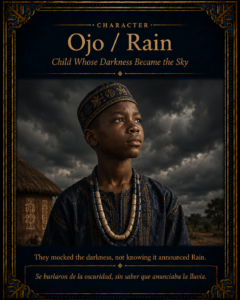
Ojo, or Rain, is the child born after sacrifice.
At first, he is judged by appearance. His charcoal-black form becomes the reason others dismiss him.
But Rain’s identity is larger than public perception. His darkness is not a defect. It is not shame. It is not emptiness.
It is the first sign of Rain.
Before rain falls, the sky darkens. Before the showers come, the face of heaven is covered. The people mocked the very sign that announced who the child was.
Rain becomes a force whose reach extends to friends and foes, old and young, high and low, day and night, trees and animals.
Esu
Esu receives the prescribed black he-goat and later prepares Rain.
He dresses Rain in black attire.
He rubs Rain’s face with soap foam.
He gives Rain cudgels.
Esu must not be reduced to a generic trickster. In this story, his function is preparatory and transformative.
He does not erase what Rain is. He reveals what Rain already carries.
The people judge appearance.
Esu activates destiny.
The Contemporaries
The contemporaries represent social misrecognition.
They see the child’s appearance but do not understand his destiny. Their ridicule helps explain the saying that Rain has no friends.
But the story should not be reduced to revenge against mockers.
Their failure is a failure of sight. They judge too early. They see darkness and assume emptiness.
The Woman Looking for a Child
The woman looking for a child appears in the final divinatory instruction.
She represents the later use of the story in divination. Her presence shows that this story is not only remembered as narrative. It continues as guidance within a sacred divinatory frame.
HUMAN CONDITIONS REVEALED
Desire for a Child
The story begins with the desire for a child. Afi dudu kpa Oju’s longing is the human condition that brings the story into motion.
Vulnerability Before Fulfillment
Before Rain is born, the mother stands in a place of need.
The story shows that destiny may begin in vulnerability before it becomes visible.
Social Misrecognition
The contemporaries judge the child by appearance.
They assume that his charcoal-black body means he is incapable. This reveals the danger of judging destiny too early.
Hidden Destiny
Rain’s greatness is hidden at first.
The community does not see it. The story teaches that what is prepared through divination and sacrifice may not be immediately understood by others.
Sacred Preparation
Rain’s destiny does not manifest without preparation.
Divination, sacrifice, offering, chant, and Esu’s guidance all belong to the story’s movement from hiddenness to manifestation.
Communal Impact
Rain affects everyone.
The story makes this clear by naming friends and foes, old and young, high and low, day and night, trees and animals.
Rain’s reach is not selective.
MORAL AND SPIRITUAL TEACHINGS
1. Public Sight Is Not Always Sacred Sight
The world may judge too early.
But Ifá sees the road before the world understands the traveler.
2. Destiny May Be Hidden Before It Is Recognized
Rain’s greatness is hidden inside the very appearance that people mock.
The child’s darkness is not a defect. It is the first sign of Rain.
3. Sacrifice Prepares Manifestation
The sacrifice is not decorative.
The story connects sacrifice to pregnancy, birth, and Rain’s later manifestation.
4. Esu’s Role Must Be Respected
Esu is not presented as demonic, villainous, or merely mischievous.
In this story, Esu receives offering and later prepares Rain for public manifestation.
5. What Is Mocked May Become Necessary
The child who is dismissed becomes the force everyone eventually feels.
The mocked child becomes necessary to the world.
6. Rain Is Not Private Revenge
Rain touches everyone.
Rain does not fall only on those who understood him. Rain does not avoid those who mocked him.
Rain’s greatness is larger than social approval or rejection.
7. Rain Is Force and Renewal
At first, Rain is felt as force.
The sky darkens.
Clouds gather.
Showers strike the earth.
But after the rain passes, the world is changed.
The dust settles.
The heat cools.
The soil receives water.
Seeds begin to open.
Trees are refreshed.
Animals drink.
Life continues.
Rain is not only a force that strikes. Rain is a force that renews.
SYMBOLS AND SACRED ELEMENTS
Black Sheep
The black sheep is part of the sacrifice material.
Its role belongs to the ritual preparation before conception.
Black Garment / Black Dress / Black Attire
The black garment appears first as part of the sacrifice instruction and later as the attire Esu places on Rain.
The source links it to the darkness before rain.
Soap and Soap Foam
Soap appears among the sacrifice materials.
Soap foam later appears on Rain’s face.
The source links this foam to the cloud before Rain.
The foam should not be read as whitening the child or correcting his color. It does not cover shame. It reveals cloud.
Cudgels
Cudgels appear as part of the sacrifice materials and later as the instruments Esu gives to Rain.
The source links the showers of Rain to the cudgels in his hand.
Black He-Goat
The black he-goat is the offering prescribed for Esu.
This detail must remain visible because Esu later plays a central role in preparing Rain.
Charcoal-Black Appearance
The child’s charcoal-black appearance becomes the basis for ridicule.
But it is also part of the story’s larger movement from misunderstood appearance to revealed force.
The child’s darkness belongs to the sky.
Darkness, Cloud, and Showers
These are not random weather signs in the story.
The source explains them through Rain’s black dress, soap foam, and cudgels.
They form the visible body of Rain’s manifestation.
RITUAL / CEREMONY PUBLIC EDUCATION LAYER
This story contains divination, sacrifice, offering to Esu, sacred speech, ceremony-origin explanation, and divinatory continuation.
The ritual instruction is specific: Afi dudu kpa Oju is told to sacrifice with a black sheep, black garment, soap, and cudgels, and to give a black he-goat to Esu.
The story then says that after making the sacrifice, she becomes pregnant.
For public education, the important point is not to turn this into a ritual recipe. The story preserves ritual importance, but it does not teach ritual procedure.
It shows what the sacrifice means within the story: it responds to the condition of child-seeking and prepares the way for the birth and manifestation of Rain.
The offering to Esu also matters. Esu later prepares Rain with the very signs that explain darkness, cloud, and showers.
This means the offering is not incidental to the story’s movement.
PUBLIC BOUNDARY STATEMENT
This story preserves ritual importance, but it does not teach ritual procedure.
It shows what sacrifice, offering, sacred speech, and sacred preparation mean within the story.
It does not provide a complete ritual manual.
Any practical ritual explanation would require source verification and practitioner review.
PRAYER / REZO / CHANT / SACRED SPEECH STATUS
A sacred chant is preserved in this story.
The source preserves the chant, but no verified translation is supplied.
Because these lines are preserved in liturgical and source-based spelling, their meanings should be heard as requiring review. They should not be treated as strict word-for-word translation, and no translation should be finalized without source and pronunciation review.
The chant functions as sacred speech at the doorway of the narrative. It belongs to the divination opening and should remain connected to that moment.
The interpretive translation provided in this article is a public-facing gloss for meaning. It is not a final liturgical translation.
CULTURAL AND DIVINATORY CONTEXT
This story operates inside a divinatory frame.
A condition appears: Afi dudu kpa Oju desires a child.
Divination is made.
Sacrifice is prescribed.
The sacrifice is completed.
Pregnancy follows.
The story also includes Ugbodu guidance. When this Odù appears at Ugbodu, the person is to be told to make a similar sacrifice to avoid the risk of childlessness.
This must be handled carefully. The source gives the instruction, but it does not provide a complete public procedure.
The story closes with divination guidance for a woman looking for a child. Again, this is source-specific instruction, not a general public ritual prescription.
Culturally, the story also requires careful handling of Esu. Esu is not treated here as a demon or villain. His role is connected to offering, preparation, and the manifestation of Rain.
WHEN THIS ODÙ APPEARS
When this Odù appears, this story may point to a child-seeking condition, the risk of childlessness, or a destiny that has not yet become visible.
It may also warn about judging by appearance too early.
In the story, the child who is mocked becomes Rain, a force whose reach extends beyond the household and community.
Within this specific Odù and divinatory frame, the story places emphasis on sacrifice, offering to Esu, and sacred preparation. However, the ritual details must not be turned into public procedure from this story alone.
This story may also point to a person, child, calling, or destiny that appears misunderstood at first but later affects many people.
That reading should remain connected to the story’s own structure:
Divination.
Sacrifice.
Esu’s preparation.
Manifestation.
Recognition.
Divinatory continuation.
MODERN ETHICAL EXPLANATION
This story includes sensitive themes: child-seeking, the risk of childlessness, public ridicule, appearance, and ritual instruction.
It should be heard with care.
It should not be used to shame people experiencing childlessness, fertility struggles, grief, family pressure, or health concerns.
It should not be used as medical advice.
It should not be used to ridicule a child or stigmatize dark appearance.
It should not be used to turn ritual materials into public instruction.
The traditional warning remains serious, but it belongs within the specific Odù and divinatory frame of this story.
As a contemporary reflection, the story may also speak to the way many children are judged before their gifts are understood.
Some are judged by skin color.
Some by language.
Some by poverty.
Some by disability.
Some by cultural background.
Some by temperament.
Some by the traditions they carry from their elders.
A child may be called strange, difficult, dark, slow, awkward, or unlikely to succeed.
But this story warns us:
A child is not empty because society cannot yet understand the form their destiny takes.
Rain was not rejected because he lacked destiny.
Rain was rejected because the people could not recognize destiny when it appeared in a form they had already decided to dismiss.
WHAT MUST NOT BE MISUNDERSTOOD
This story should not be reduced to “a mocked child becomes great.”
It should not be reduced to revenge against those who laughed.
It should not be used to blame people facing childlessness.
It should not be used as medical advice.
It should not be turned into public ritual instruction.
It should not present Esu as demonic, villainous, or merely a trickster.
It should not treat Rain as a fantasy warrior or horror figure.
It should not treat ritual materials as decorative props.
The black garment, soap, cudgels, and black he-goat all belong to the story’s ritual and symbolic structure.
It should not erase the chant’s uncertainty.
The sacred speech remains review-required before final liturgical use, narration, or public performance.
PART 2 — FOCUSED STORY ANALYSIS
The Mother of Rain
The story of Afi dudu kpa Oju — She Who Covers the Face with Darkness — the mother of Rain, is not only a story about a child who was mocked.
It is a story about what is carried before destiny is revealed.
The weight before release.
The darkness before rain.
The mother who bears the hidden stage.
The child the world misunderstands.
And Esu’s guidance, which helps hidden destiny enter visible form.
Before rain falls, the sky gathers weight.
Clouds begin to collect.
The face of heaven becomes covered.
The air changes.
The atmosphere grows heavy.
And only after that heaviness does the rain come.
This is also the path of Afi dudu kpa Oju.
Her name may be understood as She Who Covers the Face with Darkness.
But in this story, darkness is not emptiness.
It is not shame.
It is not failure.
It is the covering before manifestation.
It is the hidden weight before destiny is released.
Afi dudu kpa Oju carries longing.
She carries the pain of wanting a child.
She carries the seriousness of divination.
She carries the sacrifice.
She carries pregnancy.
She carries the public ridicule that comes after her child is born.
And she carries a destiny that others cannot yet understand.
Her role is not small.
She is not only the mother of Rain in a biological sense.
She is the one who carries the atmosphere before Rain enters the world.
She carries the hidden stage.
She carries the darkness before the sky opens.
The story begins with longing, not with ridicule.
Before anyone mocks the child, the mother is already seeking a road.
Her condition enters the sacred order of divination.
Oyeku-Bo-Owanrin makes divination for her.
This means that before the child appears to the world, Ifá has already opened the road.
Before the people judge the child’s appearance, the sacred order has already recognized his coming.
This is one of the first teachings of the story:
Public sight is not always sacred sight.
The world may judge too early.
But Ifá sees the road before the world understands the traveler.
When Afi dudu kpa Oju gives birth to Ojo — Rain — the people do not welcome him with understanding.
They see his charcoal-black appearance.
They ridicule him.
They believe he will never do anything tangible.
They see darkness and call it nothing.
They see blackness and assume emptiness.
But the story reveals that they are wrong.
The child’s darkness is not a defect.
It is not a curse.
It is not something to be corrected.
It is the first sign of Rain.
Before rain falls, the sky darkens.
Before the showers come, the face of heaven is covered.
The people mocked the very sign that announced who the child was.
This is where the story can also speak to the modern world.
As a contemporary reflection, we may hear this teaching in the way many children are judged before their gifts are understood.
Some are judged by skin color.
Some by language.
Some by poverty.
Some by disability.
Some by cultural background.
Some by temperament.
Some by the traditions they carry from their elders.
A child may be called strange.
Difficult.
Dark.
Slow.
Awkward.
Unlikely to succeed.
But the story warns us:
A child is not empty because society cannot yet understand the form their destiny takes.
Rain was not rejected because he lacked destiny.
Rain was rejected because the people could not recognize destiny when it appeared in a form they had already decided to dismiss.
Then Esu enters the movement of the story.
And the timing matters.
Esu enters after the child has already been mocked.
This is important.
Esu does not cause the rejection.
The rejection comes from the people’s limited sight.
Here, Esu’s role can be understood as protective because he does not allow Rain to remain only as the mocked child.
He guides.
He prepares.
He opens the road of manifestation.
In many Ifá narratives, Esu appears where destiny needs movement.
Where a road must open.
Where misunderstanding must be exposed.
Where something hidden must be brought into visibility.
In this story, Esu prepares Rain to become readable to the world according to his destiny.
He does not erase what Rain is.
He reveals what Rain already carries.
Esu dresses Rain in black attire.
He places soap foam upon Rain’s face.
He gives Rain cudgels.
These actions are not random.
They do not change Rain into something else.
They reveal what Rain already is.
The black attire becomes the darkness before rain.
The soap foam becomes the gathered cloud.
The cudgels become the showers that strike the earth.
Esu does not erase Rain’s darkness.
He gives that darkness its form of manifestation.
The people see a dark child and laugh.
Esu sees Rain.
The people see difference and assume failure.
Esu sees a force that must be prepared.
The people judge appearance.
Esu activates destiny.
The foam on Rain’s face is especially important.
It should not be read as whitening the child.
It should not be read as correcting his color.
The foam does not cover shame.
The foam reveals cloud.
It works with the darkness, not against it.
Darkness becomes the covered sky.
Foam becomes the cloud.
Cudgels become showers.
Rain becomes release.
This is the reversal at the heart of the story.
What people mocked becomes meaningful.
What they rejected becomes visible.
What they thought was emptiness becomes the sign of a force that will reach everyone.
Rain moves through hiddenness.
Divination.
Sacrifice.
Birth.
Ridicule.
Esu’s preparation.
Manifestation.
Recognition.
And teaching.
This movement matters because destiny does not always arrive fully understood.
Some destinies pass through hiddenness.
Some pass through ridicule.
Some pass through preparation.
Some pass through disruption before their gift is recognized.
Rain’s early rejection does not define the fullness of his destiny.
When Rain begins to show his power, heaven darkens.
Clouds gather.
Showers fall.
Rain touches friends and foes.
Old and young.
High and low.
Day and night.
Trees and animals.
Rain does not fall only on those who understood him.
Rain does not avoid those who mocked him.
Rain reaches everyone.
This is why Rain’s greatness is not private revenge.
Rain is not simply punishing those who laughed.
Rain is revealing a force too large to be controlled by public opinion.
Rain is impartial.
Rain is not socially owned.
Rain cannot be controlled by friendship, status, age, rank, or approval.
Rain falls because Rain is Rain.
The story says that because people laughed at Rain, Rain has no friends.
This does not only mean loneliness.
It means Rain is beyond social favoritism.
Rain does not belong to one group.
Rain does not serve only those who praise him.
Rain does not ask who mocked him and who welcomed him before falling.
Rain touches all.
And because Rain touches all, everyone must eventually recognize him.
When we follow the symbol of Rain beyond the moment of impact, the meaning deepens.
At first, Rain is felt as force.
The sky darkens.
Clouds gather.
Showers strike the earth.
People feel the rain.
But after the rain passes, the world is changed.
The dust settles.
The heat cools.
The soil receives water.
Seeds begin to open.
Trees are refreshed.
Animals drink.
Life continues.
So Rain is not only a force that strikes.
Rain is a force that renews.
Rain’s destiny is not only to be noticed by those who mocked him.
Rain’s destiny is to nourish the world that once failed to understand him.
This is one of the most beautiful teachings of the story:
Rain is first experienced as disruption.
But its deeper gift is renewal.
The mocked child becomes necessary.
The child who was dismissed becomes the one whose presence allows life to continue.
As a contemporary reflection, this also gives the story a powerful cultural meaning.
Rain is not born outside tradition.
His arrival is prepared through divination, sacrifice, sacred chant, and Esu’s guidance.
In modern society, Rain can represent the child who carries older traditions into a new time.
A child may inherit ancestral customs.
Traditional language.
Sacred stories.
Family discipline.
Spiritual memory.
Cultural values.
At first, the modern world may call these things old.
Strange.
Dark.
Outdated.
Unnecessary.
But the story teaches that tradition does not have to trap the child in the past.
Tradition can prepare the child for the future.
The black garment, the soap foam, and the cudgels begin as ritual materials.
But later, they become weather signs.
The old form becomes living movement.
Tradition does not remain behind the child.
Tradition enters the child.
And through the child, tradition becomes rain for a new world.
A culture survives when its children are not forced to choose between the ancestors and the future.
The child can be rooted in the old road and still bring new rain.
The child can carry what came before and still nourish what is coming.
At the moment Rain’s greatness is revealed, Afi dudu kpa Oju rejoices.
Her joy is not simple pride.
It is recognition.
She understands that what she carried was great.
She carried longing.
She carried darkness.
She carried pregnancy.
She carried ridicule.
She carried the burden of a child others did not understand.
Now she sees that her burden was not empty.
What she carried in silence becomes the rain that reaches everyone.
Her darkness becomes atmosphere.
Her burden becomes release.
Her child becomes renewal.
The Mother of Rain teaches that darkness may be the first covering of blessing.
It teaches that public judgment can be blind.
It teaches that the child society mocks may carry a force the world will one day need.
It teaches that Esu can guide hidden destiny into visible form.
It teaches that tradition, when carried properly, does not imprison the future.
It prepares the future.
And it teaches that Rain does not come only to strike.
Rain comes to renew.
They saw a dark child and laughed.
They did not know the child’s darkness belonged to the sky.
They did not know the foam would become cloud.
They did not know the cudgels would become showers.
They did not know the child they mocked would become the force that touched everyone.
And when the rain stopped, the world was not the same.
The dust had settled.
The soil had opened.
The trees had drunk.
The animals had returned.
The seeds had remembered their purpose.
And the mother who carried the darkness finally saw what the darkness had been preparing all along.
REFLECTION QUESTIONS
- Why does the story begin with divination before the birth of Rain?
- What does Afi dudu kpa Oju’s desire for a child reveal about need, destiny, and sacred preparation?
- Why is Esu’s role essential to the structure of the story?
- How do the black garment, soap foam, and cudgels connect the sacrifice to Rain’s later manifestation?
- What does the ridicule of the charcoal-black child reveal about public misrecognition?
- Why does the story say Rain has no friends?
- Why should Rain’s indiscriminate reach not be reduced to revenge?
- How does Rain move from force to renewal?
- What does this story teach about children whose gifts are misunderstood?
- What ritual boundaries must be respected before this story is used in public teaching?
- What parts of the source still require review before narration, performance, or public release?
CONCLUSION
The Mother of Rain teaches that destiny may be hidden before it is revealed.
Afi dudu kpa Oju seeks a child, receives divination, performs sacrifice, and gives birth to Rain. Yet the child’s first appearance is misunderstood.
The story does not stop at ridicule.
Esu prepares Rain, and Rain’s power becomes visible through darkness, cloud, and showers.
What was mocked becomes the very force that touches all.
But Rain is not only a force that strikes.
Rain is also renewal.
Rain cools the earth.
Rain settles the dust.
Rain opens the soil.
Rain nourishes seeds, trees, animals, and life itself.
For readers, the lesson is not simply that the mocked will triumph. The deeper teaching is that sacred preparation, divination, sacrifice, and destiny may unfold before the public understands what is happening.
This story must therefore be read with respect for its ritual boundaries, its sacred speech, its source-specific divinatory frame, and its ethical responsibility toward children, mothers, appearance, and spiritual tradition.
FINAL TEACHING SEAL
Destiny may be hidden beneath what the world misunderstands.
Divination sees before the public sees.
Sacrifice prepares before recognition arrives.
Esu equips what has not yet been understood.
And Rain, once mocked, becomes the force that touches everyone.
Leave a Reply