




Odù Context
This story belongs to Èjìogbè, the Odù that often reveals how sacred warning appears before danger becomes visible. In this account, Ejiogbe becomes known because of the good he brings into the lives of others. His usefulness draws honour, but it also attracts hidden opposition.
The teaching of Èjìogbè in this story is not only about public success. It is about what happens when blessing becomes visible, when envy begins to gather, and when inward peace is disturbed by forces that have not yet openly appeared.
One of the deepest lessons of this Èjìogbè pattern is that warning is already mercy. Ejiogbe is not left without guidance. Before the danger becomes open, he receives a dream warning. But the story does not end with warning alone. It continues into divination, sacrifice, ritual preparation, and the restoration of peace.
In this way, the story teaches that rising destiny must be protected, that spiritual unrest should not be ignored, and that peace of mind returns through sacred order.
Story Reference
This narrative is drawn from the Baba Èjìogbè section of IFISM: The Complete Work of Orunmila by Mr. C. Osamaro Ibie.
In this article, the story is presented within the framework of traditional Ifá practice, sacred study, and cultural preservation.
This adaptation treats the account not as fiction, but as part of the living wisdom of Ifá. It is respectfully presented for spiritual education, reflective study, and the continuity of Yoruba sacred knowledge.
Introduction
Some Ifá stories begin with visible danger. Others begin with honour, usefulness, and public admiration. This story begins with Ejiogbe being loved by many because of the good he had done.
The sick came to him and found restoration. Paupers came to him and, through sacrifice, found the path toward wealth. Barren women came to him and were helped to bear children. Pregnant women came to him and were assisted so they could deliver safely.
Because of these works, many people held Ejiogbe in high regard.
But honour does not always come alone.
The same goodness that made Ejiogbe visible among the people also stirred resentment among certain older Awos. They could not equal his benevolence, and because of that, their hearts turned against him. What began as public admiration became surrounded by hidden hostility.
Then, in the night, Ejiogbe received a warning through a dream. His guardian angel revealed that some elders were plotting against him. When he awoke, he was troubled and confused, but he did not ignore the warning. He resolved to go for divination.
From that point, the story moves from danger into sacred correction. Ejiogbe consults Ifá priests. He receives instruction. A sacrifice with snails is prescribed. Those he had helped before return to help him. The snails are prepared. Ero leaves are added. A ritual bath is made. Through this process, Ejiogbe’s disturbed condition gives way to peace of mind.
The story therefore carries two connected teachings: first, that visible goodness may attract hidden opposition; and second, that peace is restored through divination, sacrifice, obedience, and sacred timing.
Quick Takeaway
In Èjìogbè, public honour must still be spiritually protected. Good works may attract admiration, but they can also awaken envy. When warning comes, it must be answered through divination, sacrifice, ritual preparation, and obedience to sacred order.
The Story
Ejiogbe became widely known because of the good he did for many people. His house was continually visited by those who came seeking help. He restored the sick, performed sacrifice so that paupers might obtain wealth, helped barren women bear children, and assisted pregnant women so they could deliver safely.
Because of these works, those who benefited from him held him in high regard.
At the same time, certain elderly Awos became hostile toward him because they could not equal the benevolence and usefulness for which he had become known.
As this condition grew around him, Ejiogbe became restless. In the night, he received a warning in a dream from his guardian angel. He was told that some elders were making plans against him.
When morning came, he awoke in confusion. Because of the warning he had received, he resolved to go for divination.
Ejiogbe went to certain Ifá priests for consultation. In connection with that divination, a sacred verse was spoken:
Ajogodole efo ni mo kpe Ifa mi.
Osigi sigi le ekpo.
Usee mi oojagba igbo.
Abu kele kon lo obe ide.
Prayer Interpretation
Because this prayer contains older, regional, and possibly non-standard forms, the interpretation should be presented carefully. Some words can be supported with confidence, while others should be treated as sacred poetic language rather than forced into a rigid literal translation.
| Original Line | Accented / Narration-Ready Line | Literal Meaning We Can Support | Safer Interpretive Meaning |
| Ajogodole efo ni mo kpe Ifa mi. | Àjogodólé ẹ̀fọ́ ni mo pè Ifá mi. | Ẹ̀fọ́ can refer to leaves or vegetable matter. Mo pè Ifá mi means “I call my Ifá.” | “With sacred leaves, I call upon my Ifá.” |
| Osigi sigi le ekpo. | Òsígì-sìgì lẹ́ ẹ̀pò. | This line is uncertain. Ẹ̀pò may suggest palm oil, but ekpo/kpo may reflect non-standard Yorùbá or Bini-influenced spelling. | “The sacred substance is prepared with ritual force.” |
| Usee mi oojagba igbo. | Iṣẹ́ mi ò jàgbà igbó. | Iṣẹ́ mi means “my work.” Igbó can mean forest or bush. The middle verb phrase remains uncertain. | “May my work not be lost or swallowed by the wilderness.” |
| Abu kele kon lo obe ide. | Abú kẹ́lẹ́ kọ́n lọ́ ọ̀bẹ idẹ. | Ọ̀bẹ can mean knife. Idẹ can mean brass, bronze, or copper. The full line remains uncertain. | “May the cutting force of hardship not carry away what has been prepared.” |
| Uroko iro, Erero lu uroko iro Erero. | Ùrókò irọ́, Èrèrò lu ùrókò irọ́ Èrèrò. | Irọ́ means falsehood or lie. Ùrókò / Èrèrò remain uncertain in this line. Some sources may suggest orúkọ, meaning “name.” | “Falsehood is named; may truth, thought, or sacred judgment strike down falsehood.” |
Taken together, the prayer can be understood as a sacred appeal for Ejiogbe’s work, peace, and spiritual preparation not to be scattered, lost, or overcome by hostile forces. It calls upon Ifá through ritual substances, invokes protection over the work being done, and closes with a chant of release from falsehood and disturbance.
This interpretation should not be treated as a final word-for-word translation. Rather, it is a careful reading that preserves the sacred force of the prayer while acknowledging where the language remains uncertain.
He was instructed to make sacrifice to his Ifá with a basket of snails. At that time, however, he did not have the money to obtain what was required.
Then the people he had helped before came forward and brought the snails to him.
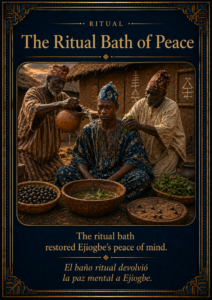
After the snails were obtained, they were broken, and the liquid from them was gathered. The Awos then collected Ero leaves and mixed them into the snail liquid so that Ejiogbe could bathe with it.
When the sacrifice had been completed and the bath had been carried out, Ejiogbe began to live in peace. His disturbed condition gave way to peace of mind.
From that event came a continuing instruction for divination. When Èjìogbè appears during divination, snails are to be offered to Ifá. When it appears at Ugbodu, the goat for the ceremony is not to be offered on that day. It is to be offered five days later. What is to be offered on the Ugbodu day are snails, dried rat, and dried fish.
After peace of mind returned to him through the ceremony, Ejiogbe rejoiced and sang:
Uroko iro, Erero lu uroko iro Erero.
This final chant marks the return of peace after disturbance. Even though the exact wording remains difficult, its placement in the story is clear: Ejiogbe sings after the sacrifice, bath, and restoration have been completed. The chant therefore functions as a sign of release, relief, and restored inward balance.
Main Characters
Ejiogbe
Ejiogbe is the central figure of the story. He is known for benevolence, healing, sacrifice, fertility support, and practical spiritual assistance. His authority comes from usefulness rather than title alone. Yet the story also shows that even one who helps many people may still need divination, protection, and restoration.
The Elderly Awos
The elderly Awos represent opposition born from envy. They are older and more established, but they cannot match Ejiogbe’s beneficial force. Their role shows that seniority alone does not guarantee righteousness. In this story, they become the field of hidden danger.
The Guardian Angel
The guardian angel appears as a messenger of warning. This figure does not remove the danger directly, but reveals it so that Ejiogbe can act correctly. The dream warning becomes an act of mercy before open harm arrives.
The Ifá Priests
The Ifá priests are the divinatory authorities who reveal the proper path. They do not merely comfort Ejiogbe. They diagnose the condition and prescribe what must be done.
The Awos
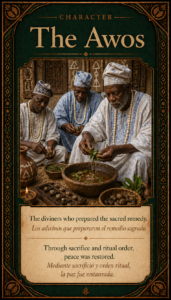
The Awos carry out the ritual preparation. They break the snails, collect the liquid, gather Ero leaves, and prepare the bath. Their work shows that sacred instruction must be enacted with care.
The People Ejiogbe Helped Before
This group is brief but important. They bring the snails when Ejiogbe cannot afford them. Their return shows that past goodness may become future support. The help Ejiogbe once gave to others now comes back to preserve him.
Ifá
Ifá is the sacred authority to whom the sacrifice is directed. The story moves through Ifá’s divination, Ifá’s instruction, Ifá’s offering, and the lasting divinatory guidance that follows.
Moral and Spiritual Teachings
One major teaching of this story is that service creates true authority. Ejiogbe is honoured because he genuinely helps people. His value is not self-declared. It is proven through restoration, sacrifice, fertility support, and care for those in need.
A second teaching is that blessing can attract opposition. The story does not present honour as simple. Being loved by many does not mean being safe from all. Admiration and envy may grow at the same time.
A third teaching is that warning is mercy. Ejiogbe receives a dream before the danger becomes open. The warning itself becomes protection because it moves him toward divination.
Another teaching is that peace of mind requires order. Ejiogbe’s unrest is not solved by wishing or waiting. It is corrected through consultation, sacrifice, material preparation, bathing, and obedience.
The story also teaches that relationship has spiritual force. Ejiogbe cannot fulfill the sacrifice alone, but those he had previously helped now help him. Their support does not replace ritual; it makes the ritual possible.
Finally, the story teaches that timing matters. The Ugbodu instruction shows that even when the correct offering is known, it must still be made in the correct order and at the correct time.
Symbols and Sacred Elements
The House
Ejiogbe’s house represents service and public recognition. It is the place where people gather because help can be found there. It also reveals the scale of his reputation.
The Dream
The dream is the medium of warning. It shows that hidden matters may be revealed before they become visible in daily life.
The Guardian Angel
The guardian angel symbolizes protective spiritual accompaniment. Protection appears first not as rescue, but as warning.
Snails
Snails are the main prescribed offering in the restoration of Ejiogbe’s peace. They are not decorative details. They are operative ritual materials within the account.
Snail Liquid
The liquid gathered from the broken snails becomes part of the ritual bath. It turns the sacrifice into something applied directly to the body.
Ero Leaves
Ero leaves are gathered and mixed into the snail liquid. Their presence shows that the bath is specific, prepared, and ritually composed.
Bathing
The bath represents direct ritual correction. Peace is not only spoken over Ejiogbe; the sacred preparation touches his body.
Goat
The goat is important because its offering is delayed. It teaches that correct ritual material must still obey correct timing.
Dried Rat and Dried Fish
The dried rat and dried fish belong to the Ugbodu-day offering. Their presence reinforces the exactness of the prescription.
The Rejoicing Chant
The final chant marks the return of peace. Ejiogbe’s restoration becomes visible and audible through song.
Divinatory Pattern
This Èjìogbè teaching leaves a clear divinatory pattern.
First, a person’s good works, usefulness, or public honour may attract hidden opposition. The danger may not yet be visible, but unrest, troubling dreams, or subtle spiritual warning may reveal that something is gathering.
Second, warning must lead to consultation. Ejiogbe does not dismiss the dream. He goes to Ifá priests, and through divination the proper path is revealed.
Third, peace requires exact observance. The story names snails, snail liquid, Ero leaves, goat, dried rat, and dried fish. It also gives sequence and timing. The goat is not offered immediately in the Ugbodu context, but five days later.
Fourth, help may return through those one has helped before. Ejiogbe’s earlier benevolence becomes part of his own preservation.
The pattern is therefore not only about danger. It is about how danger is answered: through divination, sacrifice, relationship, ritual preparation, patience, and obedience.
When This Odù Appears
When Èjìogbè appears through this teaching, it may point to a condition in which a person’s usefulness, public honour, or growing influence has attracted hidden resistance.
It may also point to inner disturbance, lack of peace, troubling dreams, or a spiritual warning that should not be ignored.
This appearance of Èjìogbè may warn against assuming that good works alone remove the need for protection. A person may be loved, useful, and spiritually effective, yet still require divination and sacrifice.
It may also reveal that the remedy is known but the means are lacking. In such a case, the story teaches that despair is not the answer. Right relationship, reciprocal goodwill, and support from others may become part of the path forward.
Finally, this Odù may warn about impatience. Correct offering must be joined to correct timing. The delayed goat in the Ugbodu context shows that sacred order includes sequence, restraint, and obedience.
Reflection Questions
Why does Ejiogbe become honoured in this story?
What is the connection between his benevolence and the hostility of the elderly Awos?
Why is the dream warning so important before the danger becomes visible?
What does the story teach about the difference between rank and true usefulness?
Why does Ejiogbe still need divination if he has already helped so many people?
Why is Ejiogbe’s lack of money important to the story?
How does the help of those he once helped deepen the meaning of the narrative?
Why are snails, snail liquid, and Ero leaves central to the restoration of peace?
What does the delayed goat offering teach about sacred timing?
How does Ejiogbe’s personal restoration become instruction for later divination?
Conclusion
The power of this Èjìogbè story lies in the way it joins public honour, hidden danger, sacred warning, and restored peace.
Ejiogbe is honoured because he helps others. His house becomes a place of healing, sacrifice, fertility, and assistance. Yet the same goodness that lifts his name also draws envy from those who cannot match his benevolence.
Before the danger becomes open, he is warned in a dream. That warning is mercy. But mercy must be answered. Ejiogbe does not respond with pride, denial, or panic. He goes for divination.
Through Ifá’s instruction, the sacrifice with snails, the support of those he had once helped, the preparation of snail liquid and Ero leaves, and the ritual bath, Ejiogbe’s troubled condition is corrected. Peace returns.
The final teaching is unmistakable: rising destiny must be protected. Good works create honour, but honour must still be guarded. Peace of mind is not always restored by feeling alone. Sometimes it must be restored through divination, offering, preparation, timing, relationship, and obedience.
Warning is already grace.
But grace must be answered.
And when sacred order is followed, peace can return.
Leave a Reply