Odù Context
This story belongs to Baba Ejìogbè, one of the foundational Odù of Ifá, and reflects themes of origin, manifestation, sacred order, and divinely sanctioned transition. In this surviving account, destiny is not presented as a merely human process. Instead, the movement begins in the unseen realm before becoming visible on earth.
A central pattern of Baba Ejìogbè appears clearly here: what is meant to enter the world may first require heavenly approval, proper alignment, and guarded passage. Desire exists on earth, but fulfillment advances only when higher authorization has been given.
Although this portion of the account does not preserve a formal divination scene, a named priest, or listed ebó materials, it still reveals a strong spiritual law. Manifestation does not unfold by longing alone. It moves through permission, timing, and sacred order.
Story Overview
This sacred narrative begins before birth itself. Rather than opening with the child already in the world, the story first reveals an unseen process taking place in heaven. It teaches that some lives are not brought into the world by human desire alone, but are first prepared, approved, and released through sacred order.
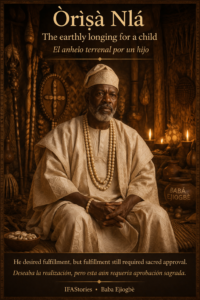
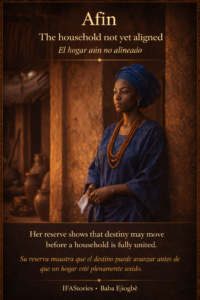
On earth, Òrìṣà Nlá was already married to Afin, yet they were not united in one desire regarding childbirth. Òrìṣà Nlá deeply wanted a child, while Afin did not appear inclined toward having one. That difference creates the first tension in the story. It is not shown as open household conflict, but as a condition of incompletion.
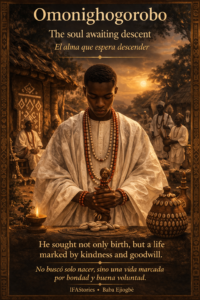
At the same time in heaven, Omonighogorobo desired to come into the world as the child of Afin and Òrìṣà Nlá. He did not seek birth merely for existence. He wished to enter the world in order to show benevolence, kindness, and goodwill.
Though brief, the surviving account leaves behind a strong teaching: what is meant to appear on earth may first require sacred approval above.
The Story
Òrìṣà Nlá was already in the world and was married to Afin. Although they were joined in marriage, they were not joined in one desire concerning childbirth. Òrìṣà Nlá strongly wished for a child, while Afin was not inclined toward having one.
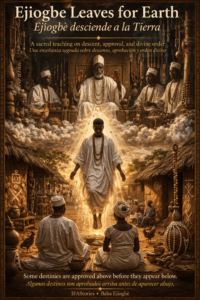
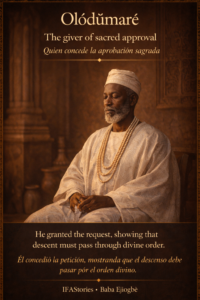
At the same time in heaven, Omonighogorobo went to the altar of Olódùmarè with the desire to come into the world as the child of Afin and Òrìṣà Nlá. He also wished to show the world benevolence, kindness, and goodwill.
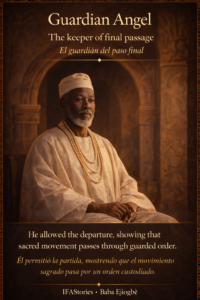
Olódùmarè granted the request. Even then, the descent was not immediate. Omonighogorobo still had to receive clearance from his guardian angel. Only after that final permission was given did he depart from heaven for earth.
This is where the surviving portion of the story ends. The birth itself is not yet described, nor does the narrative show the later household outcome on earth. But the fragment leaves behind a clear law: some destinies are first named, sanctioned, and released in heaven before they become visible in the human world.
Story Structure Explained
The structure of the fragment is brief, but highly ordered.
The first movement establishes the earthly condition: marriage is present, but shared desire is not. A household exists, yet a child has not come forth.
The second movement shifts to heaven. Omonighogorobo does not simply appear in the world by impulse. He approaches the altar of Olódùmarè and makes a sacred request to descend through a specific earthly lineage.
The third movement is authorization. The request is granted by Olódùmarè, showing that the descent has received divine approval.
The fourth movement is guarded passage. Even after approval, there is still another threshold: clearance from the guardian angel.
The final movement is departure. Omonighogorobo leaves heaven for earth, but the surviving account stops before the birth itself is shown.
The governing pattern of the fragment is therefore clear: earthly longing, heavenly petition, divine authorization, guarded passage, descent.
Main Characters
Òrìṣà Nlá
Òrìṣà Nlá represents earthly desire within the story. He longs for a child, yet his longing alone does not produce fulfillment. His role shows that sincere human desire may remain incomplete until it is brought into alignment with a larger sacred order.
Afin
Afin represents non-alignment within the household. The story does not condemn her, nor does it explain her reasons. Her importance lies in the fact that she does not share the same desire for childbirth. Through her, the story reveals that destiny may be connected to a household that is not yet fully united within itself.
Omonighogorobo
Omonighogorobo is the most active figure in the fragment. He desires to descend into the world and expresses a benevolent purpose before birth itself. His role reveals that manifestation may begin with intention long before it appears in visible life.
Olódùmarè
Olódùmarè is the supreme divine authority before whom the petition is made and by whom the request is granted. This confirms that entry into the world is not treated as an ordinary occurrence, but as something subject to sacred approval.
Guardian Angel
The guardian angel provides final clearance before descent. This is one of the most important details in the fragment. It shows that even after divine approval, passage into the world is still watched, ordered, and protected.
Human Conditions Revealed
One of the clearest conditions in the story is the longing for fulfillment. Òrìṣà Nlá desires a child, but the story makes clear that desire by itself does not complete destiny.
Another condition is non-alignment within human life. The household is not internally united, yet the sacred process is already moving beyond what can be seen on earth.
A third condition is purpose before manifestation. Omonighogorobo expresses a benevolent mission before entering the world. This gives the story spiritual depth, suggesting that some lives are linked to purpose before they become visible.
A fourth condition is dependence on sacred order. The path to earth passes through petition, approval, and clearance. Destiny here is not impulsive. It is governed.
Spiritual Teachings
A major teaching of this fragment is that desire alone does not complete destiny. Human longing may be real, but fulfillment may still depend on a higher order.
Another teaching is that manifestation is governed by sacred permission. Omonighogorobo does not enter the world simply because he wishes to. He enters through approval and orderly passage.
The story also teaches that purpose can exist before visible life. Omonighogorobo’s intention toward benevolence is declared before his earthly arrival. This presents existence not as random arrival, but as mission-bearing descent.
Finally, the fragment teaches that transition is structured and protected. Even after approval is granted, there is still guardian clearance. Sacred movement is layered, not rushed.
Symbols and Sacred Elements
The Altar of Olódùmarè
This is the site of petition. It represents reverent access to divine authority and shows that descent begins through sacred approach rather than self-assertion.
Heaven
Heaven is the unseen realm where intention, permission, and order are established before visible life unfolds.
Earth
Earth is the realm of manifestation, household life, longing, and eventual fulfillment. It is where what has been prepared above becomes visible below.
Guardian Clearance
This symbolizes watched and regulated passage. The movement from heaven to earth is not unguarded, but spiritually overseen.
Ritual Logic
No explicit divination, sacrifice, prohibition, or ritual prescription is preserved in this surviving portion of the account. That absence should be respected.
What the fragment does preserve is a sacred sequence: petition, sanction, clearance, descent.
That sequence is the ritual logic of the story. Its spiritual intelligence lies not in a listed ebó here, but in the law of ordered permission. The account teaches that what enters the world in truth may first pass through sacred approval before taking earthly form.
When This Odù Appears
In the light of this fragment, Baba Ejìogbè may speak to situations in which fulfillment has not yet appeared, even though the movement toward it has already begun.
It may reflect moments when desire exists, but manifestation depends on alignment, sanction, and timing beyond immediate human control.
It may also speak to family or household conditions in which unity is incomplete, yet destiny is still moving through the unseen layers of life.
The deepest counsel here is not haste, but order. When something important has not yet appeared, this fragment advises patience, alignment, and respect for sacred timing.
Reflection Questions
Why does the story begin with a divided household condition before shifting to heaven?
What does Omonighogorobo’s mission teach about purpose before birth?
Why is divine approval followed by guardian clearance instead of immediate descent?
What does this fragment reveal about the difference between longing and manifestation?
How should incomplete sacred narratives be read without adding details the surviving text does not provide?
Closing Reflection
This fragment is short, but its teaching is enduring. What is meant to appear in the world may first be prepared elsewhere. What is longed for on earth may require approval beyond earth. And what carries true destiny may need not only desire, but also order, sanction, and sacred passage before it becomes visible in human life.
Source Reference
This narrative is drawn from the Baba Ejìogbè section of IFISM: The Complete Work of Orunmila by Mr. C. Osamaro Ibie. In this article, the story is presented within the framework of traditional Ifá practice, sacred study, and cultural preservation.
This adaptation treats the account not as fiction, but as part of the living wisdom of Ifá. It is respectfully presented for spiritual education, reflective study, and the continuity of Yoruba sacred knowledge.
Leave a Reply