ODÙ CONTEXT
This story belongs to the sacred stream of Ejiogbe, where marriage, forgotten instruction, household disorder, sacrifice, healing, and irreversible consequence become central teachings.
At the heart of the account is a union that begins with desire but remains unprotected because a sacred instruction is left undone. Ejiogbe marries Eji-Alo, but he forgets the he-goat offering he had been instructed to give to Esu after marriage.
From that omission, the story unfolds through affliction, separation, ritual correction, healing, and transformation into landscape memory.
This Odù teaches that joy does not cancel responsibility. A household may begin in love, but when sacred order has spoken and its instruction is forgotten, what was neglected may later appear through suffering, rupture, and consequence.
STORY REFERENCE
This story is respectfully adapted from the Baba Èjìogbè section of IFISM: The Complete Work of Orunmila by Mr. C. Osamaro Ibie.
Within IFAStories, the account is presented as a sacred Ifá narrative for spiritual education, cultural preservation, and reflective study.
This adaptation preserves the traditional meaning of the story while shaping the narration, structure, and commentary for a modern educational audience. It is offered with respect for Ifá, Yoruba sacred knowledge, and the ancestral wisdom carried through Odù.
INTRODUCTION
Some Ifá stories reveal disorder through open conflict. Others reveal it through what was forgotten.
The Marriage of Ejiogbe begins with attraction and union. Ejiogbe sees Eji-Alo, loves her, and accepts her as his wife. Yet beneath that beginning lies a serious omission: after marriage, he fails to give the big he-goat to Esu that he had been instructed to offer.
The story does not treat what follows as random. The afflicted child, the departure of Eji-Alo, and the sorrow of the household are all read through the earlier forgotten instruction.
Yet this is not only a story of consequence. It is also a story of correction. The offering is remembered. The medicine is prepared. The child is healed.
But the story refuses an easy ending.
The child is restored, yet the marriage is not. What had already broken does not simply return to its first condition. Instead, the consequence enters the land itself through the river called Oluweri.
QUICK TAKEAWAY
A household is not secured by affection alone.
When sacred instruction is forgotten, its consequence may enter quietly. Healing may still come, but not every broken thing returns to what it was before.
THE STORY
Ejiogbe woke and met a fair-skinned woman named Eji-Alo.
As soon as he saw her, he loved her. She also desired him and offered herself to him in marriage. Ejiogbe accepted her as his wife.
But after the marriage, Ejiogbe forgot what had been required of him.
He had been instructed in heaven to give a big he-goat to Esu after marrying on earth, so that his wife would not desert him. He did not make the offering.
Eji-Alo was the daughter of a wealthy chief at Ife. In time, she became pregnant and gave birth to a male child who was crippled from the womb.
Although Ejiogbe could heal other cripples, he could not heal his own child.
Because of the child’s condition, Eji-Alo became frustrated. She refused to remain in Ejiogbe’s house and care for the child. At last, she left the house and left the child behind with him.
After some time, Esu, Ogun, and Obalifon met Ejiogbe and asked why he had not been seen outside. Ejiogbe told them that Eji-Alo had left him with a crippled child to care for.
Then Esu went to seek ritual help in heaven.
The two Awos connected with the matter were Eduwe Koko Meji and Ejo Meijinja. They were the same Awos who had earlier performed divination for Ejiogbe during his last spiritual journey to heaven.
They reminded him that he had been instructed to give a big he-goat to Esu after marriage so that his wife would not desert him.
The forgotten instruction was finally restored.
The he-goat was given to Esu. After the sacrifice was completed, the two Awos prepared medicine and used it to wash the child’s legs.
At once, life returned to the child’s limbs.
The child was healed.
But Eji-Alo did not return. She had already married Oluweri.
A portion of the medicine that had been used for the child was then prepared into Àṣẹ for Ejiogbe. With it, he could command Eji-Alo to return if he chose.
But because she was already with another man, Ejiogbe used the Àṣẹ differently. He called Eji-Alo to meet him at a place far from the environs of Ife. He also commanded Oluweri to come to that same place.
When Eji-Alo and Oluweri appeared before him, Ejiogbe caused them to fall down. He joined them into one body and commanded them to move forward forever without turning back.
In this way, Eji-Alo and Oluweri became the flowing river now called Oluweri in Ondo State of Nigeria.
The story also preserves a divinatory warning. When Ejiogbe appears in divination for a woman who is thinking of leaving her husband, she should be warned not to do so lightly, especially if she is the wife of an Ifá priest.
STORY STRUCTURE
Initial Desire and Hidden Omission
The story opens with immediate attraction and marriage. Ejiogbe and Eji-Alo are drawn to each other, and the union begins with desire and acceptance.
But the true instability is already present.
The required offering to Esu has not been made. The visible happiness of the union is therefore built over an unseen omission. This is the hidden fracture beneath the household.
Exposure Through Affliction
The child’s crippled birth makes the hidden disorder visible.
The story then deepens the crisis by showing that Ejiogbe can heal others, yet cannot heal his own child. His power is real, but it cannot function fully while the earlier instruction remains unfinished.
The household becomes the place where the neglected obligation is exposed.
Divination and Ritual Recall
The turning point begins when Esu, Ogun, and Obalifon meet Ejiogbe and bring the matter into the open.
The Awos Eduwe Koko Meji and Ejo Meijinja do not invent a new solution. They remember the old instruction. They reconnect the present crisis to the earlier divination.
This is important because the story teaches that forgotten guidance does not stop governing destiny simply because a person has moved on.
Sacrifice and Correction
Once the he-goat is finally given to Esu, the ritual correction begins.
Medicine is prepared. The child’s legs are washed. Life returns to the child’s limbs.
The healing confirms that the offering, medicine, and remembered instruction are not decorative details. They are the sacred means through which the story moves from disorder toward correction.
Healing Without Reconciliation
The child is healed, but the marriage is not restored.
This is one of the deepest teachings of the story. Correction is real, but it does not erase everything that has already happened.
Eji-Alo has already married Oluweri. The relationship has moved beyond its first condition.
Transformation Into Landscape Memory
The story ends not with reunion, but with transformation.
Eji-Alo and Oluweri are joined into one body and made to move forward forever. They become the river called Oluweri.
The private sorrow of the household becomes public memory in the land.
Lasting Divinatory Instruction
The narrative does not end only as an origin story for the river.
It continues as divinatory guidance. When this sign appears, the story warns against leaving a marriage lightly under the conditions preserved in the Odù.
The story survives because it continues to speak.
MAIN CHARACTERS
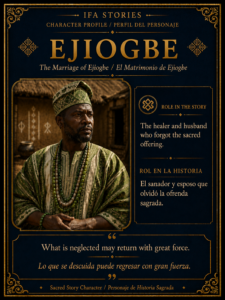
Ejiogbe
Ejiogbe is the central figure of the story: husband, father, ritual subject, and final acting authority.
His life carries the consequence of neglected instruction. He enters marriage but forgets the offering required after marriage. Because of this, the household becomes exposed to affliction, departure, and sorrow.
Spiritually, Ejiogbe represents the danger of incomplete obedience. He has power, but he is not above sacred responsibility. He can heal others, yet cannot heal his own child until the forgotten instruction is restored.
By the end of the story, he moves from helplessness into restored authority.
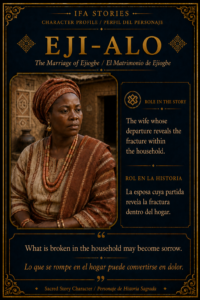
Eji-Alo
Eji-Alo is the woman Ejiogbe loves and marries.
Her role should not be flattened into that of a simple villain. Her departure is serious, and the story gives it consequence, but it happens within a household already affected by neglected sacred order.
She becomes the visible sign of the earlier warning: Ejiogbe had been told to give the he-goat to Esu so that his wife would not desert him.
Her movement away from the marriage becomes one of the ways the forgotten instruction manifests.
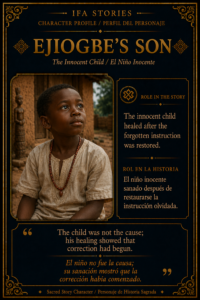
The Child
The child is one of the most important figures in the story.
He does not speak, but his condition reveals the hidden disorder of the household. His affliction is not presented as moral blame. The child is innocent.
His body becomes the place where the unfinished instruction becomes visible.
Through his healing, the story shows that correction is possible. Yet through the continued rupture of the marriage, the story also shows that healing one wound does not restore everything that has been broken.
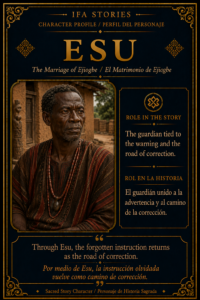
Esu
Esu carries the warning Ejiogbe failed to honor.
The offering to Esu was meant to guard the home, preserve the marriage, and protect the innocent child from becoming exposed to consequences he did not cause.
When the warning was left undone, the protection remained unfinished. Correction therefore had to return through Esu, because Esu was connected to the instruction that had been neglected.
His role in this story is not separate from the crisis. He stands at the point where forgotten instruction, consequence, and correction meet.
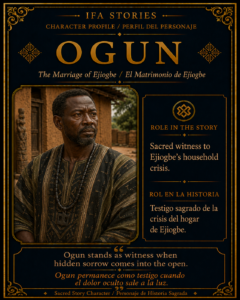
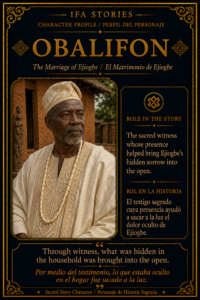
Ogun and Obalifon
Ogun and Obalifon appear with Esu when Ejiogbe has withdrawn from public life.
Their presence helps reveal the seriousness of the crisis. They function as sacred witnesses to Ejiogbe’s isolation and household sorrow.
Their arrival marks the moment when private suffering becomes exposed before sacred figures.
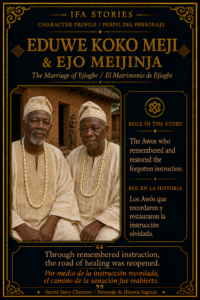
Eduwe Koko Meji and Ejo Meijinja
Eduwe Koko Meji and Ejo Meijinja are the Awos who reconnect the crisis to its original source.
They had already performed divination for Ejiogbe during his earlier spiritual journey. When they appear again, they do not create a new explanation. They remember what had already been spoken.
Their importance lies in memory, precision, and ritual continuity.
They show that some problems cannot be solved by new action until the old instruction is completed.
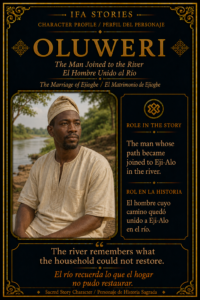
Oluweri
Oluweri is the man Eji-Alo later marries.
His presence prevents a simple return to the earlier marriage. Once Eji-Alo has joined herself to another man, the story moves away from reconciliation and toward transformation.
In the final outcome, Oluweri is joined with Eji-Alo and becomes part of the river that carries the memory of the story forward.
HUMAN CONDITIONS REVEALED
Attraction
The story begins with attraction between Ejiogbe and Eji-Alo.
This attraction is real, but it is not enough to secure the household. The story teaches that desire can begin a union, but cannot protect it by itself.
Neglected Obligation
The central hidden condition is the neglected offering to Esu.
This forgotten obligation becomes the source of disorder beneath the visible events. The story insists that what is left undone may later become the deepest cause of suffering.
Affliction
The child’s condition is the visible form of the hidden disorder.
The story does not blame the child. Instead, the child’s affliction reveals that something in the household was unfinished before he was born.
Helplessness
Ejiogbe’s inability to heal his own child is central.
He has spiritual ability, but his power is blocked in the matter closest to his heart. This reveals that public strength does not cancel private responsibility.
Household Fracture
Eji-Alo’s departure shows how suffering can break a household apart.
The marriage does not simply endure the pressure. The forgotten instruction moves from hidden omission into visible rupture.
Correction
The restored offering and medicine show that correction is possible.
The child’s healing proves that the disorder can be addressed when the forgotten instruction is remembered and restored.
Irreversible Consequence
The transformation of Eji-Alo and Oluweri into the river shows that not every consequence can be reversed.
The story ends by fixing unresolved human conflict into geography and memory.
MORAL AND SPIRITUAL TEACHINGS
Sacred Instruction Remains Binding
One of the central teachings of this story is that sacred instruction remains active even when it is forgotten.
The Awos do not search for a new cause. They recover the old instruction. This shows that what Ifá has already revealed may continue to govern later events.
Sacrifice Protects the Household
The he-goat offering to Esu is tied directly to the stability of the marriage and the protection of the household.
This makes the story especially important for understanding that sacrifice is not only personal. In this account, the offering concerns relationship, family, and the child who comes through the union.
Visible Suffering May Reveal Hidden Disorder
The child’s affliction points backward to the forgotten offering.
The story does not encourage shallow explanation. It teaches that visible suffering may require deeper spiritual diagnosis.
Healing and Reconciliation Are Not the Same
The child is healed, but the marriage is not restored.
This is one of the story’s most powerful teachings. Healing may come, but it does not always return everything to its former condition.
Some consequences continue after one part of life has already been corrected.
Sacred Stories Continue as Guidance
The story does not remain only in the past.
Its final warning continues into divinatory practice. This means the narrative is not only remembered as history or myth. It remains a living teaching when the sign appears.
SYMBOLS AND SACRED ELEMENTS
The Child’s Legs
The child’s legs are the visible site of affliction and healing.
Their restoration shows that the ritual correction has become effective in the body. The story does not only say healing occurred; it shows movement returning.
The River Called Oluweri
The river preserves the final transformation.
Spiritually, it represents consequence fixed into geography. What began as household disorder becomes memory carried by the land.
The river also completes the movement pattern of the story: first the child cannot move, then the child is healed, and finally Eji-Alo and Oluweri are made to move forward forever.
Ife
Ife anchors the story in a sacred and social setting.
It is the place connected to marriage, household life, family status, and the beginning of the visible crisis. The final confrontation occurs away from the environs of Ife, showing that the matter has moved beyond ordinary domestic repair.
The Big He-Goat
The big he-goat is the prescribed offering to Esu after marriage.
Its importance lies in enacted responsibility. The offering becomes the material hinge between warning, omission, and correction.
Medicine
The medicine first heals the child’s legs and later becomes connected to Àṣẹ-command.
This shows that sacred remedy may carry both restorative and authoritative force within the story.
Àṣẹ
Àṣẹ is the command-force prepared for Ejiogbe.
It is not vague power. It is effective authority used to summon Eji-Alo and Oluweri and bring the unresolved matter before him.
The Washing of the Legs
The washing of the child’s legs is the visible ritual action through which healing occurs.
Its meaning is embodied correction. What was blocked is opened. What could not move begins to move.
CULTURAL AND DIVINATORY CONTEXT
This story reflects a world in which marriage, child affliction, ritual obligation, divine inquiry, and later divination remain connected.
The household is not treated as separate from spiritual order. What happens in family life may be shaped by prior instruction, forgotten sacrifice, and ritual correction.
The story also preserves the importance of divination before action. The two Awos had already spoken to Ejiogbe during an earlier heavenly journey. Their words remain authoritative when the crisis later appears.
Sacrifice also appears here in concrete form. The he-goat is specific. Esu is specific. The ritual outcome is visible.
In the same way, the healing medicine and later Àṣẹ are preserved as exact parts of the story’s movement.
Most importantly, the narrative continues into practice. The ending makes clear that this account survives because it guides later divination. It is not just a remembered event. It becomes an active warning.
WHEN THIS ODÙ APPEARS
When this Odù appears, this story may warn about a household problem whose deepest cause is older than the visible crisis.
It may point to a situation where suffering has appeared, but the real disorder began with a neglected responsibility or forgotten instruction.
This narrative may also point to strain in marriage or partnership, especially where separation is being considered under unstable spiritual conditions.
One lesson drawn from this account is that departure should not be treated lightly when the sign itself preserves a warning against it.
The story may also diagnose a condition in which a person has strength in many areas but remains powerless in the matter closest to home.
In such a case, the counsel is not shallow confidence. The counsel is return to proper diagnosis, remembered instruction, and ordered correction.
It may further warn that not every healed condition restores the whole of life. A person may see one area repaired while another remains under consequence.
That is why the story invites humility, seriousness, and caution rather than quick conclusions.
RITUAL BOUNDARY NOTE
This story preserves ritual importance, but it does not provide a complete ritual procedure.
It tells us that Ejiogbe had been instructed to give a big he-goat to Esu after marriage.
It tells us that the forgotten offering was later restored.
It tells us that medicine was prepared and used to wash the child’s legs.
It tells us that part of the medicine became Àṣẹ-command.
But it does not teach how to perform the ritual.
Any procedural explanation would require source verification and practitioner review.
PRAYER / CHANT STATUS
No explicit prayer, rezo, chant, or súyẹ̀rẹ̀ is preserved in this verified story segment.
Because no chant is preserved, this article does not create one.
However, the absence of a chant does not mean the absence of sacred speech. Sacred speech appears through the original instruction given to Ejiogbe, the remembered divination of the Awos, the warning tied to the offering, the medicine, the Àṣẹ-command, and the final divinatory instruction.
REFLECTION QUESTIONS
Why does the story place so much weight on the offering that Ejiogbe failed to make after marriage?
What does the child’s affliction reveal that ordinary household explanation cannot fully explain?
Why is the child healed before the broken marriage is addressed?
What is the difference between correction and reconciliation in this story?
How should Esu’s role be understood here: as receiver of sacrifice, keeper of warning, mediator of correction, or all of these together?
Why does the story preserve its final warning in divination rather than ending only with the river’s origin?
What does it mean that unresolved household conflict becomes remembered through the river called Oluweri?
CONCLUSION
The Marriage of Ejiogbe teaches that what is neglected at the beginning of a household may later return with great force.
The story does not treat consequence as accidental. It shows that instruction, sacrifice, and relationship remain joined.
It also teaches that real healing does not erase every form of damage.
The child’s body is restored, yet the marriage is not. In this way, the narrative remains spiritually serious and refuses shallow comfort.
Its final dignity lies in the fact that it continues to speak.
It survives as counsel, warning, and teaching for those who meet the sign again in divination.
DOWNSTREAM SUMMARY BLOCK
Core Story Tension:
A marriage begins in attraction but is destabilized by a neglected post-marriage offering, leading to child affliction, separation, healing, and final consequence.
Core Ritual Dynamic:
The forgotten he-goat offering to Esu is later restored; medicine heals the child; part of that same ritual stream becomes Àṣẹ for summons and transformation.
Core Character Dynamic:
Ejiogbe moves from helpless husband under consequence to restored acting authority, while Eji-Alo moves from bride to absent wife to transformed consequence alongside Oluweri.
Core Teaching:
Neglected sacred obligation can disturb household destiny, and healing one condition does not always restore the whole of what was broken.
Core Divinatory Warning:
When this sign appears, the story warns that leaving a marriage should not be treated lightly, especially under the specific divinatory conditions preserved in this Odù.
Leave a Reply