Three Brothers
Odù: Oyekun-Okana
Source Tradition: IFISIM Volume 3 of Oyekun Meyi
Alternate Archive Title: The Three Brothers and the Delayed Sacrifice
Source Note
This story is preserved under Oyekun-Okana in the IFISIM corpus, Volume 3 of Oyekun Meyi. This IFAStories version presents the narrative for cultural education, spiritual reflection, and responsible public study.
Ritual Boundary Note
This article discusses ritual meaning as preserved in the story. It does not teach how to perform sacrifice, offering, initiation work, divination, or shrine preparation. Any practical ritual matter requires source verification and practitioner guidance.
Naming and Diacritic Note
For public readability, this article uses common canonical spellings such as Ifá, Odù, Òrúnmìlà, Èṣù, and Ògún where appropriate. Source spellings such as Orunmila, Esu, Ifa, and Ogun remain important for archive comparison. Names whose diacritics are uncertain are preserved in source spelling, including Oyekun-Okana, Olikatirege, Oligbonjamuko, Elesetirege, Okere, Oka, Arummwoto, Elegbede, Obu, Ugbodu, and Ase.
Quick Takeaway
A sacred warning is not passive information. In this story, delayed sacrifice becomes the opening through which disorder spreads, yet divine judgment still separates root cause from those swept into consequence.
Introduction
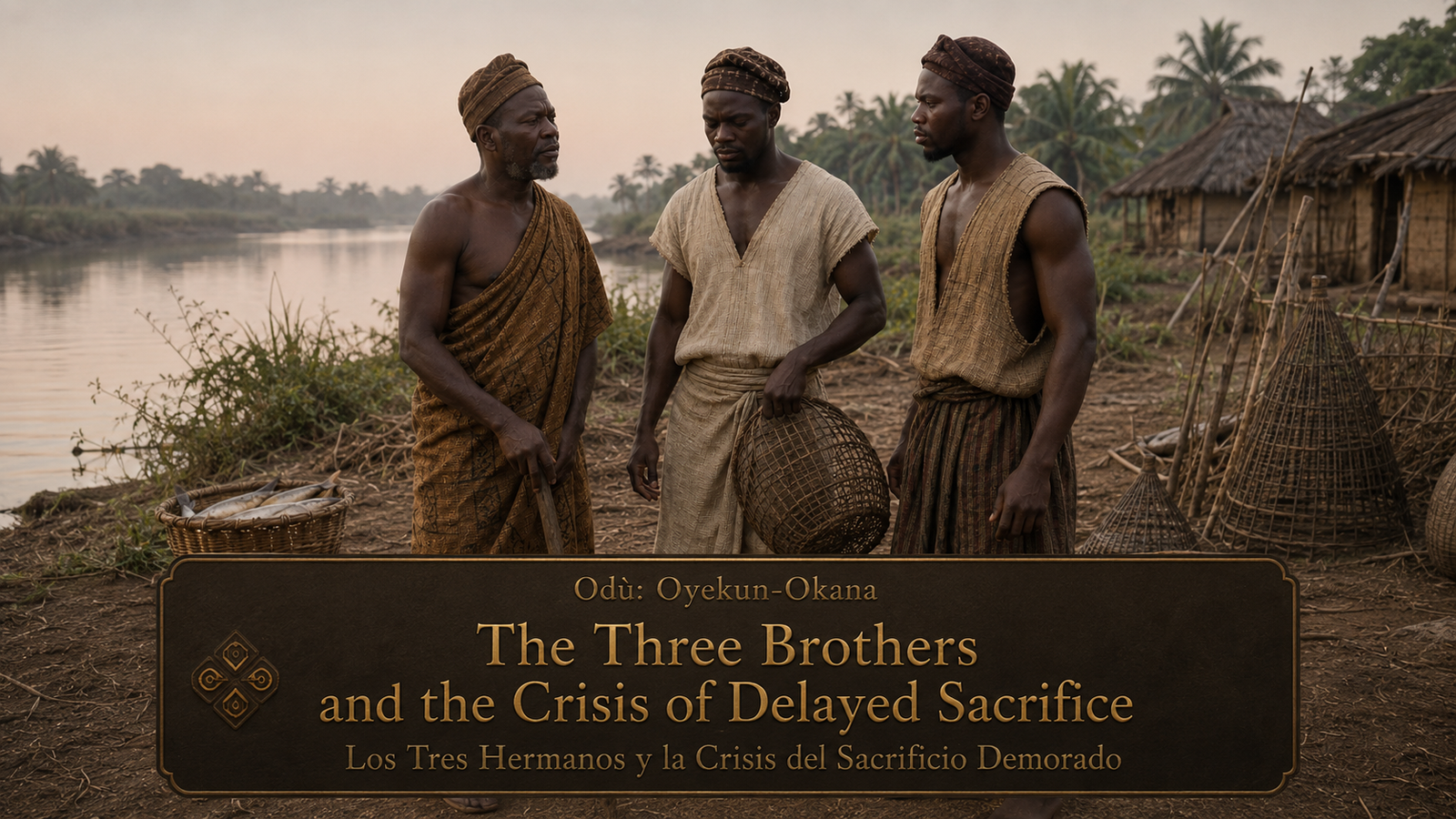
This traditional Ifá story preserved under Oyekun-Okana begins with three brothers whose work appears ordinary. They practice pond fishing, known in the source as Obu, by isolating a portion of the river, removing the water, and collecting the fish left behind.
Before going to the pond, the brothers consult Òrúnmìlà. They receive a warning: they must give a he-goat to Èṣù so that an imminent catastrophe can be avoided. The danger in the story does not begin because they reject the instruction. It begins because they delay it.
From that delay, the story unfolds into a widening chain of consequence: bodily injury, laughter, inherited fear, panic among animals, destruction of eggs, alarm, disorder in the town, harm within the royal household, and finally divine intervention.
The teaching is serious but precise. The story does not blame every being caught inside the crisis. It shows that Ifá looks beneath visible events to identify the root condition that allowed disorder to spread.
The Story
The Brothers and the Warning
There were three brothers. In order of seniority, their names were Olikatirege, Oligbonjamuko, and Elesetirege. Their work was pond fishing, called Obu in Yoruba. They would isolate a section of the river, bail out the water, and gather the fish left behind.
Before going to their fish pond, the brothers had gone to Òrúnmìlà for divination. Òrúnmìlà advised them to give a he-goat to Èṣù so that an imminent catastrophe would be avoided. The brothers did not reject the sacrifice, but they intended to perform it after returning from the pond.
The First Injuries
At the pond, Olikatirege, the eldest brother, was bailing water when his hand became fractured. Oligbonjamuko, the second brother, shouted when he saw what had happened, and in the process his jaw broke. Elesetirege, the youngest brother, saw the condition of his two elder brothers and ran toward home to seek help.
As Elesetirege was running, a rope twisted around his foot. He fell to the ground and broke his leg. Okere, the squirrel, saw him fall and began to laugh loudly.
The Chain of Fear Begins
When the boa, called Oka or Arummwoto, heard the squirrel laughing, he began to run. By tradition, the boa fled whenever the squirrel laughed. In his flight, the boa entered the hole of a rabbit.
When the rabbit saw the boa inside her hole, she understood that the same hole could not safely contain both of them. She ran out of the hole. The monkey saw the rabbit running in broad daylight and remembered that such a sight was a sign of calamity. The monkey then climbed high into an oak tree.
The Oak Tree Warning
When the monkey settled on one of the branches, the oak tree warned him that the branch on which he stood had been causing pain for three years. The monkey did not heed the warning. Instead, he paced back and forth on the weakened branch.
The branch broke and fell upon the stack of 201 eggs that the guinea-fowl had laid at the foot of the oak tree. When the guinea-fowl returned to her roost and saw what had happened, she cried out:
Ara kan mi go-go-go-go.
The Cry, the Drum, and the Elephant
Elegbede, the gorilla, was nearby and heard the cry of the guinea-fowl. To him, that cry was a signal that war was near. Preparing for the expected combat, he began beating the drum on his chest:
gidi-gidi-gidi-gidi.
The sound of the gorilla’s chest drumming startled the elephant. The elephant thought that war had begun, and he ran without direction until he entered the town.
The Crisis Reaches the Palace
When the cow and the other domestic quadrupeds saw an elephant in the town, they also began running for their lives. As the cow ran, he trampled the only child of the Oba, and the child died immediately.
The Oba had one eye and one child. When the Olori, the wife of the Oba, learned of the strange events, she ran into the room to alert him. She pointed her forefinger while asking whether he did not hear what was happening. As the Oba rose to respond, the sharp nail of the Olori’s pointed finger pierced his remaining eye, and he became totally blind.
The Heavenly Messenger
In the midst of the pandemonium, a heavenly messenger appeared and ordered the disturbance to stop. He gathered all the participants in the event and required them to explain the cause of their troubles.
The three brothers explained that before leaving for the fish pond, they had gone to Òrúnmìlà for divination. Òrúnmìlà had advised them to give a he-goat to Èṣù, but they had intended to make the sacrifice after returning.
The squirrel explained that he also had just returned from Òrúnmìlà. He had been advised to give palm fruits to Èṣù so that he would not cause a disturbance greater than himself. He said he was eating one of the palm fruits he had obtained when he saw a large man falling on the ground, and he could not stop himself from laughing.
The boa explained that the laughter of the squirrel had killed his parents and grandparents. Because of that, he had formed the habit of running for safety whenever he heard the squirrel laugh.
The rabbit explained that the boa had been the enemy of her kindred, because he had swallowed her parents and grandparents in past years. For that reason, whenever the snake entered her house, she fled.
The monkey explained that seeing the rabbit running in broad daylight was known to mean serious danger. That was why he climbed the oak tree.
The oak tree recalled that he warned the monkey not to trouble the painful branch. The monkey did not heed the warning, and the branch broke.
The guinea-fowl explained that the eggs she had produced over 201 days were destroyed before she returned home. That loss caused her to cry out.
The gorilla explained that his parents had warned him that whenever the guinea-fowl rang her bell, he should begin drumming on his chest.
The elephant explained that experience had taught him that whenever the gorilla beat his drum, it signaled a dangerous calamity. For that reason, he ran for his life.
The cow explained that the open town was not the proper place for an elephant. Seeing the elephant there caused him to run, and in that running he unintentionally trampled the only son of the Oba.
The Olori explained that the shock over the death of the Oba’s only child sent her into great agitation. In that state, she unwittingly pierced the Oba’s only eye with her finger.
Judgment, Restoration, and New Boundaries
After hearing the explanations, the heavenly messenger declared the others innocent. The exceptions were the three pond-fishing brothers and the squirrel, because they had delayed their sacrifices.
The heavenly messenger then proclaimed the restoration of the status that existed before the calamity. The broken hand of Olikatirege, the broken jaw of Oligbonjamuko, and the broken leg of Elesetirege were restored.
The messenger re-established God’s earlier decree from the beginning of time: the boa would die on the day he killed the rabbit or any of her children. It was also decreed that the boa should never again enter any hole.
The 201 eggs of the guinea-fowl were restored. The hand of the oak tree was restored. The life of the Oba’s dead son was restored, and the sight of the Oba was restored. The elephant was returned to the forest forever.
The heavenly messenger also proclaimed that from that time onward, the squirrel should no longer laugh at anyone he saw. The exception was the boa, because the squirrel had been appointed by God to warn others of the boa’s presence in any place, due to the boa’s venomous weapon, called Ase, which the boa had been warned not to use arbitrarily.
Divinatory Instruction Preserved in the Source
When this Odù comes out at Ugbodu, the person should be told to make sacrifice. The source states that the person was destined to become a great man and to do great things, provided the required sacrifice was made. If the sacrifice was not made, the person could cause a crisis of abominable proportions in his town or in his family.
The person should serve Èṣù with:
- he-goat
- squirrel
- boa
- the head of a rabbit
- the feather of a guinea fowl
- the branch of an oak tree
- the meat of elephant
- bones of domestic animals
This is identified as the special sacrifice to be made before the conclusion of the person’s Ifá initiation ceremony.
At ordinary divination, the person should be told to have his own Ifá without delay. If the person is a woman, the source states that she should be advised to marry an Ifá man.
The person should also make sacrifice with:
- a he-goat
- a drum prepared with cocoyam leaves
The person should give:
- a cock to Ògún
The stated purpose is to avert the danger of becoming the victim of an undeniable falsehood.
For a person born of this Odù, the source states that he should make special sacrifice with:
- a goat
- a hen
The stated purpose is to live long and avoid doing harm to others.
The person born of this Odù should forbid:
- alcohol
- roasted yam
- the meat of a he-goat
The person should also prepare his own Ògún shrine.
Public reading note: These instructions are preserved because they belong to the source tradition. They should not be treated as a complete ritual manual or universal modern advice.
Story Structure
Initial Condition
The story begins with three brothers who work together as pond fishermen. Their daily labor creates the first setting of the narrative: the river and the pond.
Divination
Before going to work, the brothers consult Òrúnmìlà. This places the whole story under a divinatory frame. The crisis has already been seen before it becomes visible.
Sacrifice and Warning
Òrúnmìlà tells the brothers to give a he-goat to Èṣù to avoid imminent catastrophe. This warning is specific and ritual-based. It is not vague advice.
Delayed Obligation
The brothers intend to complete the sacrifice later. The squirrel also has a delayed obligation: palm fruits to Èṣù, prescribed so he would not cause a disturbance greater than himself.
Conflict and Escalation
The crisis grows through a chain of reactions. Injury leads to laughter. Laughter leads to flight. Flight leads to displacement. Displacement leads to fear. Fear leads to a broken branch, destroyed eggs, alarm, panic, death, and blindness.
Divine Reordering
The heavenly messenger stops the disorder and gathers every participant. The messenger listens before judging. This is important because the story does not treat every participant as equally guilty.
Restoration
The injured brothers are restored. The guinea-fowl’s eggs are restored. The oak tree is restored. The Oba’s child is restored to life, and the Oba’s sight is restored.
Lasting Instruction
The story ends with prohibitions, restrictions, and divinatory guidance. The boa and squirrel receive future boundaries, and the source preserves instructions for Ugbodu, ordinary divination, and a person born of this Odù.
Main Characters and Relationship Roles
Olikatirege, Oligbonjamuko, and Elesetirege
These are the three brothers at the center of the opening conflict. They are not presented as evil or malicious. Their error is delay. They receive divination, but the required sacrifice is postponed.
Their role shows that a sacred instruction may require timely completion. In the final outcome, their injuries are restored, but their responsibility is still named.
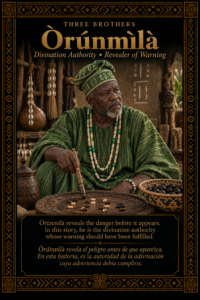
Òrúnmìlà
Òrúnmìlà is the divination authority. He sees the danger before it appears and gives the required instruction. He should not be treated as a fantasy figure. His role is divinatory authority and revealer of warning.
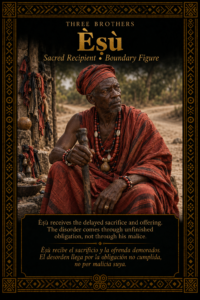
Èṣù
Èṣù is the recipient of the prescribed sacrifice and offering. In this story, Èṣù functions as the sacred recipient connected to ritual obligation, boundary, and the prevention of disorder.
Èṣù should not be presented as demonic or as the villain of the story. The crisis comes from delayed obligation, not from Èṣù acting maliciously.
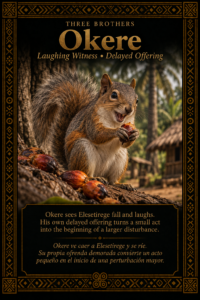
Okere / Squirrel
The squirrel sees Elesetirege fall and laughs. This laughter begins the wider animal chain. The squirrel also had received instruction from Òrúnmìlà to give palm fruits to Èṣù but had not completed the offering.
His role shows how a small act may become large when it occurs within unresolved sacred obligation.
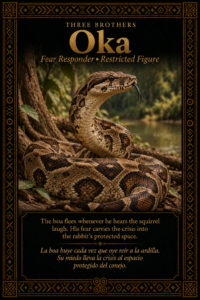
Boa / Oka / Arummwoto
The boa reacts to squirrel laughter because of inherited danger. The story says squirrel laughter had killed his parents and grandparents. His flight sends the crisis into the rabbit’s protected space.
The boa is not a horror figure. He is part of the chain of fear and later receives restrictions.
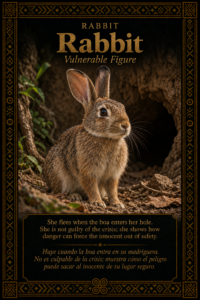
Rabbit
Rabbit flees when the boa enters her hole. Her role shows vulnerability and displacement. She is not guilty of the crisis; she is forced to move because danger enters her space.
Monkey and Oak Tree
The monkey reads the rabbit’s daylight flight as a sign of calamity and climbs the oak tree. The oak tree warns him about the painful branch, but the monkey ignores it. Their relationship shows that seeing one warning does not excuse ignoring another.
Guinea-fowl and Elegbede
The guinea-fowl loses 201 eggs and cries out. Elegbede, the gorilla, hears her cry as a war signal and beats his chest. Their relationship shows how sound and warning move through the story.
Elephant, Cow, Oba, and Olori
The elephant carries forest panic into town. The cow reacts to the elephant and accidentally kills the Oba’s child. The Olori reacts to the death of the child and accidentally blinds the Oba.
These figures must be handled carefully. The story does not present the Oba’s child, the Oba, the Olori, or the cow as root causes. They are caught inside the consequence.
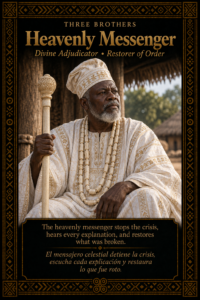
Heavenly Messenger
The heavenly messenger is the divine adjudicator. He stops the crisis, hears every explanation, identifies the delayed sacrifices as the true root, restores what was broken, and establishes future boundaries.
Ògún
Ògún appears in the final divinatory instruction through the cock offering and shrine reference. His role belongs to the source’s practical divinatory guidance, not the main chain of crisis.
Character Card Gallery
The following captions may be paired with the individual IFAStories character cards for this blog page.
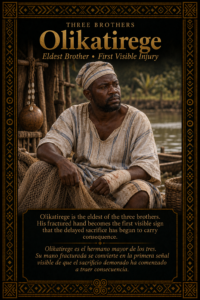
Olikatirege — Eldest Brother / First Visible Injury
English: Olikatirege is the eldest of the three brothers. His fractured hand becomes the first visible sign that the delayed sacrifice has begun to carry consequence.
Español: Olikatirege es el hermano mayor de los tres. Su mano fracturada se convierte en la primera señal visible de que el sacrificio demorado ha comenzado a traer consecuencia.
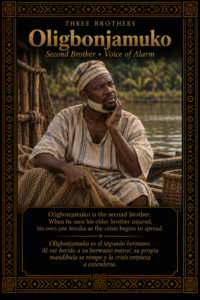
Oligbonjamuko — Second Brother / Voice of Alarm
English: Oligbonjamuko is the second brother. When he sees the injury of his elder brother, his own jaw breaks, showing how the crisis begins to spread from action into alarm.
Español: Oligbonjamuko es el segundo hermano. Al ver la herida de su hermano mayor, su propia mandíbula se rompe, mostrando cómo la crisis empieza a pasar de la acción al sobresalto.
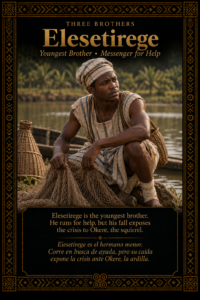
Elesetirege — Youngest Brother / Messenger for Help
English: Elesetirege is the youngest brother. He runs to seek help, but his fall becomes the moment that exposes the crisis to Okere, the squirrel.
Español: Elesetirege es el hermano menor. Corre en busca de ayuda, pero su caída se convierte en el momento que expone la crisis ante Okere, la ardilla.
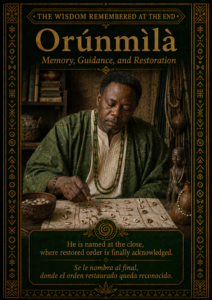
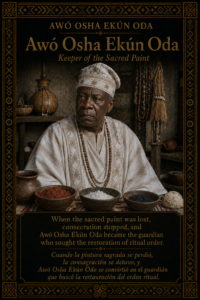
Òrúnmìlà — Divination Authority / Revealer of Warning
English: Òrúnmìlà reveals the danger before it becomes visible. In this story, he is the sacred divination authority whose warning should have been fulfilled.
Español: Òrúnmìlà revela el peligro antes de que se haga visible. En esta historia, es la autoridad sagrada de la adivinación cuya advertencia debía cumplirse.
Èṣù — Sacred Recipient / Boundary Figure
English: Èṣù is the recipient of the sacrifice and offering that were delayed. He is not the cause of disorder; the disorder comes through unfinished obligation.
Español: Èṣù es el receptor del sacrificio y de la ofrenda que fueron demorados. No es la causa del desorden; el desorden llega por la obligación no cumplida.
Okere / Squirrel — Laughing Witness / Delayed Offering
English: Okere sees Elesetirege fall and laughs. His own delayed offering to Èṣù turns a small action into the beginning of a much larger disturbance.
Español: Okere ve caer a Elesetirege y se ríe. Su propia ofrenda demorada a Èṣù convierte una acción pequeña en el comienzo de una perturbación mucho mayor.
Boa / Oka / Arummwoto — Fear Responder / Restricted Figure
English: The boa runs when he hears the squirrel laugh because that sound carries inherited danger for him. His fear sends the crisis into the rabbit’s protected space.
Español: La boa corre cuando escucha la risa de la ardilla porque ese sonido lleva para ella un peligro heredado. Su miedo lleva la crisis al espacio protegido del conejo.
Rabbit — Vulnerable Figure / Displaced Dweller
English: Rabbit flees when the boa enters her hole. She is not guilty of the crisis; she shows how danger can force the innocent out of safety.
Español: El conejo huye cuando la boa entra en su madriguera. No es culpable de la crisis; muestra cómo el peligro puede sacar al inocente de su lugar seguro.
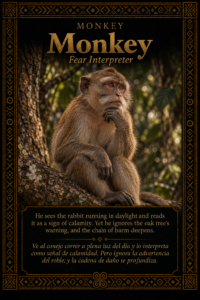
Monkey — Fear Interpreter / Ignorer of Warning
English: Monkey sees the rabbit running in daylight and reads it as a sign of calamity. Yet he ignores the warning of the oak tree, and the chain of harm deepens.
Español: El mono ve al conejo correr a plena luz del día y lo interpreta como señal de calamidad. Pero ignora la advertencia del roble, y la cadena de daño se profundiza.
Oak Tree — Living Witness / Warning Voice
English: The oak tree warns the monkey that the branch has been causing pain for three years. Its ignored warning becomes the turning point that destroys the guinea-fowl’s eggs.
Español: El roble advierte al mono que la rama le ha causado dolor durante tres años. Su advertencia ignorada se convierte en el punto que destruye los huevos de la gallina de Guinea.
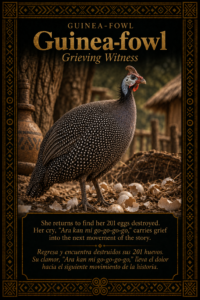
Guinea-fowl — Grieving Witness / Sacred Speech Carrier
English: Guinea-fowl returns to find her 201 eggs destroyed. Her cry, “Ara kan mi go-go-go-go,” carries grief into the next movement of the story.
Español: La gallina de Guinea regresa y encuentra destruidos sus 201 huevos. Su clamor, “Ara kan mi go-go-go-go,” lleva el dolor hacia el siguiente movimiento de la historia.
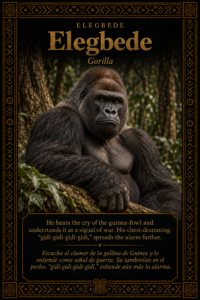
Elegbede / Gorilla — Alarm Responder / Chest-Drum Figure
English: Elegbede hears the cry of the guinea-fowl and understands it as a signal of war. His chest-drumming, “gidi-gidi-gidi-gidi,” spreads the alarm further.
Español: Elegbede escucha el clamor de la gallina de Guinea y lo entiende como señal de guerra. Su tamborileo en el pecho, “gidi-gidi-gidi-gidi,” extiende aún más la alarma.
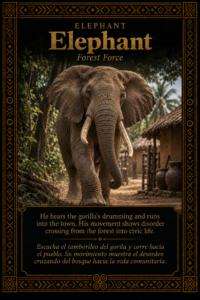
Elephant — Forest Force / Carrier of Panic
English: Elephant hears the gorilla’s drumming and runs into the town. His movement shows disorder crossing from the forest into civic life.
Español: El elefante escucha el tamborileo del gorila y corre hacia el pueblo. Su movimiento muestra el desorden cruzando del bosque hacia la vida comunitaria.
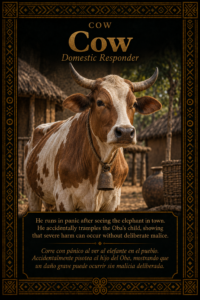
Cow — Domestic Responder / Accidental Harm
English: Cow runs in panic after seeing the elephant in town. He accidentally tramples the Oba’s child, showing that severe harm can occur without deliberate malice.
Español: La vaca corre con pánico al ver al elefante en el pueblo. Accidentalmente pisotea al hijo del Oba, mostrando que un daño grave puede ocurrir sin malicia deliberada.
Oba — Royal Authority / Wounded Governing Center
English: The Oba loses his only child and then his remaining eye. Through him, the crisis reaches the royal center of the town.
Español: El Oba pierde a su único hijo y luego su único ojo restante. A través de él, la crisis llega al centro real del pueblo.
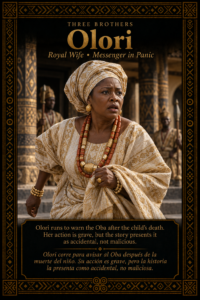
Olori — Royal Wife / Messenger in Panic
English: Olori runs to warn the Oba after the death of his child. Her action is grave, but the story presents it as accidental, not malicious.
Español: Olori corre para avisar al Oba después de la muerte del niño. Su acción es grave, pero la historia la presenta como accidental, no maliciosa.
Heavenly Messenger — Divine Adjudicator / Restorer of Order
English: The heavenly messenger stops the crisis, hears every explanation, and identifies the true root. He restores what was broken and establishes new boundaries.
Español: El mensajero celestial detiene la crisis, escucha cada explicación e identifica la verdadera raíz. Restaura lo que fue roto y establece nuevos límites.
Ògún — Divinatory Continuation Figure
English: Ògún appears in the final divinatory instruction through the cock offering and shrine reference. His role belongs to the source’s practical guidance, not the main chain of crisis.
Español: Ògún aparece en la instrucción adivinatoria final mediante la ofrenda del gallo y la referencia al santuario. Su papel pertenece a la guía práctica de la fuente, no a la cadena principal de la crisis.
Human Conditions Revealed
Delay
Delay is the central condition. The brothers intend to make sacrifice later, and the squirrel has not yet fulfilled his own offering. The story shows that delay can become dangerous when the matter concerns sacred warning.
Fear
Fear moves through the story from one being to another. Boa flees from squirrel laughter. Rabbit flees from boa. Monkey reacts to rabbit. Elephant reacts to gorilla. Cow reacts to elephant. Fear spreads the crisis.
Inherited Memory
Several figures respond because of what they have inherited or remembered. Boa remembers the danger of squirrel laughter. Rabbit remembers boa’s danger to her kindred. Gorilla follows the warning of his parents. These inherited signals shape present action.
Ignored Warning
The monkey ignores the oak tree’s warning. This moment is important because it shows that warning is not only received through formal divination. The living world also warns, and that warning can be ignored.
Accidental Harm
The cow and Olori cause serious harm without being framed as malicious. The cow tramples the Oba’s child while fleeing. The Olori blinds the Oba while trying to alert him. The story distinguishes intention from consequence.
Communal Disorder
The crisis spreads beyond the original actors. It begins with the brothers and reaches animals, town, palace, child, and king. The story shows that sacred disorder can become communal disorder.
Restoration with Boundaries
The heavenly messenger restores life, sight, eggs, body, and order. But restoration does not erase all consequences. The boa and squirrel receive restrictions, and the elephant is returned to the forest forever.
Moral and Spiritual Teachings
Divination Creates Responsibility
The brothers and squirrel receive divinatory instruction before the crisis unfolds. The story shows that divination is not merely information. Once a warning is given, responsibility follows.
Delay Is Not the Same as Refusal, but It Can Still Be Dangerous
The brothers do not reject Òrúnmìlà’s instruction. They intend to make the sacrifice later. The story’s teaching is that postponement itself can become spiritually serious when the warning concerns imminent danger.
The Visible Actor Is Not Always the Root Cause
Many beings participate in the chain of events. Yet the heavenly messenger does not blame everyone equally. Ifá traces the disorder back to the unfinished obligations.
Sacred Judgment Requires Discernment
The heavenly messenger listens to each participant before giving judgment. This matters because the story does not support careless blame. It teaches precise diagnosis.
Restoration Is Not Forgetfulness
The story restores what was broken, but it also establishes new limits. The boa cannot enter holes. The squirrel cannot laugh freely. The elephant is returned to the forest. Restoration includes memory and boundary.
Symbols and Sacred Elements
River / Pond / Obu
The river and pond are the place of ordinary work. They become the first location where the delayed warning appears as consequence.
Rope
The rope twists around Elesetirege’s foot and causes him to fall. It is a small object, but it becomes the trigger that exposes the crisis to squirrel.
Squirrel Laughter
The squirrel’s laughter moves the crisis into the animal world. Because squirrel has also delayed a required offering, the laughter becomes more than a passing reaction.
Rabbit Hole
The rabbit hole represents a protected space that becomes unsafe when the boa enters it.
Oak Tree Branch
The branch is a wounded support. The tree warns monkey, but the warning is ignored. The branch then breaks and destroys the eggs.
201 Eggs
The eggs represent accumulated life-potential within the story. They were produced over 201 days, destroyed in the chain of consequence, and later restored.
Guinea-fowl’s Cry
The cry “Ara kan mi go-go-go-go” carries grief and alarm. It becomes the sound that activates the gorilla.
Gorilla’s Chest Drumming
The phrase “gidi-gidi-gidi-gidi” carries the sound of the gorilla beating his chest. It becomes the signal that frightens the elephant.
Elephant Entering Town
The elephant belongs to the forest, but he enters the town in panic. This crossing shows disorder moving beyond its proper boundary.
Oba’s Eye
The Oba’s remaining eye is damaged when the crisis reaches the palace. Symbolically, the governing center loses sight.
He-goat to Èṣù
The he-goat is the sacrifice prescribed to prevent catastrophe. It must remain a ritual material, not a metaphor only.
Palm Fruits to Èṣù
The palm fruits are the offering prescribed for squirrel. They are connected to preventing a disturbance greater than squirrel himself.
Cock to Ògún
The cock appears in ordinary divination guidance and is connected to averting the danger of becoming the victim of undeniable falsehood.
Ògún Shrine
The Ògún shrine appears in the instruction for a person born under this Odù. The source names the instruction but does not provide a procedure.
Ritual / Ceremony Public Education Layer
This story contains divination, sacrifice, offering, prohibitions, and divinatory instructions. It must therefore be read with ritual precision.
The first ritual movement is the consultation with Òrúnmìlà. The brothers receive a warning and a prescribed sacrifice: a he-goat to Èṣù. The squirrel also receives instruction: palm fruits to Èṣù.
The source states that these prescriptions were meant to prevent catastrophe and a furore greater than the one who caused it. The story’s unfolding shows what happens when the obligations are delayed.
The story also includes instructions for Ugbodu, ordinary divination, and a person born of this Odù. These instructions name specific materials, offerings, prohibitions, and shrine-related guidance.
This story preserves ritual importance, but it does not teach ritual procedure.
It shows what the ritual, offering, or sacred work means within the story.
It does not provide a complete ritual manual.
Any practical ritual explanation would require source verification and practitioner review.
Prayer / Rezo / Chant / Sacred Speech Status
No explicit prayer, rezo, or súyẹ̀rẹ̀ is preserved in this story segment as a full sacred prayer text.
Because no full sacred prayer is preserved, this article does not create one.
However, sacred force is still carried through instruction, warning, divination, sacrifice, prohibition, remembered authority, divine decree, ritual obligation, and divinatory continuation.
The story preserves two source speech phrases:
Ara kan mi go-go-go-go.
Translation: Not provided.
Gloss: Not provided.
gidi-gidi-gidi-gidi
Translation: Not provided.
Gloss: Not provided.
These phrases should be preserved exactly as source speech. Their meanings should not be invented or presented as certain without later source review.
Cultural and Divinatory Context
This story works within a traditional Ifá pattern: divination reveals danger before the visible event occurs. Òrúnmìlà sees the danger and prescribes sacrifice. The warning is not merely symbolic; it is connected to ritual action.
Èṣù’s role in the story must be understood carefully. Èṣù is not presented as an evil figure who creates trouble for its own sake. The story presents Èṣù as the sacred recipient of the obligation that should have been completed. The disorder emerges from delay.
The heavenly messenger’s judgment also preserves an important divinatory principle: visible damage does not always reveal root cause. The cow kills the child, and Olori blinds the Oba, but the messenger does not judge them as the root cause. The story traces the crisis back to the delayed sacrifices.
The Ugbodu and ordinary divination sections show that the narrative is not only remembered as a story. It continues into divinatory guidance. The story includes warnings about greatness, crisis in town or family, falsehood, prohibitions, and shrine-related instruction.
Because the ritual material is partial, it should be preserved as source-reported divinatory material, not public ritual instruction.
When This Odù Appears
When this Odù appears, this story may warn about a serious instruction that has been received but delayed.
It can point to an unfinished sacred obligation whose consequence may extend beyond the person who first received the warning.
The story may also point to panic, misread signals, inherited fear, and communal disorder. Many participants in the story act from fear or inherited memory. This suggests that a crisis may spread through reaction even when most participants are not the root cause.
Within this specific Odù and divinatory frame, the source states that sacrifice is required at Ugbodu because the person is destined for greatness and great works if the sacrifice is made. The source warns that neglect may cause crisis in town or family.
At ordinary divination, the story also preserves warnings about having one’s own Ifá without delay, avoiding the danger of undeniable falsehood, and following source-specific prescriptions.
For a person born of this Odù, the story preserves sacrifice, prohibitions, and Ògún shrine instruction.
These teachings must be handled carefully. They are not generic advice. They belong to a specific Odù, a specific story, and a practitioner-sensitive divinatory frame.
Modern Ethical Explanation
This story includes sensitive material: injury, child death, blindness, sacrifice materials, prohibitions, and gendered divinatory instruction.
The traditional warning remains serious, but it must be heard within this specific Odù and divinatory frame.
The instruction that a woman should be advised to marry an Ifá man is preserved because it belongs to the source. It should not be turned into a universal modern rule about all women, all marriages, or all practitioners.
The same care applies to the story’s harm. The Oba’s child is not guilty. The Oba is not blamed. The Olori is not presented as malicious. The cow is not judged as the root cause.
The story teaches responsibility, but it also teaches careful judgment. It should not be used to shame vulnerable people, blame those harmed by crisis, or turn sacred warning into social accusation.
What Must Not Be Misunderstood
This story should not be reduced to “someone missed a sacrifice, so everyone was punished.”
The teaching is more precise. The brothers and squirrel delayed obligations that had already been revealed through divination. The crisis then moved through many beings who were reacting from fear, inherited warning, or sudden danger.
This story does not present Èṣù as demonic.
This story does not treat the Oba’s child as guilty.
This story does not treat Olori as malicious.
This story does not blame every figure who appears in the chain.
This story preserves ritual importance but does not teach ritual procedure.
This story’s warnings belong to Oyekun-Okana and to the specific divinatory frame preserved in the source. They should not be universalized into broad modern social rules.
Reflection Questions
- What is the difference between receiving a warning and fulfilling the obligation that follows from that warning?
- Why does the heavenly messenger declare most participants innocent even though many of them contributed to the chain of events?
- How does the story distinguish root cause from visible consequence?
- What role does Èṣù play in this story, and why should that role not be misunderstood?
- How does fear move from one being to another in the narrative?
- What does the oak tree’s warning teach about listening beyond formal divination?
- Why does restoration in this story include new restrictions?
- How can ritual materials and divinatory instructions be preserved publicly without turning them into ritual procedure?
Conclusion
The story of Three Brothers teaches that a warning revealed through Ifá carries responsibility. The danger is not only in open rejection. In this story, even delay becomes serious because the instruction was given to prevent imminent catastrophe.
The narrative also teaches careful judgment. Many figures participate in the crisis, but the heavenly messenger does not blame all of them. The true root is traced to the delayed sacrifices.
Restoration comes, but it comes with memory. The injured are healed, the lost are restored, and the town is reordered. Yet the boa, squirrel, and elephant receive lasting boundaries.
The final teaching is clear: sacred warning must be honored in time, and restoration must name the true cause of disorder without blaming those who were only swept into its path.
Editor / Archive Summary Block
Core Story Tension: Three brothers and squirrel receive divinatory instructions but delay the prescribed sacrifice or offering, leading to a widening crisis.
Core Ritual Dynamic: Divination reveals danger; sacrifice and offering to Èṣù are prescribed; delayed fulfillment becomes the root condition behind the disorder.
Core Character Dynamic: The brothers and squirrel are identified as root parties because they delayed sacrifice; most others are responders within the chain; the heavenly messenger separates cause from reaction.
Core Teaching: A sacred warning carries obligation. Delay can become consequence, but divine judgment must identify root cause carefully.
Core Divinatory Warning: When this Odù appears, the story may warn of delayed sacrifice, crisis in town or family, danger of undeniable falsehood, prohibitions, and the need for source-specific divinatory guidance.
Prayer / Sacred Speech Status: No explicit prayer, rezo, or súyẹ̀rẹ̀ is preserved as a full sacred prayer text. Two source phrases are preserved: “Ara kan mi go-go-go-go” and “gidi-gidi-gidi-gidi.” Translation and gloss are not provided.
Ritual / Ceremony Boundary: Ritual materials and actions are named, but no complete ritual procedure is given. Practitioner review is required before any procedural explanation.
Modern Ethical Flag: Yes. Sensitive material includes child death, blindness, sacrifice materials, prohibitions, and gendered divinatory instruction. The marriage instruction must remain source-specific and should not be universalized.
Terms Requiring Diacritic Review: Oyekun-Okana, Oyekun Meyi, Olikatirege, Oligbonjamuko, Elesetirege, Okere, Oka, Arummwoto, Elegbede, Obu, Ugbodu, and Ase. Common canonical forms used for public readability: Ifá, Odù, Òrúnmìlà, Èṣù, and Ògún.
IFAStories Website Story Article Complete