
Odù Context
Odù: Oyekun-Odi
This story is associated here with Oyekun-Odi, whose liturgical opening and thematic field align with a teaching about witness, sacred order, human disorder, and doctrinal boundary. The narrative reveals a world in which divine influence reaches human beings, yet that influence becomes corrupted through pride, rivalry, and misuse. The story is remembered because it explains a specific spiritual law: why Òrúnmìlà does not descend upon the head in the same manner as the possessing powers described in the account.
Source Reference
This story is drawn from an Afro-Cuban Ifá source tradition, specifically Caminos de Ifá: Baba Eyiogbe y Omoluos, from Caminos de Ifá, associated with Ernesto Valdés Jane and Proyecto Orúnmila. In this article, the story is presented for spiritual education, cultural preservation, and reflective study within the living wisdom of Ifá.
Introduction
Some Ifá stories do not begin with a personal dispute, but with a transformation in the structure of the world itself. This is one of those stories. It opens with Olófin establishing the earth and granting power and àṣẹ to the Òrìṣà, yet what begins as sacred order gradually turns into conflict among human beings.
At the heart of this narrative lies a serious spiritual question: what happens when divine influence reaches people who do not carry it with humility? The story answers by showing how sacred force, rather than producing balance, can become a cause of rivalry, arrogance, and war when it is misunderstood.
This account matters because it does more than explain a conflict. It preserves a doctrinal distinction. It teaches why Òrúnmìlà does not descend upon the head in the same way other powers in the story are described as doing. That teaching is not presented as an abstract rule, but through a sequence of creation, corruption, investigation, warning, failed correction, and sacred declaration.
For readers and students of Ifá, this story remains important because it brings narrative, ritual, and teaching together in one place. It is not only a memory of what happened. It is also a guide to spiritual order, authority, restraint, and sacred difference.
Quick Takeaway
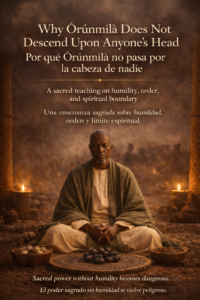
Sacred power without humility becomes dangerous. This story teaches that when divine influence is turned into superiority and rivalry, disorder follows, and Òrúnmìlà responds not by joining that confusion, but by establishing a boundary.
The Story
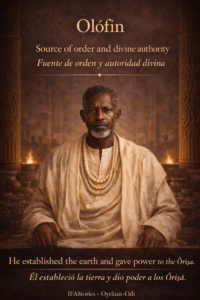
After establishing the earth, Olófin gave power and àṣẹ to all the Òrìṣà. He granted them the capacity to send their presence to the earth as a spiritual emanation, and by that power they could extend influence to several people at the same time under the protection of the Òrìṣà who sent it.
Those who received that sacred force no longer remained as they had been before. Under divine influence, they spoke words and knowledge that did not originate from themselves, because they were under the power of the divinity.
For a time, this condition unfolded without open disturbance. Later, however, those who received such force began to regard themselves as greater than others, and war arose among the inhabitants of the earth. The conflict took both armed form and the form of rivalry rooted in knowledge, whether open or secret, and the earth came near to destruction through that division.
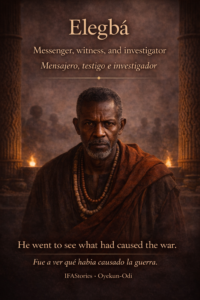
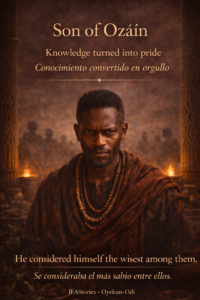
When the condition became severe, Olófin sent Elegbá to inspect the earth and report on the state of its inhabitants. Elegbá went among them and asked one of those who claimed wisdom what had led to the war. The man answered that he was a child of Ozáìn, that his father had granted him privilege above others, and that Ozáìn came upon his head and supplied him with knowledge. Because of this, he considered himself the wisest among them.
Elegbá rebuked him and declared that Olófin would not approve of such conduct, nor would the Òrìṣà accept it, because such a war could not be allowed to continue. The man answered that he was king and would not allow anyone to remove him from his position.
Elegbá continued his investigation among the inhabitants of the earth and found nearly the same answer everywhere. He then returned to Olófin and reported all that he had seen and heard.
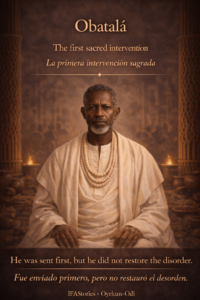
After hearing the report, Olófin decided to send the Òrìṣà to the earth so that they might speak to their respective children and correct their conduct. Obatalá was sent first, but he failed in that task. After him, the other Òrìṣà were sent, and they also failed.
When no other Òrìṣà remained to be sent, Olófin remembered Òrúnmìlà and called him. When Òrúnmìlà came, Olófin told him that all the other Òrìṣà had already been sent to correct the condition on earth, but the inhabitants remained trapped in a war that could bring about their destruction, because those under the sacred force of an Òrìṣà believed themselves exalted above others. Olófin then asked Òrúnmìlà to see whether he could correct that war.
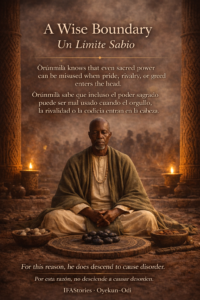
Òrúnmìlà answered that he would set himself to correcting that conflict and restoring human beings, but that until the disorder could be amended, he would not descend upon anyone’s head.
Olófin then said, “to iban eshu.”
That is the reason given in this story for why Òrúnmìlà does not descend upon anyone’s head.
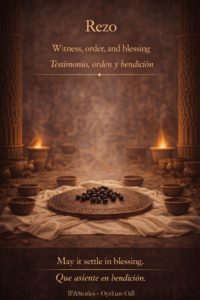
Rezo
1. Oyèkùn Dì Èlérì Ní Bógno Òtídàs Pínu Ní Olófin Kúri Latíwò Bógbo Orísha Lérí,
2. Bógbo Kè Kówa Lérí Èlérì Ní Omó Orúnmìla Ósì Lérí Ní Omó Nína Olóddùmarè,
3. Móddu Kuésun Le Alórdo Iré.
Translation
1. Oyekun Di bears witness. Before Olófin, in the matter concerning all the Òrìṣà and the head, witness is established.
2. Witness to the child of Òrúnmìlà; witness to the child of Olódùmarè.
3. May it settle in blessing.
The Prayer and Its Meaning in the Story
The rezo is deeply connected to the central teaching of this narrative because it frames the matter of the head not as a field of rivalry, but as a matter of witness, order, legitimacy, and rightful settlement before Olófin.
The opening phrase, “Oyèkùn Dì Èlérì,” places the prayer in the mode of witness. That is important because the crisis of the story begins when sacred influence is no longer carried with humility. Human beings do not remain content with divine contact; they turn that contact into superiority, privilege, and conflict. The prayer responds to that disorder by grounding the entire matter in testimony. Before anyone claims greatness, before anyone exalts himself above others, the issue is first brought into the domain of witness. In that sense, the rezo immediately opposes the spiritual vanity that drives the plot.
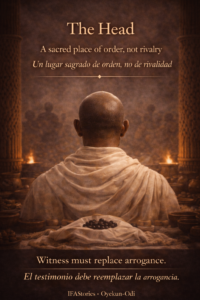
Its reference to Olófin, all the Òrìṣà, and the head is especially significant. The story is not simply about possession or manifestation. It is about the spiritual meaning of the head, who has authority in relation to it, and what happens when that authority is misunderstood. In the narrative, the head becomes the place where divine association is turned into a claim of superiority. In the prayer, however, the head is returned to sacred order. It is no longer treated as a ground for ego, but as a matter subject to witness, hierarchy, and divine recognition.
The lines that establish witness to the child of Òrúnmìlà and witness to the child of Olódùmarè further deepen the lesson. They shift attention away from human boasting and back toward sacred lineage, accountability, and rightful source. In the story, the son of Ozáìn makes knowledge into a reason for self-exaltation. The prayer moves in the opposite direction. It reminds the listener that true legitimacy is not seized by rivalry; it is confirmed within a higher spiritual order. This is one reason the prayer fits the narrative so closely: both the rezo and the story reject the idea that sacred contact automatically justifies personal supremacy.
The prayer also helps clarify why Òrúnmìlà’s role is different from that of the other forces described in the narrative. Òrúnmìlà does not enter the story by joining the same pattern that has already corrupted the earth. He does not intensify the struggle for spiritual dominance. Instead, he answers the crisis through discernment, law, and restraint. The rezo supports that doctrinal distinction by presenting the matter of the head in terms of witness and sacred order rather than competitive possession. In this way, the prayer prepares the same truth that the narrative concludes: Òrúnmìlà stands in a different relation to the head.
Its final movement, “May it settle in blessing,” carries the closing wisdom of the account. What the earth lacks is not power, but proper settlement. Disorder came because sacred force was turned into rivalry. Blessing can return only when that confusion is corrected and the sacred order surrounding the head is restored. The prayer therefore does not stand beside the story as a decorative liturgical fragment. It expresses in ritual language the same lesson the narrative teaches through conflict: witness must replace arrogance, order must replace rivalry, and blessing depends on rightful spiritual alignment.
For that reason, the rezo belongs organically to the story’s doctrinal meaning. It is not merely attached to the narrative; it interprets it. The prayer turns the lesson inward. It reminds the reader or practitioner that the head is not to be approached as a site of vanity or conquest, but as a sacred domain governed by divine order, truthful witness, and the possibility of blessed settlement.
Story Structure
The story unfolds through a clear sequence of escalation.
It begins with sacred order. Olófin establishes the earth and delegates power to the Òrìṣà. This creates a legitimate spiritual arrangement rather than a chaotic beginning.
That power then enters human life. The Òrìṣà extend their force into human beings, and a cosmic structure begins to operate within society itself.
What was originally sacred then becomes socially distorted. Human beings mistake received force for personal superiority, and war emerges.
At that point, investigation becomes necessary. Elegbá is sent to determine the true cause of the disorder. The story narrows from a broad social conflict to a representative figure, the son of Ozáìn, whose arrogance reveals the deeper problem.
Warning follows, but warning is rejected. Obatalá and the other Òrìṣà are then sent to restore order, yet all fail. This repeated failure shows that the crisis cannot be solved by ordinary intervention alone.
Only after those efforts fail does Òrúnmìlà enter. His response does not dramatize external conquest. Instead, it establishes a spiritual law.
The story closes by linking his declaration to an enduring doctrinal truth: this is why Òrúnmìlà does not descend upon the head in this manner.
Main Characters
Olófin
Olófin is the supreme authority in the story. He establishes the earth, grants power to the Òrìṣà, sends Elegbá to investigate, commissions the corrective missions, and finally calls Òrúnmìlà. Spiritually, he represents governing order above the conflict.
The Òrìṣà
The Òrìṣà are the divine collective empowered by Olófin. They first transmit sacred force into human life, and later they are sent to correct the resulting disorder. Their significance lies in showing that divine power is real, varied, and active, but not identical in function.
Elegbá
Elegbá is the messenger and investigator. He goes to the earth, questions the proud claimant, and exposes the human condition causing the conflict. Spiritually, he represents truthful diagnosis, threshold knowledge, and necessary confrontation.
The Son of Ozáìn
This unnamed figure is the clearest embodiment of the disorder in the story. He claims superiority because Ozáìn comes upon his head and gives him knowledge. His role reveals how sacred association can be distorted into pride.
Ozáìn
Ozáìn appears indirectly through the claim made by his son. His narrative function is to stand behind the idea of head-based sacred knowledge and thus frame the contrast with Òrúnmìlà’s later refusal.
Obatalá
Obatalá is the first named Òrìṣà sent to correct the disorder, yet he fails in that mission. His role shows that even sacred authority does not operate identically in every condition.
Òrúnmìlà
Òrúnmìlà is the final authority called after all previous attempts fail. His significance lies in witness-knowledge, restraint, order, and right relation to the head. He does not enter the disorder by imitating it. He answers it by establishing law.
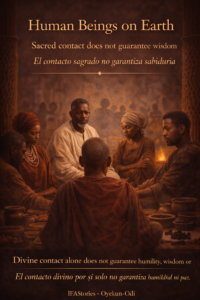
Human Beings on Earth
The human collective receives sacred influence but mishandles it. Their role is to show that divine contact alone does not guarantee humility, wisdom, or peace. Humanity is the field in which the whole teaching unfolds.
Human Conditions Revealed
Arrogance appears when those touched by divine influence begin to believe themselves superior. It teaches that sacred access does not justify self-exaltation.
Possession without discipline appears when people speak beyond themselves under divine force, yet that experience is not governed by humility or law. It shows that altered states are not the same as wisdom.
Rivalry appears in the struggle for supremacy, kingship, and privileged status. It reveals how competition corrupts what should have remained sacred relationship.
Resistance to correction appears when Elegbá’s warning is rejected and the wider population remains unchanged. It teaches that truth must be received, not merely spoken.
Collective disorder appears as the social form of spiritual imbalance. It shows that inner corruption eventually becomes communal suffering.
Moral and Spiritual Teachings
The story teaches that sacred power is not the problem in itself. The problem lies in how that power is received, interpreted, and embodied. Olófin’s original delegation is legitimate, but human beings turn that gift into a ground for superiority and war.
It also teaches that divine functions are not interchangeable. The Òrìṣà who influence, possess, or intervene are real powers, yet Òrúnmìlà stands in a different relation to the head. His authority is not presented as competitive possession, but as corrective wisdom and principled restraint.
A further teaching concerns the sequence of restoration. First there must be diagnosis. Then warning. Then attempted correction. Only after repeated failure does the deeper law emerge. This means that spiritual order is not restored by force alone, but by right discernment.
Finally, the account teaches that restraint can itself be sacred action. Òrúnmìlà’s refusal is not absence. It is a boundary that protects spiritual order from further confusion.
Symbols and Sacred Elements
The Head
The head is the central symbol of the story. It is the place where divine influence is claimed and later refused. Spiritually, it signifies authority, receptivity, destiny, and the danger of illegitimate descent.
Àṣẹ
Àṣẹ is the foundational sacred power given by Olófin to the Òrìṣà. It shows that sacred authority originates in ordered divine delegation.
Sacred Force
The spiritual force extended by the Òrìṣà into human beings represents transmission that requires moral containment. Without humility and discipline, what should sustain order becomes a cause of division.
War
War is the visible social result of inner spiritual disorder. It reveals what happens when sacred contact is turned into ego and rivalry.
Animals, Cloths, and Offerings
The sacrificial materials ground the narrative in ritual action. They show that the story belongs to living divinatory and sacrificial practice, not abstract theology alone.
Cultural and Divinatory Context
This story preserves an important distinction within Ifá understanding: not every sacred power manifests through the same form of descent. The narrative is not merely explaining conflict; it is clarifying hierarchy, function, and sacred difference.
It also reflects a world in which divine-human contact is socially consequential. Power, speech, ritual authority, and communal order are bound together. When sacred force enters human life without humility and discipline, the result is not enlightenment, but instability. That is why investigation, warning, and correction are all necessary stages in the narrative.
The story further preserves a concern with order and sequence. Elegbá investigates before judgment is made. Obatalá and the other Òrìṣà are sent before Òrúnmìlà is called. This layered progression reinforces the seriousness of the crisis and the distinctiveness of Òrúnmìlà’s final role.
Within the Afro-Cuban practice and textual transmission of Ifá, this story also functions as a preserved doctrinal explanation. It does not simply recount an event. It teaches why a ritual and spiritual distinction is remembered and maintained.
When This Odù Appears
When this Odù appears, the story may warn about spiritual pride, especially where people confuse access, charisma, knowledge, or influence with true wisdom. It can point to conditions in which sacred language or sacred association is being used to justify rivalry and domination.
It may also point to conflict within a group, family, house, or community, especially when multiple people believe they alone carry authority. One lesson drawn from this account is that disorder often grows where correction has been resisted for too long.
The story can further indicate that the deeper issue is not only external conflict, but misuse of force, status, or recognition. In such a case, its counsel is to restore humility, receive warning, accept proper hierarchy, and return to disciplined ritual alignment.
It also teaches that not every problem is solved by more visible power. Some situations require a different kind of authority: witness, interpretation, boundary, and restraint.
Reflection Questions
- How does the story distinguish between sacred power and rightful wisdom?
- Why does the narrative place investigation before correction?
- What does the son of Ozáìn reveal about the danger of spiritual privilege without humility?
- Why do the earlier corrective missions fail before Òrúnmìlà is called?
- What does Òrúnmìlà’s refusal to descend upon the head teach about spiritual boundaries?
- How does the story transform a doctrinal rule into a narrative explanation?
- In what ways can communal conflict begin from private spiritual arrogance?
- How should a practitioner handle a rezo that is preserved and transmitted with instability in wording?
Conclusion
This story preserves a hard teaching: sacred contact does not automatically produce humility, wisdom, or peace. When divine influence is turned into superiority, the result is rivalry, war, and spiritual confusion.
Its final lesson is not merely about manifestation. It is about order. Òrúnmìlà’s authority appears here through refusal, limit, witness, and discernment. He does not join the confusion already consuming the earth. He answers it by establishing a law.
That is why the story remains important. It teaches that true spiritual authority is measured not only by manifestation, but by right function, right boundary, and right relation to sacred power.