Introduction
Some Ifá stories explain why life is difficult. Others explain why life is ordered the way it is. This story does both. Under Ejiogbe, “The Head as a divinity” reveals how the Head, which was itself a sacred being, came to have a permanent place upon the body and why that placement matters. At first, the world of the story is incomplete. The divinities exist, but the Head has not yet taken its place as the governing center.
What follows is not a random miracle. It is a sacred sequence. Divination is performed. Sacrifice is prescribed. A warning is given. A ritual object is protected. Many come forward, but none of them is the right one. Only after preparation, cleansing, prayer, and the appearance of the appointed being does the hidden purpose of the sacrifice become fulfilled.
This story matters because it teaches a law of order. Not everything becomes complete by force. Not every powerful figure is the one chosen to carry out the decisive act. What is meant to become central must be recognized, prepared, and established according to sacred instruction.
It also matters because it does not remain only in heaven. Like many Ifá narratives, it ends by turning toward human life. The story closes with guidance for the son of Ejiogbe, showing that the account is not only about cosmic origins, but also about practical divinatory teaching.
QUICK TAKEAWAY
What is reserved by sacrifice reaches fulfillment only through the one appointed for it. When the rightful center is established, the rest can finally take their proper place.
THE STORY
This story explains how the Head, which was itself a divinity, came to dwell permanently upon the body. It is set in heaven and centers on the divination performed for Orunmila and for ORI, the preservation of a ritual object, and the act through which the Head was established above the other parts of the body. It also ends with an instruction for those who come under Ejiogbe.
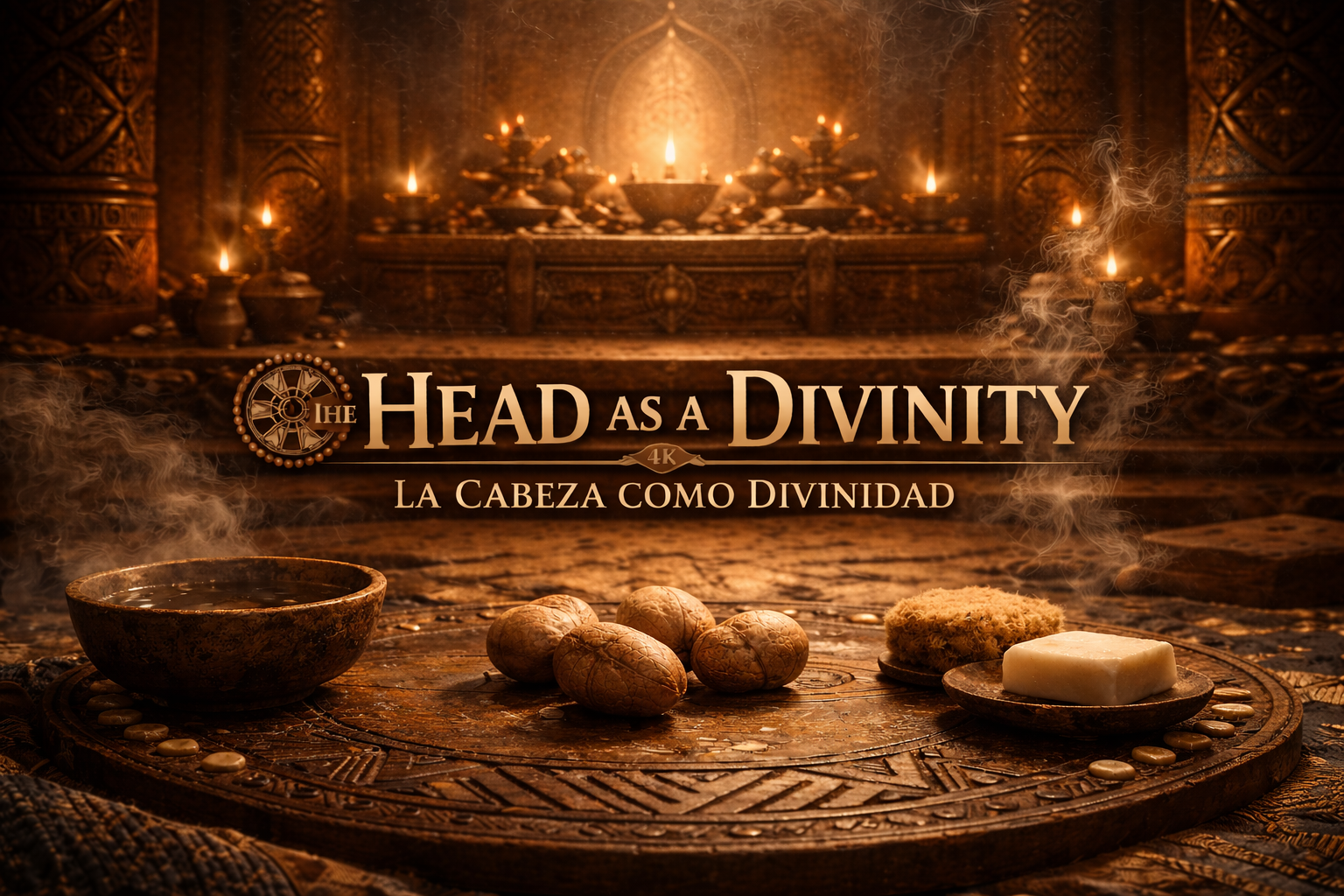
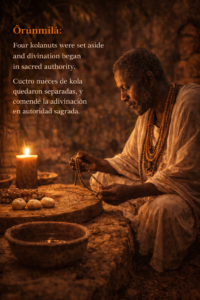
The account begins with the statement that the Head was originally one of the divinities and that the divinities had not yet possessed the bodily form they later came to have. Amure, awo eba ono, was the Awo who made divination for ORI in heaven. When Orunmila sought to know how he might obtain complete physical form, he invited Amure to divine for him, because at that time the divinities had no head. Amure instructed Orunmila to raise his palms and pray to receive a head. He also prescribed sacrifice with four kolanuts, a clay bowl, a sponge, and soap. Orunmila was told to place the kolanuts upon his Ifa shrine without breaking them, because another visitor, not yet arrived, would later break them.
ORI also called Amure for divination. He was told to serve his guardian angel with four kolanuts and was informed that prosperity would begin for him only after that service had been made, though he did not have the means to buy the kolanuts. Orunmila, for his part, completed the sacrifice that had been prescribed for him and left the four kolanuts on his shrine exactly as he had been told.
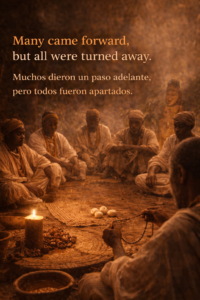
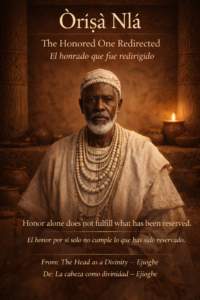
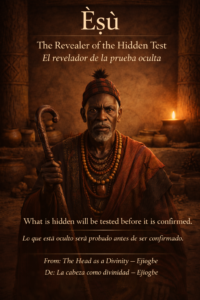
After this, Esu proclaimed in heaven that Orunmila had four beautiful kolanuts at his shrine and sought one fit to break them. Then the divinities came to Orunmila one after another, with Ogun leading them. To each one Orunmila said that he was not strong enough to break the kolanuts. Because of this, they felt slighted and withdrew in annoyance. Even Orisa Nla came, but Orunmila received him with other and better kolanuts, telling him that the ones in question were not meant for him. Orisa Nla accepted the fresh kolanuts and departed.
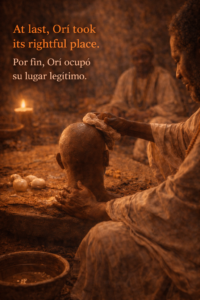
At last ORI resolved to go to Orunmila, being the only divinity who had not yet tried to break the mysterious kolanuts, and still unable to afford the ones required for service to his guardian angel. He rolled to the house of Orunmila. When Orunmila saw ORI approaching, he went out to meet him, lifted him up, and brought him inside. He took the clay bowl, filled it with water, and washed ORI with the sponge and the soap. After drying him, Orunmila carried ORI to the shrine and asked him to break the kolanuts that had long been kept for him.
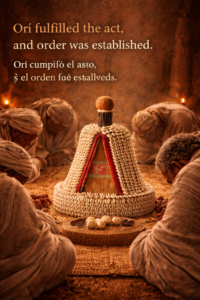
ORI gave thanks for the honor shown to him. With the kolanuts he first prayed for Orunmila, that whatever he undertook would come to fulfilment and manifestation. Then he prayed for himself, that he would obtain a permanent abode and many followers. After this, ORI rolled backward and hurled himself against the kolanuts. They split open with a loud report that was heard throughout heaven.
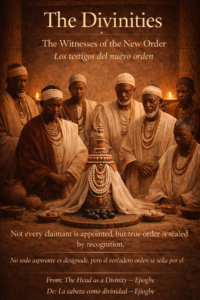
When the other divinities heard the sound, they knew that the kolanuts on Orunmila’s shrine had at last been broken. Esu then declared that ORI had broken them, and the divinities agreed that the Head was the one rightly fitted to do it. Immediately afterward, the hand, the feet, the body, the stomach, the chest, the neck, and the rest, each of which had formerly stood with its own separate identity, gathered together and chose to live with the Head. They lifted the Head above themselves, and there at the shrine of Orunmila the Head was established as king of the body. Because Orunmila had a decisive part in the fortune of the Head, the head is said to bow to the ground in deference to him. It is for the same reason that Orunmila, though counted among the younger divinities, is held to be greater and more widely honored than the others.
STORY STRUCTURE
Initial Condition
The story opens in a state of incompleteness. The divinities exist, but the Head has not yet taken its permanent place on the body.
Divination
Orunmila and ORI both receive divination from Amure. This establishes that the problem will be resolved through revealed sacred procedure, not accident.
Sacrifice and Warning
Orunmila is told to sacrifice with four kolanuts, clay bowl, sponge, and soap. He is also warned not to break the kolanuts because they are reserved for another being yet to come.
Conflict and Testing
Esu announces the existence of the kolanuts. Many divinities come to try to break them, but Orunmila refuses all of them. Even Orisa Nla is not the one appointed for the act.
Transformation
ORI arrives, is washed and prepared, prays over the kolanuts, and then breaks them with a great explosion heard across heaven.
Divine Reordering
After ORI succeeds, the body parts gather around the Head and the Head is established as king of the body. The story moves from incompleteness into ordered hierarchy.
Lasting Instruction
The account ends with guidance for the son of Ejiogbe, showing that the story continues into lived divinatory practice.
MAIN CHARACTERS
Orunmila
Orunmila is the divinity who seeks completion and then becomes the guardian of the sacred process. He receives the divination, performs the sacrifice, preserves the kolanuts, receives ORI, washes him, and places him at the shrine. Spiritually, he represents obedience, discernment, and the wisdom to recognize the proper moment and the proper agent.
Amure
Amure is the Awo who performs divination in heaven. His role is not dramatic in the emotional sense, but it is essential. He reveals the ritual path for both Orunmila and ORI. He represents the authority of correct divination before manifestation.
ORI
ORI is the Head itself, treated here as a divinity and not merely a body part. At first ORI appears vulnerable and unable to afford the required offering. Yet ORI is the one appointed to complete the decisive act. Spiritually, ORI represents rightful centrality, governing authority, and the point through which order becomes visible.
Esu
Esu announces the challenge and later announces the outcome. His function is to expose what is hidden and make it visible in the public field. He serves as the force through which destiny is tested and later confirmed.
All the divinities
The divinities as a group first appear as unsuccessful claimants. They want access to the reserved act, but they are not the ones chosen for it. Later, they become the witnesses who recognize that the Head was the proper one. They reveal the difference between power and sacred suitability.
Orisa Nla
Orisa Nla appears as an honored divine visitor, yet even he is redirected away from the reserved kolanuts. His place in the story shows that spiritual rank alone does not override sacred appointment.
Ejiogbe
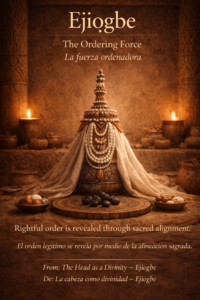
Ejiogbe is the Odù force under which the story is framed. The closing instruction identifies Ejiogbe as patron divinity of the head and links the heavenly account to earthly divinatory practice. Ejiogbe here represents foundational order, rightful installation, and sacred correction.
HUMAN CONDITIONS REVEALED
Incompleteness
The story begins with a world that lacks proper form. This is not a minor inconvenience but a foundational disorder. It teaches that some problems are structural and require sacred correction.
Obedience
Orunmila does exactly as instructed. He keeps the kolanuts unsplit even when many others come forward. This obedience preserves the story’s outcome.
Vulnerability
ORI cannot afford the prescribed kolanuts and arrives rolling to Orunmila’s house. The future center first appears in a humble and exposed condition.
Premature claim
Many divinities want to perform the act, but none of them is the rightful one. The story reveals how easily visible strength can be mistaken for sacred fitness.
Public exposure
Esu’s announcement takes something protected and places it into public awareness. This creates pressure, testing, and the need for stronger discernment.
Recognition
The story does not end with ORI acting alone. It ends when others also recognize that ORI was the right one. This shows that order becomes more stable when it is publicly acknowledged.
Reordering
The body parts gather around the Head once it has been properly established. The final condition is not chaos, but hierarchy and harmony through correct placement.
MORAL AND SPIRITUAL TEACHINGS
This story teaches that not every sacred purpose is fulfilled immediately. A thing may already be destined, yet still require sacrifice, protection, and proper timing before it can manifest.
It also teaches that rank, visibility, and eagerness do not equal appointment. Many divinities came forward, but only ORI was right for the task. In this way, the story warns against confusing prominence with suitability.
Another major teaching is that obedience protects destiny. Orunmila does not surrender the reserved kolanuts to the wrong claimants. Because he holds the ritual boundary, what was intended reaches its rightful fulfillment.
The story also teaches that cleansing and preparation are part of installation. ORI is not simply allowed to act at once. He is washed, carried, and placed at the shrine before the decisive moment. Sacred elevation is shown as something that must be prepared.
Finally, the story insists that real order is not only personal victory. The final movement is collective reordering. The body parts gather around the Head, and harmony is created through the establishment of the right center.
SYMBOLS AND SACRED ELEMENTS
A. Symbols
Head / ORI
The Head is the central symbol of the story. It represents governing authority, rightful centrality, manifestation, and the principle around which the rest must align.
Body parts gathering around the Head
This is the story’s final image of harmony. The many do not disappear; they take proper place around the true center.
Heaven
The setting in heaven signals that the story is explaining a foundational law of order, not just an individual event.
B. Sacred / Ritual Elements
Four kolanuts
These are the key ritual objects of the story. They are protected, reserved, prayed over, and finally broken by the appointed being. They reveal sacred suitability.
Clay bowl
The bowl is part of the ritual preparation of ORI. It serves as the vessel through which cleansing is performed.
Sponge and soap
These are not incidental objects. They show that purification is necessary before the decisive act can occur.
Water
Water functions as a cleansing medium. It marks the transition from unprepared condition to readiness.
Ifa shrine
The shrine is where the reserved kolanuts are kept and where the final act occurs. It is the place of guarded destiny and sacred fulfillment.
Guardian angel
This element appears in ORI’s divination and links prosperity to service. It reminds the reader that blessing is tied to ritual obligation.
Skull of any animal
This appears in the closing divinatory instruction. It shows that the story continues into applied practice.
Special bathing soap
This is the final prescription for long life on earth. It connects heavenly narrative to practical ritual guidance.
CULTURAL AND DIVINATORY CONTEXT
In this story, divination comes before action. That is an important mark of Ifá seriousness. The story does not present order as something improvised. Sacred correction begins with consultation, instruction, and correctly prescribed materials.
Sacrifice also matters because it prepares what will only later be understood. The kolanuts are set aside before their purpose becomes visible. This reflects a traditional logic in which offerings do not always produce immediate results; sometimes they establish a field that must be protected until the proper moment arrives.
The narrative also shows how authority is installed and protected. Orunmila does not allow everyone access to the sacred object. The story therefore teaches that spiritual authority includes guarding boundaries, recognizing appointed roles, and refusing premature claims.
Most importantly, this account is more than memory. It continues into practice. The final instruction for the son of Ejiogbe shows that the narrative still functions in ordinary divination. The story is not only about what happened in heaven. It becomes counsel for how life on earth may be corrected.
WHEN THIS ODÙ APPEARS
When this Odù appears, this story may warn about a condition in which the proper center has not yet been established. A person, family, role, or community may be active, but still lacking the ordering principle that allows everything else to align.
This story may also point to situations where something important is being prepared but must not be forced too early. One lesson drawn from this account is that what has been reserved by sacrifice should not be given away to every claimant who appears strong, senior, or ready.
When this Odù appears, it can point to rivalry around responsibility, leadership, honor, or recognition. The narrative warns that many may come forward, but not all are meant to carry the decisive work.
It may also diagnose a condition in which the rightful center appears weak, under-resourced, or easily overlooked. ORI arrives without grandeur, yet becomes king of the body. The story therefore counsels patience, discernment, protection of what is appointed, and respect for ritual preparation before manifestation.
Finally, this Odù may indicate the need for cleansing, reordering, and practical correction. The account closes with a concrete instruction for long life, reminding the reader that the sign does not only reveal a condition; it may also call for action.
REFLECTION QUESTIONS
- Why does the story insist that the kolanuts remain unsplit until the right being arrives?
- What is the difference in this story between strength and sacred suitability?
- Why is ORI shown first in a vulnerable condition rather than in immediate power?
- What does Orunmila’s obedience teach about protecting destiny?
- Why is cleansing necessary before ORI performs the decisive act?
- What does it mean that the body parts gather around the Head rather than compete with it?
- How does this story help us think about leadership, order, and rightful placement in modern life?
- Why does the narrative end with practical instruction instead of stopping at the cosmic explanation?
CONCLUSION
“The Head as a divinity” is a story of sacred installation. It begins with incompleteness and ends with order, but that order is not produced by chance. It comes through divination, sacrifice, warning, protection, cleansing, prayer, and the recognition of the one truly appointed for the act.
Its deepest lesson is that what belongs at the center must still be prepared, guarded, and brought forth at the right time. Not every claimant is the rightful bearer. Not every delay is failure. Sometimes what is being preserved is the very condition needed for proper fulfillment.
In the end, the story teaches that harmony does not come when everything struggles equally for prominence. Harmony comes when the true center is established and the rest can finally take their place around it.
DOWNSTREAM SUMMARY BLOCK
Core Story Tension: A world without the Head in its proper place can only be corrected through protected ritual fulfillment.
Core Ritual Dynamic: Divination, sacrifice, restriction, cleansing, sacred speech, and the breaking of the reserved kolanuts lead to installation.
Core Character Dynamic: Orunmila guards the process, ORI fulfills the destined act, and the divinities move from failed claim to public recognition.
Core Teaching: Rightful centrality is established through sacred alignment, not mere status or force.
Core Divinatory Warning: Do not force what has been ritually reserved, and do not confuse visible power with appointed suitability.